
Patient portals, mobile apps, and AI-powered assistants have transformed how patients interact with healthcare organizations, but technology alone does not guarantee meaningful engagement.
For clinic networks and health plans managing large volumes of fragmented data, driving better patient engagement depends on what sits beneath these digital touchpoints: connected and standardized healthcare data, a semantic layer that gives that data clinical meaning, and intelligent applications that can turn it into relevant, personalized, and actionable patient experiences.
This article explores how these foundations enable AI and digital health solutions to improve patient engagement while reducing the burden on clinical and administrative teams.
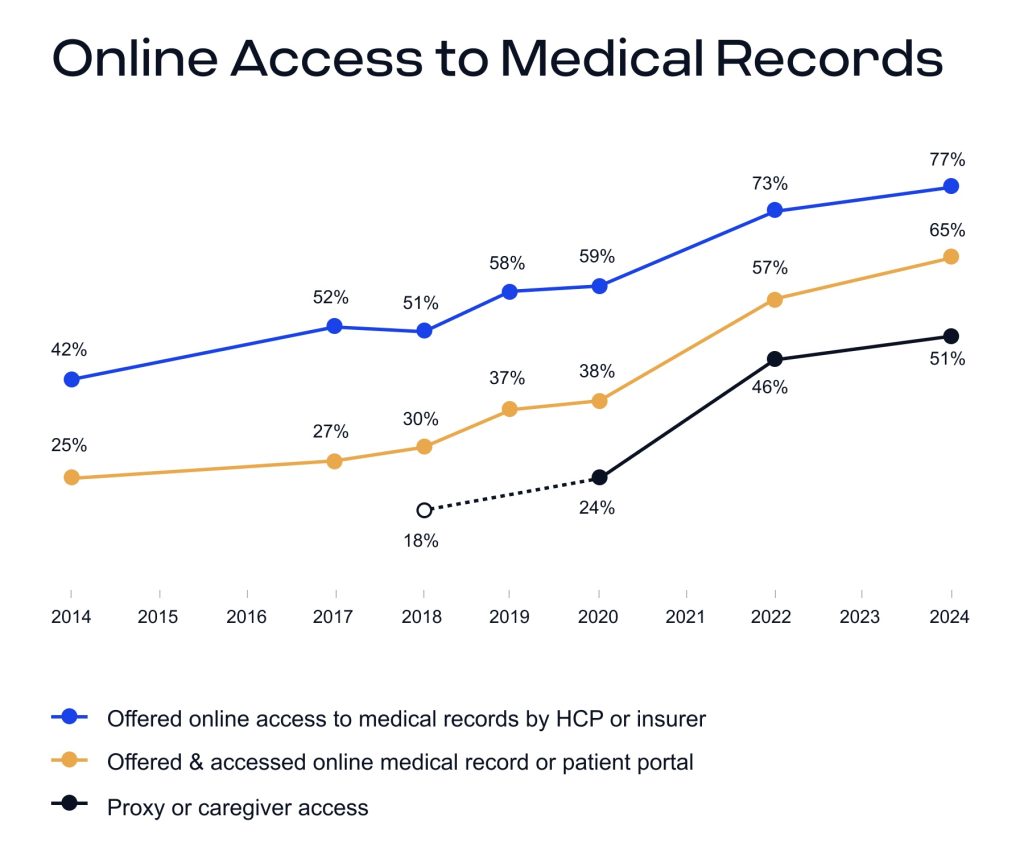
In 2024, 77% of adults in the United States were offered online access to their medical records, and close to two-thirds opened them at least once. Access has largely been solved, and the phones stayed exactly as busy.
A patient still calls to ask whether a referral has been approved. The coordinator who answers has the scheduling system open, but the authorization lives in the payer’s system, and the clinical note sits in the EHR under a different login. The patient gets a partial answer and a promise of a callback, thousands of times a week.
The arithmetic is unforgiving. WHO’s 2025 nursing report counts a global shortage of 5.8 million nurses, while chronic conditions keep multiplying the touchpoints each patient needs across a year.
Most organizations answered this with software. A portal came first, with a mobile app a few years behind it. Somewhere in the last two years, a chatbot arrived. Staff workload did not fall. The interface was rarely the thing holding it back. Patient engagement solutions depend on connected data and the capacity to interpret it.
Neither number moves with a better interface. Access at 77% and a nursing gap of 5.8 million describe one problem: patients can reach their records and still cannot get an answer without occupying a member of staff.
That is the work Edenlab does. We connect clinical and administrative data into one governed layer, then add the semantic model that turns it into concepts a patient-facing assistant can answer from.
Highlights
- Engagement describes a two-way relationship in which the patient can initiate care. Notification volume is a poor proxy for it.
- AI chatbots in healthcare are not new. Most fail because they run on isolated and raw data.
- Connecting an EHR to a CRM moves records around without producing meaning.
- A semantic layer turns standardized data into business concepts in seconds, which is what an assistant needs.
- ONC, CMS, and EHDS already require patient access. That spending can become an engagement asset.
What Patient Engagement Actually Means
Patient engagement describes a relationship in which the patient becomes an active participant in their own care. They can initiate contact and ask questions between visits. Increasingly, they arrive with a position on their treatment that the clinician has to account for. On the individual level, the capacity is called patient activation: the confidence and knowledge a person has to manage their own health.
The business case follows. Coordination hours drop once patients can self-serve reliably. Acquisition improves too, since the digital experience is the first thing a prospective patient sees. Patient retention has a different mechanism behind it: leaving a network that answers questions well is inconvenient. The patient experience improves at the same time, which is unusual for a cost-reduction program.
Healthcare patient engagement runs through a wide set of channels, and almost none of them work alone:
- Portals and mobile apps cover records and scheduling, with secure messaging carrying patient communication between visits. These are the patient-facing products we build in healthcare product development, on top of a governed data layer rather than beside one.
- Telemedicine and virtual care move the consultation itself online, which raises the stakes on what the clinician can see. A video call with a partial record produces the same callback as a phone call.
- Chatbots and AI assistants increasingly handle intake and routine questions. Their ceiling is set by the data they can read, which is why we treat them as an outcome of healthcare AI groundwork rather than a starting point.
- Remote patient monitoring pulls readings from wearable devices into the record between visits, which only produces value once those feeds are standardized alongside everything else. That is a healthcare interoperability problem before it is a clinical one.
- Digital therapeutics extend structured programs into the patient’s own time and report back into the same record.
The mistake worth avoiding is treating digital patient engagement as a delivery problem.
Reminders travel one way. Engagement requires the return path, where a patient asks something and gets an answer that reflects their situation.
Why Patient Engagement Became a Financial Question
Disengagement has a price. A 2025 review of the care congress found that up to 31% of patients never fill a first prescription, and more than half eventually stop taking their medication or drift off the regimen. Poor medication adherence drives avoidable admissions and worse healthcare outcomes.
Missed appointments carry a similar cost: in a 2025 analysis of nearly 750,000 outpatient appointments at an Italian hospital, 37.3% of the patients who missed an appointment turned up in the emergency department during the same period. WHO’s European office now attributes 1.8 million avoidable deaths and US$514 billion in annual cost to noncommunicable disease across the Region.
Value-based care contracts pay for outcomes and for closing care gaps. Preventive care only happens when patients show up, which is why HEDIS measures reward it. CMS readmission programs work from the other end, and readmissions correlate with weak follow-up after discharge.
Proportions of outpatient services compared to emergency room visits:
| State | Frequency | Percentage (%) |
|---|---|---|
| With ED access | 10,754 | 37.3% |
| Without ED access | 18,096 | 62.7% |
| Total | 28,850 | 100% |
The First Digital Wave Left Staff Workload Intact
AI patient engagement is not a new proposition. Conversational tools have been used in healthcare for a year or two, and portals for far longer. The market has no shortage of patient engagement software, and most clinic networks already own a patient engagement platform.
The staffing relief rarely arrives. Call centers stay as busy as they were. Coordinators keep doing manual lookups, and the deflection numbers in the business case never materialize.
The cause sits below the application layer. Patient engagement tools operate on isolated and raw data.
Each vertical system holds its own slice, with clinical history in the EHR and interactions in the CRM, while authorizations sit in the claims system. Patient questions rarely respect those boundaries. “Has my prior authorization been approved?” needs administrative and clinical context in one answer.
What Is AI-Powered Patient Engagement?
AI-powered patient engagement uses machine learning and language models to answer patient questions from the full record. The same models score risk and trigger outreach. What separates it from rule-based automation is the source of the response: live clinical and administrative data, read at the moment the question is asked.
Why Connecting an EHR and a CRM Falls Short
The obvious remedy is integration, and it is where many programs stop. Records move between systems on a schedule, producing no meaning on their own.
Silos are the reason underneath most engagement failures. See how we approach healthcare interoperability for organizations running mixed environments.
Consider what an assistant needs to answer a routine question. It needs concepts: an open care gap, an overdue follow-up, an authorization in review, a lapsed prescription. A bundle of FHIR resources and claim lines supplies none of those directly. Each concept is computed from many tables at once and carries business rules that differ by organization. A chatbot with database access and no concept model will produce vague answers, whether or not it uses AI.
This is the layer where healthcare interoperability earns its budget. Data has to arrive from the EHR and EMR, from labs and pharmacy systems, from claims and imaging, with remote patient monitoring feeds in the same pipeline. All of it needs standardizing first, because every later capability inherits the quality of this step.
Why Is FHIR Important for Patient Engagement?
FHIR gives every source system a common representation for patients, encounters, medications, and results. A longitudinal patient record becomes possible once that shared model is in place. Without it, each engagement tool needs its own mapping, and personalized outreach breaks whenever a source system changes.
The Semantic Layer Is Where Engagement Becomes Possible
Standardized data answers the question of format. Meaning is a separate problem. The semantic layer sits above the data model and holds the definitions an organization uses: what counts as an active patient, and when a follow-up becomes overdue. Program membership rules live there too.
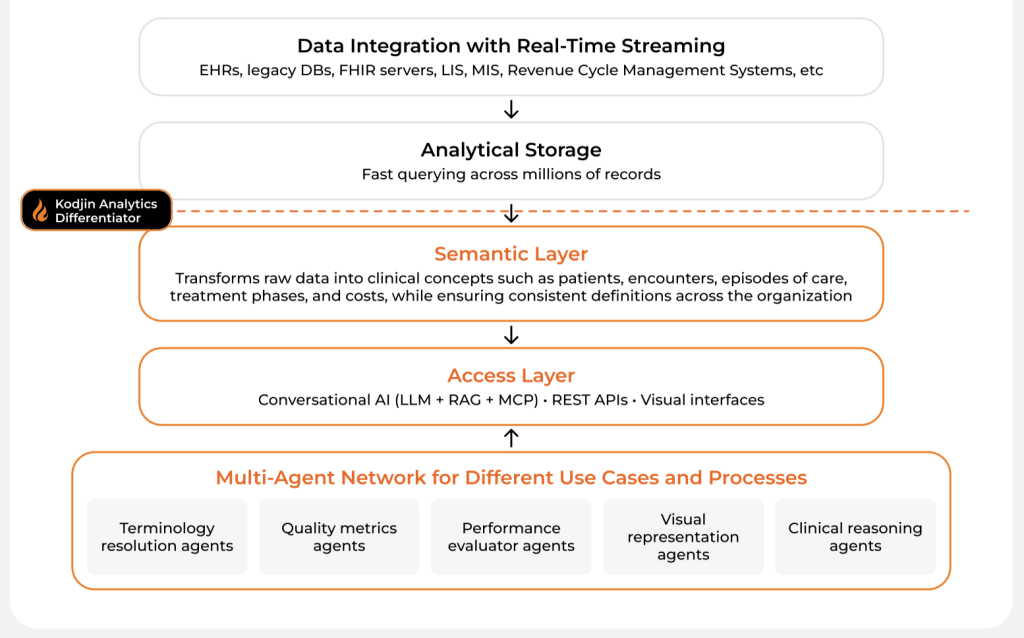
Define those once, and every application inherits them, from reporting through advanced analytics in healthcare to patient-facing assistants. At Edenlab, we built Kodjin Analytics around this idea. It extracts data out of vertical silos and turns it into meaningful concepts in seconds, supplying what chatbot projects have been missing: context.
The interface changes as a result. A care manager types a question in plain language and gets an answer back. Conversational healthcare analytics puts that semantic layer in front of staff, and the conversational AI healthcare teams expose to patients runs on the same definitions.

What This Looks Like in Production
One of our engagements is a large data exchange platform for payers and providers. It is under NDA, so specifics stay general, but the sequence is worth copying.
Consolidated data infrastructure came first, and AI applications went on top afterward. Member assistants are one of them: language models answer real member questions such as whether a prior authorization has been approved or what to bring to a hospital admission, grounded in actual claims and clinical data.
The result is lower call-center volume and less of the confusion that drives repeat calls. Because the assistant reads from the shared layer, it works across insurers and providers, in more than one language.
Want to understand the architecture in detail? Our healthcare analytics case studies walk through how the semantic layer was built.
With the data foundation in place, Edenlab builds the applications that run on it:
patient and member assistants, outreach, and care management tools.
See our healthcare product development servicesThe Format of the Conversation Changes Too
For most of medicine’s history, only a clinician could turn a result into an explanation a patient understood. That created a bottleneck no staffing plan could clear. AI assistants now handle part of that work in natural language, at the moment the patient asks. Personalized care becomes operationally realistic, and the economics of virtual care change with it.
Guardrails belong in the design from the start. Sensitive clinical judgment escalates to a human, and every answer should be traceable to the record it came from. Our perspective on healthcare AI covers how we approach that in regulated environments.
How Does Conversational Analytics Help Clinicians?
Conversational analytics lets clinical and operational staff query governed data in natural language and get an answer in seconds. A care manager can ask which diabetic patients are most likely to miss a follow-up without filing a request with a BI team. The answer reflects the organization’s own definitions, so it can be acted on directly.
Can AI Reduce Patient No-Shows?
Yes, when prediction and outreach are connected. Predictive analytics can score each upcoming appointment’s no-show risk based on history, distance, appointment type, and prior cancellations. High-risk patients then receive targeted outreach or rescheduling. The largest gains appear in specialty clinics.
Patient Journey and Pathway Analysis
Most organizations can report what happened. Explaining why a specific patient is disengaged is the harder question, and the one that changes anything.
Patient journey analysis reconstructs the sequence of events for a population: appointments attended and missed, medication gaps, transitions of care, referrals that leaked outside the network, readmissions. Layer social determinants of health onto it and the drop-off points stop looking random. When a large share of a cohort fails at the same step of a patient pathway, the cause sits in the process.
Evidence of that kind moves care management analytics and population health analytics into clinical workflows. It also shows which interventions to fund for chronic disease management, and where care coordination is quietly failing.
How Does Pathway Analysis Improve Patient Engagement?
Pathway analysis maps the real routes patients take through a health system and shows where they stop progressing. Teams can then fix the step that loses people, such as a referral handoff or a post-discharge follow-up. That is more effective than raising outreach volume across an entire population.
Read also:
Pathway Analysis in Kodjin Analytics: Turning Clinical Journeys into Actionable IntelligenceWhere the Value Lands
The pattern generalizes across settings. Below are the use cases we see most often in clinic networks and health plans, with the capability behind each one and the number a finance team will ask about.
| Use case | AI capability | Business impact |
| Care gap detection | Predictive analytics | Higher HEDIS performance |
| Medication adherence | AI-generated reminders | Fewer avoidable admissions |
| Remote patient monitoring | Risk prediction | Lower readmission rates |
| Chronic disease management | Journey analysis | Sustained adherence |
| Patient outreach | Conversational AI | Higher engagement rates |
| Care coordination | FHIR-based integration | Better continuity |
Measuring What Changed
Engagement programs fail review when nobody agrees on the numbers in advance. Define them before the first release, and compute them from the semantic layer serving the assistants.
| Metric group | What to track |
| Access | Engagement rate, portal adoption, cost per patient |
| Clinical | No-show rate, readmission rate, medication adherence |
| Quality | Care gap closure, HEDIS performance, patient satisfaction |
| Operations | Call deflection, staff productivity |
Not sure which metrics to commit to first? Our healthcare analytics services team scopes the measurement layer alongside the first use case.
Turn Compliance Spending Into an Engagement Asset
Regulators in both major markets have arrived at the same objective. ONC criteria in the United States require standardized API access to clinical data. CMS rules oblige plans to expose claims and authorization status to members. Europe took a legislative route, with the European Health Data Space establishing patient access rights across the EU.
Their shared purpose is patient participation. Most organizations treat the work as a cost line, building the minimum viable API surface and filing the certification.
That is a missed opportunity. The infrastructure a compliance program funds is largely what an engagement program needs: standardized data, identity and consent handling, plus an access layer. Regulatory compliance is one of our core practice areas, and the organizations that gain most from it specify the engagement use cases at design time. When patient access genuinely works, the benefits stop being regulatory and start being commercial.
Conclusion
The next stage of patient engagement will not be won with a better app. It depends on connected data and a semantic layer that gives that data meaning, with AI on top. Organizations that fix the foundation can add engagement capabilities in weeks. Those that keep buying interfaces will keep staffing the phones.
Ready to move beyond portals and static healthcare dashboards? Talk to Edenlab about a FHIR-native engagement layer built on Kodjin Analytics.

We turn records into answers
Edenlab connects clinical and administrative data into one governed layer, then adds the semantic model that turns it into concepts your assistants can use. Kodjin Analytics is ready to deploy, so patient questions get answered without a call-back.
FAQs
What is patient engagement?
Patient engagement is the practice of involving patients as active participants in their own care. It covers record access, two-way communication with care teams, shared decision-making, and self-management. Digital patient engagement delivers the same relationship through software.
How does AI improve patient engagement?
AI answers patient questions from live data, with no scripted decision tree behind it. Prediction is the second contribution: models flag which patients are likely to disengage, so outreach can be targeted. Language models also draft personalized communication at a volume no coordination team could match.
What is conversational analytics?
Conversational analytics allows a user to query governed healthcare data in natural language and get a direct answer, replacing the request-and-wait cycle around BI dashboards. Because answers come from a semantic layer holding the organization’s definitions, results stay consistent across teams.
How does FHIR improve patient engagement?
FHIR standardizes how clinical data is represented and exchanged, letting an organization assemble a longitudinal patient record from many sources. Engagement applications then read one consistent model, with no custom integration per source system. FHIR APIs also underpin the patient access requirements set by ONC and CMS.
Can AI improve medication adherence?
AI can improve medication adherence by identifying patients whose refill patterns indicate a lapse, then prompting a targeted intervention. Refill history and clinical risk together predict non-adherence more accurately than either signal alone. The prompt still has to reach the patient on a channel they actually use.
What KPIs measure patient engagement?
Common patient engagement KPIs include engagement rate, portal adoption, no-show rate, readmission rate, medication adherence, care gap closure, and cost per patient. Choose a small set tied to a business outcome and compute them from one governed data layer.
How does Edenlab support patient engagement?
Edenlab builds the data foundation for engagement programs that depend on interoperability work and FHIR-based standardization, with the Kodjin Analytics semantic layer turning raw records into usable concepts. Teams then deploy conversational assistants and pathway analysis on governed infrastructure.
Stay in touch
Subscribe to get insights from FHIR experts, new case studies, articles and announcements
Great!
Our team we’ll be glad to share our expertise with you via email