Contact us

FHIR facade development

Edenlab delivers custom FHIR Facade solutions that make legacy systems compatible with today’s interoperability standards. We turn your existing data into fast, secure, HL7 FHIR resources without touching core workflows. Whether you need to expose your data to partners or meet compliance deadlines, our solutions enable robust, real-world data exchange.

Contact us

Expertise you can trust

Our hands-on FHIR and healthcare knowledge

Our hands-on FHIR and healthcare knowledge

We work exclusively in healthcare, bringing expertise from the world’s largest HL7 FHIR projects, including a nationwide HIE serving 30 million people. With our Kodjin FHIR Server and a team led by top health tech experts, we deliver secure, high-performance, interoperable solutions built on a trusted medical data standard.

Case study
Payers & TPAs
Hong Kong Hong Kong

Heals.Asia HIE

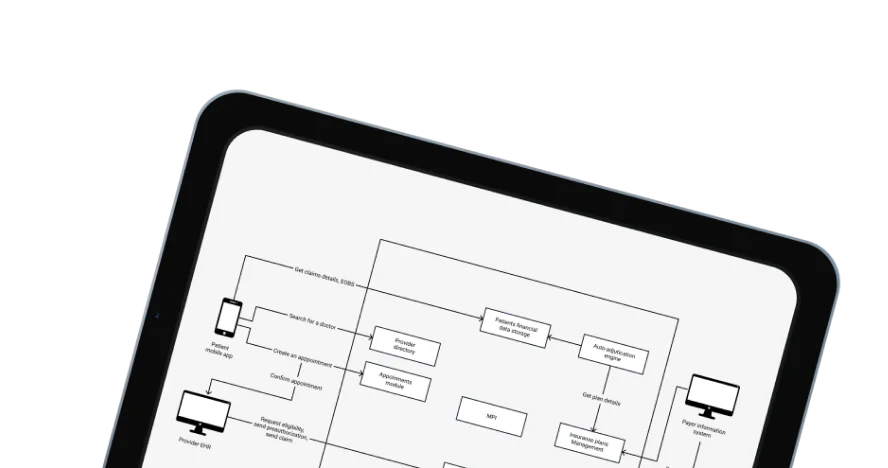
Implemented a FHIR Facade to provide real-time, standards-based access to the provider directory with search by specialty and location, without changing the legacy system. Mapped proprietary data to FHIR resources and deployed the Kodjin FHIR Server, also adding an auto-adjudication engine to speed up and improve claim processing.

Heals.Asia HIE

Signs you may need a FHIR facade

A FHIR facade can be a suitable approach if your company faces most of these conditions:

Condition What it means for you
Condition

You have an existing legacy system

What it means for you

When your data lives in an older platform that still runs critical processes.

Condition

You need to share data in FHIR format

What it means for you

If external partners, national exchanges, or third-party apps require your data in FHIR, but you don't want to disrupt internal workflows.

Condition

You can’t change or replace the old system

What it means for you

Your system is too costly, risky, or regulated to modify.

Condition

You need results quickly

What it means for you

You can’t afford to wait longer than 3-4 months to set up data exposure.

FHIR Facade is not the only answer. A FHIR Server can also address the same needs. Let’s compare the two approaches.

Two ways to meet your data exposure needs

Both a facade and a server let you move fast. The distinction lies in whether you want to extend your legacy system for now or invest in a future-ready interoperability solution.

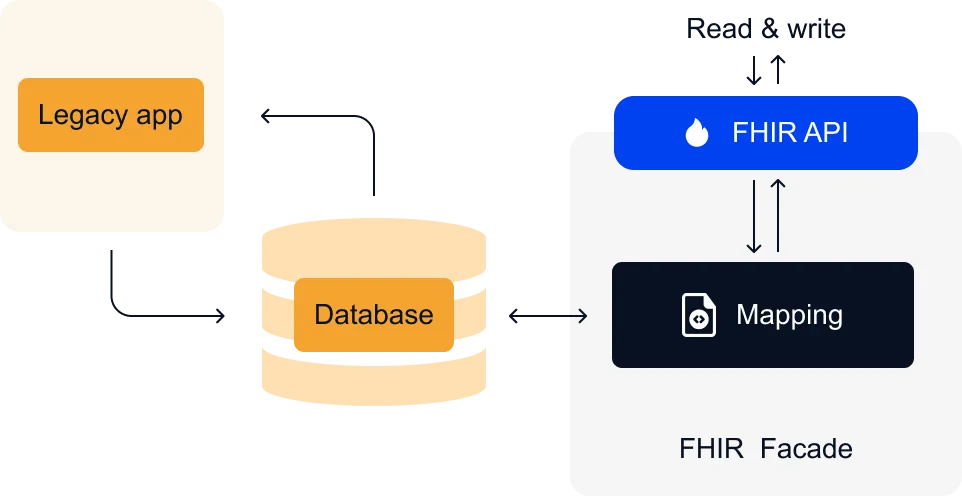
API layer over your data

Facade

API layer over your data

Pros

  • Converts legacy data into FHIR format on the fly
  • No duplicate database, works on top of your existing system
  • Fast, low-impact way to meet FHIR requirements

Cons

  • Technical impossibility to implement pagination and sorting on a multiple-source table resolved into a single FHIR resource
  • Technical impossibility or very high cost to implement full-fledged FHIR search with all supported parameters, prefixes, and logic

Best when you need standards-based access quickly without changing the core system

Additional database

FHIR Server

additional database

Pros

  • Stores data natively in FHIR format
  • Supports full interoperability, version control, and provenance
  • Does not put load on your native database and enables higher performance

Cons

  • Requires initial data mapping and migration
  • Data duplication

Best for long-term, future-ready interoperability at scale

When to use a Facade and when to go with a Server

business-level use cases

FHIR Facade

FHIR Server

Regulatory certification and compliance (ONC, CMS, ISiK)

FHIR Facade

Best for fast, minimal‑scope formal compliance when timelines are tight and you only need to expose a limited set of read‑only endpoints with data staying in the legacy system. You implement just the required mappings.

FHIR Server

A full FHIR Server is essential for meeting advanced ONC and CMS requirements at scale: write operations, bulk data export, resource versioning, and SMART on FHIR. While basic SMART workflows can be emulated via a facade, only a native FHIR Server provides robust support for scopes.

Real‑time operational integration for appointments, claims, etc.

FHIR Facade

Works when the legacy system must remain the single source of truth. Ideal for focused, one-to-one integration when the partner and data flow are known in advance, for example, sending claims to a TPA.

FHIR Server

Recommended for multi‑partner flows. Maintain a near‑real‑time FHIR mirror in the FHIR server via events/ETL, so partner queries and adjudication steps hit the repository, not the core.

Data sharing for research and analytics initiatives

FHIR Facade

Possible, but you’ll need extra code to assemble batches each time, increasing runtime load on the legacy DB.

FHIR Server

Built‑in Bulk Data Export runs faster over indexed, pre‑normalized FHIR data. FHIR server acts as the “export head” with stable performance.

Making your EHR or IT product compatible with FHIR applications

FHIR Facade

The facade allows your product to speak FHIR without modifying your internal data model, however, it doesn’t provide full compatibility: many external apps expect consistent search behaviour, versioning, and terminology support.

FHIR Server

Recommended when your product needs to be consistently interoperable with modern digital health infrastructure. A repository enables you to ingest and normalise your data in FHIR, support rich search/filter functionality, and expose a stable, reusable FHIR API even as your backend evolves.

Prototyping FHIR and
de-risking future adoption

FHIR Facade

Best for fast, low‑risk evaluation. Stand up a thin facade over a small subset of your legacy data to expose a few resources, validate mappings and terminology choices, test partner/API contracts, and SMART app connectivity.

FHIR Server

Preferred for production after the pilot. Stand up a native FHIR database and selectively ingest the domains you’ll expose. Benefit indexed search, bulk export, subscriptions, versioning, and operational isolation from the legacy system.

tech-level use cases

FHIR Facade

FHIR Server

High query load and complex real-time search combinations

FHIR Facade

Custom mapping logic executes on every request, increasing latency and complexity as query volume and variety grow. Difficult to support many resource types and advanced search parameters at scale.

FHIR Server

Built for high-load use cases with pre-indexed FHIR resources, asynchronous processing, and fine-tuned support for complex queries, including chained parameters and filtered search.

Supporting write operations (including writing back to the legacy system)

FHIR Facade

Ideal when the legacy system must remain the single south of truth. You can build custom logic to map incoming FHIR resources back into the proprietary data model. This allows controlled, workflow-specific write operations while keeping core business logic in place. However, writing support in a facade requires additional dev effort.

FHIR Server

Supports read & write natively via the FHIR API. But if the repository is not your source system, you must implement synchronisation back to the legacy database, using event streams, pub/sub, or batch jobs. This model is best suited when you’re gradually decoupling from the legacy system or want to support write-heavy scenarios.

Multi‑source data aggregation (EHR + LIS + CRM) before exposing

FHIR Facade

Each source needs its own facade and mapping. Good for a quick first mile to expose a few endpoints without migrating data. But getting a single source of truth requires a separate orchestration layer.

FHIR Server

Allows you to ingest data from multiple systems into one normalized FHIR repository. The server can support patient de‑duplication, terminology management, and uniform access policies.

Limiting data exposure for compliance, risk, or governance reasons

FHIR Facade

Can restrict who can access data and which resource types are exposed via API, but the data stays in the legacy system, meaning all records are still addressable at runtime unless explicitly filtered per request.

FHIR Server

Ideal when you need to sharply limit what data is even available to expose. With Server, you selectively ingest only the data you want to share: like last 2 years, only active patients, only clinical documents, etc.

Case study
EHR platform
USA USA

Deploying an FHIR-compliant solution for ONC Certification

Edenlab helped Elation Health achieve ONC certification by building a high-performance FHIR backend with USCORE 5.0.1 support. Using the Kodjin FHIR Server, we delivered custom ETL mapping, SMART on FHIR integration, and optimizations that boosted throughput to 1,160 RPS, enabling fast, secure access for 24,000+ clinicians.

Deploying an FHIR-compliant solution for Elation Health’s EHR

Let us help you choose the right FHIR solution for you

Get expert guidance to find the fastest, most compliant way to connect systems and share data seamlessly.

Contact us

Common FHIR Facade integration challenges we solve

Real-world workflows and data timeliness

Real-world workflows and data timeliness

We match your operational needs by mapping legacy data via real-time streaming for instant updates or using ELT pipelines for batch delivery when workflows demand scheduled sync.

System performance and infrastructure load

System performance and infrastructure load

We protect your core systems by routing FHIR traffic through a dedicated layer, facade or server, so your infrastructure stays responsive even under heavy query volumes.

Secure, compliant data access

Secure, compliant data access

We implement enterprise-grade security with SMART on FHIR authentication, OAuth2, and granular access controls, ensuring healthcare data is accessed safely and in full compliance with regulatory requirements.

Ease of maintenance & adaptability

Ease of maintenance & adaptability

Our integrations are well-documented and modular, making it easy for your team to update mappings, adapt profiles, or extend workflows with minimal effort.

Scalability for future needs

Scalability for future needs

Our FHIR infrastructure handles millions of resources and high request throughput, ensuring smooth expansion as your data and interoperability needs grow.

Data quality and semantic interoperability

Data quality and semantic interoperability

We normalize your legacy data into structured FHIR profiles and medical terminology, ensuring consistent data exchange across systems now and in the future.

Our proven approach to integrating FHIR into your data architecture

01

Business needs and process discovery

We capture goals, data flows, volumes, constraints, timelines, and user roles. Together, we choose a facade or a repository and the mapping approach, streaming or ELT.

02

Solution architecture design

We design components, security controls, the deployment model, and data flows. We select market FHIR products or our Kodjin platform tools to fit your stack.

03

FHIR data modeling

We define profiles, extensions, terminology bindings, and validation rules for resources. We produce clear, accurate mappings from legacy structures to FHIR, field by field.

04

Cloud or on‑premises infrastructure setup

We prepare cloud or on-premises environments with infrastructure as code. We configure monitoring, logging, backups, and autoscaling to match expected load.

05

Solution development & implementation

We build backend FHIR Facade services, orchestration, and FHIR APIs for your flows. CI/CD pipelines run unit, integration, and performance tests on every change.

06

Integrations configuration

We connect source systems, partner APIs, and external registries as needed. We implement authentication, SMART on FHIR, and streaming or ELT pipelines.

07

Regulatory compliance checks

We ensure alignment with ONC or CMS, and other standards, supporting certification tests, security controls, and required data exports.

08

Real‑life solution testing

We test with realistic loads, real user workflows, and data. We fix gaps, run security checks, and train your team before going live.

We are here to streamline your healthcare data exchange

Edenlab provides robust integration solutions to enhance your healthcare operations. Our expert team ensures seamless connectivity across diverse medical systems, improving patient care and operational efficiency.

Learn more

Why Edenlab is a reliable FHIR Facade development partner

Proven expertise in complex interoperability projects

We have delivered large-scale interoperability solutions that connect diverse healthcare systems without disrupting existing workflows. Our FHIR facades enable standards-based data exchange while keeping legacy platforms intact and fully operational.

End-to-end delivery with seamless system integration

Our team manages the entire process, from source data analysis and mapping to testing and go-live, ensuring smooth interaction with EHRs, partner APIs, and external platforms. We minimize disruption and keep your core workflows intact.

Fast, cost-effective results without compromise

Using our proven Kodjin components, including mapping engines, orchestration tools, and terminology services, we deliver working facades in weeks. You stay in control while gaining a scalable, future-ready foundation for interoperability.

See how we work

More services we provide and custom solutions we implement

Healthcare integration services

We connect systems, applications, and data sources to enable smooth data exchange and improve workflows. Our team combines trusted industry tools with custom-built platforms and deep data management expertise.

Data migration services

We deliver a structured migration process for a smooth, secure transition between healthcare data standards, using ETL solutions to extract, transform, and load data while ensuring accuracy, integrity, and compliance.

Healthcare data and analytics services

We design infrastructure to normalize, structure, and activate healthcare data for better decision-making and operational efficiency. Our solutions keep your data AI-ready and consistently high-quality.

Patient portal development

We deliver custom health portals that improve efficiency and patient engagement, integrating with EHRs for clinics, telehealth providers, and multi-location practices to streamline access and enhance care experiences.

Let’s talk about your goals

Connect directly with our experts for clear answers and practical guidance on how we can help.

    Name

    Business email

    Message

    Your form has been submitted successfully

    We will contact you shortly

    "In Edenlab, they don’t just follow your technical brief as other outsourcing companies, but care about the final result and are ready to help you find the best way. Their deep expertise in FHIR is impressive. We appreciate it a lot, as many really good solutions were born in this cooperation."

    Kodjin White Paper

    Please, leave your email to get Kodjin White Paper

      Full name

      Business email

      Your form has been submitted successfully.

      Find the Kodjin Interoperability Suite White Paper in a new tab.

      Guide on HTI-1 Final Rule updates

      Please leave your email to get the guide.

        Full name

        Business email

        Your form has been submitted successfully.

        The guide will open in a new tab.

        Guide to Patient and Population Services API

        Please leave your email to get the guide.

          Full name

          Business email

          Your form has been submitted successfully.

          The guide will open in a new tab.

          HL7 FHIR Explained

          Please leave your email to get the guide.

            Full name

            Business email

            Your form has been submitted successfully.

            The guide will open in a new tab.