
AI for EHR/EMR has moved from an experimental feature to a product priority. For EHR and EMR vendors, the question is no longer whether to add AI, but how to scale it across the product.
Physician adoption reached 81% in early 2026, up from 38% in 2023, and three-quarters of US health systems use or plan to use at least one AI application, according to Eliciting Insights’ 2026 survey of 120 systems. Customers have also stopped waiting for vendor roadmaps: offered an AI feature from their EHR vendor in 18 months or a third-party tool in three, only 22% of health system IT leaders said they would wait, down from 52% a year earlier in Qventus’ annual CIO survey.
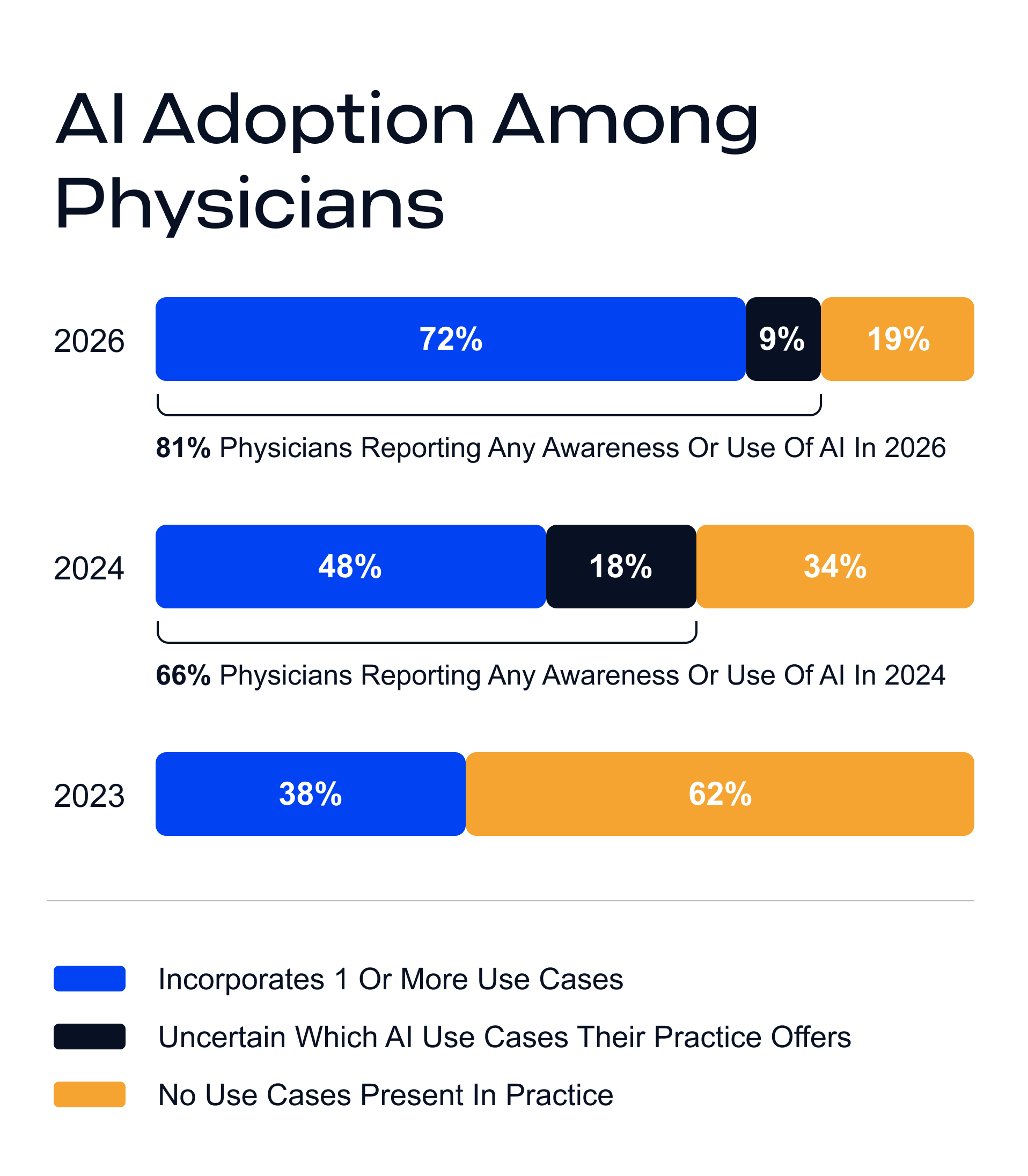
That moves the hard part of the work. One AI feature reaches production with little trouble, but scaling across a product is where teams stall. In that same survey of 60-plus IT leaders, 45% cited difficulty scaling pilots, and only 4% reported having scaled AI with measurable outcomes.
Gartner expects more than 40% of agentic AI projects to be canceled by the end of 2027. The causes it names are escalating costs, unclear business value, or inadequate risk controls. None of those three is a model quality problem.
This article is for product owners, CTOs, and product managers working on EHR and EMR systems already in production. We will look at what AI is being used for on both sides of a health IT business, why systemic AI enablement is harder than shipping one feature, and what drives the cost. We will also show where Edenlab and the Kodjin Data Platform close part of that gap.
Highlights
- With physician AI use at 81% in 2026, adoption is settled, and scale is the open question.
- Only 4% of health system IT leaders report scaling AI with measurable outcomes.
- Gartner traces the coming agentic AI cancellations to cost and unclear value, with weak risk controls named alongside them.
- Internal automation runs broad, while customer-facing AI in EMR products works better one vertical at a time.
- A shared semantic layer makes the fourth AI feature cheaper than the first.
What AI for EHR and EMR Means in 2026
AI for EHR is the use of machine learning, NLP, large language models (LLMs) that healthcare organizations already license, and agents to perform work inside electronic health records: drafting documentation, extracting data from notes, answering questions from the chart, running a workflow end-to-end.
AI for EMR describes the same work in electronic medical records. What separates a demo from a product is the data underneath, and that is where artificial intelligence in EHR systems usually succeeds or fails.
Most vendors still describe this as a shift from a system of record to an intelligent clinical workspace, with AI sitting beside a clinician to help. That framing is about a decade old.
What is happening looks closer to a digital workforce: the model takes a unit of work a person used to own, and review is scoped to the risk that work carries.
The business case changed with it. Measured against a real employee, an AI-powered EHR feature saves less than the early promises suggested, and the token math is not rescuing it. Gartner expects inference on a trillion-parameter model to cost providers over 90% less in 2030 than in 2025, while agentic models consume 5 to 30 times more tokens per task than a standard chatbot. Unit prices fall while consumption rises faster, so the bill goes up anyway.
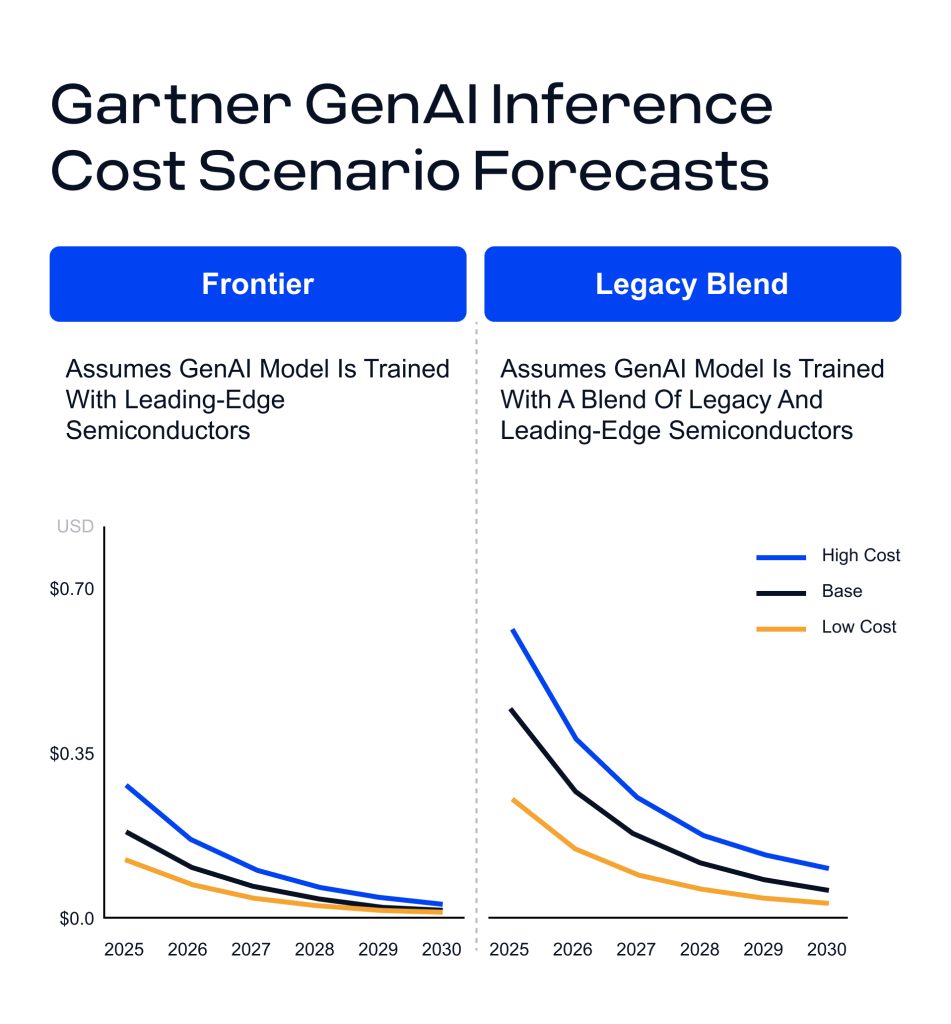
Scale is the argument that survives that. Growing a support function from 100 customers to 200 with people is a hiring program with a six-month lead time, while an assistant makes it a budget line and changes nothing else about the process. There is also consistency, since a model runs the same process the same way every time, which counts for more in administrative work than most ROI models capture.
AI EHR Use Cases Split Into Two Directions
Adoption inside health IT companies runs on two tracks that compete for the same budget and behave nothing alike.
Internally, Everything Is In Scope
For internal operations, there is almost nothing left to argue about. EHR automation and clinical workflow automation now reach delivery, support, finance, procurement, QA, and documentation, and a provider network running back-office processes is no different.
One pattern here contradicts how engineers instinctively approach the problem. Large enterprises have automated back-office work by teaching a model to click through the same difficult interface a human clicked through, error-free, leaving the database untouched.
An integration at the data layer would have been simpler by orders of magnitude, and it was also an architecture change, which meant committees and quarters. The same holds in revenue cycle management and in AI in health information exchange, where what earns money is a model that logs into payer portals and phones payers. Worth knowing before you plan around counterparties with no incentive to expose an API.
Externally, One Vertical at a Time
Customer-facing AI follows the opposite discipline. Owners tolerate rough edges internally because a person catches them. In front of a patient or a partner, tolerance drops to near zero, so narrow the scope hard and take one vertical to a high standard before opening the next. Patient engagement is the one most teams pick first, and it is deep enough to occupy a year of roadmap on its own.
Why Systemic AI Enablement Is the Real Problem
Local applications are a solved problem. A team can put a working AI EMR feature into production in weeks, and it will demo well on two developers’ laptops.
Systemic EHR AI integration has no solved shape. Classic application architecture settled decades ago: nobody designs an authorization layer from first principles, because architects assemble from known modules. AI has had no time to build that library.
Production-grade agent patterns are roughly a year old. Sub-agent designs are newer still, where a coordinator hands narrow subtasks to cheaper models. Memory and context management came after that. There is no blueprint to pull from, and we have not found a vendor offering one. Four problems account for most of the difficulty.
Architectural Complexity
A single call to a model is easy. A platform that accepts an intent and resolves it through several models is a distributed system with unusual properties. A complex request can occupy an agent for an hour, and agents are not well suited to maintaining long-running sessions. Context windows are finite, so a model on a long task forgets, degrades, and hallucinates. Something has to remind it what it was doing.
That is an agent harness, and it belongs in the same category as an authorization layer. There is a presentation layer too: a chatbot returning charts and forms is its own product surface.
Privacy and Security
PHI moving through third-party models is the first question compliance asks and the one that stops projects. HIPAA and GDPR obligations attach to the whole implementation: encryption, role-based access, audit logging, data minimization, and a defensible answer about where inference happens. Build it per feature, and a five-feature product carries five security reviews.
Model Flexibility
Nobody wants to be locked into a single provider in a market that reprices every few weeks. Different tasks want different models, and cost-sensitive subtasks want cheap ones. So the data layer cannot couple to a specific model, and a provider swap cannot mean redoing prompts and embeddings and integration work.
Observability and Unit Economics
This one is underrated, and it is where the cost conversation lives. API keys get hardcoded, 20 consumers end up on one key, and working out which drives utilization takes an investigation. Without that attribution, you cannot compare models, price a feature, or forecast next quarter’s AI line. Model governance and cost accounting are one discipline, and the harder half of AI in clinical data management.
Need help with healthcare data & analytics?
We are here to help. Check our
Healthcare Data & Analytics ServicesWhat Actually Drives the Cost
There is no reliable per-project cost estimate for AI implementation in EHR or EMR systems, because variance between similar-looking projects runs an order of magnitude. The shape of the bill can be described.
| Cost driver | What moves it |
| Data preparation | Condition of source data, terminology coverage across SNOMED CT, LOINC, ICD-10 and RxNorm, how much clinical data extraction comes first |
| Inference | Token volume per interaction, model tier, retry and evaluation traffic, provider price moves you do not control |
| Integration | Read-only against a FHIR API is one budget, write-back into a legacy EHR another |
| Architecture | Session handling, memory, orchestration, guardrails, presentation |
| Compliance | Security review, audit logging, human-in-the-loop design, clinical validation |
| Operations | Monitoring, model drift, evaluation suites, re-integration on each deprecation |
Two of these compound. Data preparation and architecture get paid once per organization when the work is reusable, once per feature when it is not, which is the largest lever on the cost of an AI-powered EMR.
The rest is ordinary discipline: cheap tasks routed to cheap models, caching, enough groundwork to prepare clinical data for AI so retries fall on AI-ready healthcare data, and observability sharp enough to see which feature burns the budget.
Kodjin Data Platform as the Architectural AI Enablement Layer
We built Kodjin Data Platform, an AI-powered healthcare data platform, to be that layer, so product teams are not designing one from scratch while the market moves underneath them.
Kodjin provides a semantic layer over your existing data, leaving your system of record where it is. Clinical and financial records reconcile into one model alongside operational data, and that model incorporates clinical concepts such as episodes of care, so a general-purpose LLM understands them without fine-tuning. It handles FHIR nested structures natively, making the FHIR integration you already paid for usable across AI use cases and adding the semantic interoperability FHIR alone lacks.

Three things follow. Model choice stays open, since any general-purpose LLM works through standard APIs. Because role-based access, consent, and audit logging live in the layer, every application inherits them instead of implementing its own. Outputs stay traceable, with citations beneath generative responses.
The economic argument is reuse: cohort definitions, temporal logic, metric definitions, and entity relationships get built once, and can then be combined to support whatever comes next, whether that is a clinical assistant, an agent, or an AI-assisted healthcare analytics platform your users query in plain language.
No two products need the same things on top, so we customize the platform to a client’s data model before building anything on it, which is most of what our healthcare AI solution development work involves.
Where to Start with EHR/EMR Modernization
Sequencing matters more than tooling. Pick one workflow with a measurable baseline and measure it before anything ships. Assess whether its data can support a model, which is a healthcare interoperability question before a modeling one. Then decide where the AI layer sits, once, for the product, before any healthcare product development work starts on top of it.
EHR/EMR enhancement with AI goes wrong at that third step, because teams skip it. The first feature ships without an architectural decision, the second inherits the shortcut, and by the fourth the healthcare data platform tech stack has calcified around choices nobody made. Where a legacy system has no modern APIs, FHIR for legacy EHR integration means a facade that opens the data without touching the core.
Conclusion
By 2026, the question that matters to an EHR vendor is what the fifth AI feature costs, and whether customers are still waiting for it by the time it ships.
The answer gets set early, in architecture: where the AI layer sits, how governance is inherited, whether model choice stays open. Skip that decision and the same groundwork gets paid for four more times. The technology keeps moving underneath whatever you build, which argues for a layer that absorbs the movement.
If you are working out where AI belongs in your architecture, start with our healthcare data analytics services.

Operationalize AI in your EHR safely and at scale
We build the semantic layer, wire in governance, and put assistants and agents on top of your existing data. Model flexibility, privacy, and cost visibility included from day one.
FAQs
What is AI for EHR and EMR systems?
AI for electronic health records means machine learning and large language models performing work inside the record. Common applications include AI clinical documentation, chart summarization, clinical data extraction, care gap detection, and conversational access to patient data. Output quality depends on governed, standardized clinical data.
How is AI used in electronic health records today?
Most production deployments sit in low-clinical-risk areas. Documentation leads, handled by medical scribe AI and the wider ambient AI healthcare category vendors call ambient clinical intelligence. In these workflows, NLP turns clinical notes into structured data. Administrative work is the other cluster: medical coding automation, prior authorization. Clinical decision support AI and predictive analytics run with human review.
How much does it cost to add AI to an EHR?
No meaningful benchmark exists because cost follows the condition of your data and the integration pattern, then the architecture you choose on top. Data preparation and architectural work dominate the first project, and whether they recur later depends on whether the AI layer is shared.
Can generative AI integrate with a legacy EHR?
Yes. Generative AI in EHR products built before modern APIs usually reaches data through a FHIR facade, which exposes standardized endpoints over the existing database without changing the core. Read-only access is the common starting point, and write-back requires stricter controls and an audit trail.
How does FHIR support AI integration with EHR systems?
FHIR gives every source system a shared representation of patients, encounters, medications, and results, making AI integration with EHR data repeatable across sources. SMART on FHIR lets applications run inside the clinical workflow with scoped permissions. FHIR alone does not deliver AI readiness: terminology normalization and semantic context still have to be added.
What are the biggest challenges of AI in EHR implementation?
Architecture is the largest. Individual features ship easily, while systemic enablement lacks established patterns for session handling, memory, orchestration, and guardrails. Privacy and security across PHI flowing through external models come next, then model lock-in and the difficulty of attributing inference cost.
Is AI in an EHR HIPAA-compliant?
Compliance is a property of the implementation, never of the model. A HIPAA-compliant deployment requires encryption, role-based access control, audit logging, data minimization, agreements with any processor handling PHI, and human oversight proportional to clinical risk. Explainable AI matters wherever output influences care.
Stay in touch
Subscribe to get insights from FHIR experts, new case studies, articles and announcements
Great!
Our team we’ll be glad to share our expertise with you via email