
AI prior authorization (PA) is transforming a persistent bottleneck in healthcare. Manual PA can consume 13-14 hours per physician each week, require extra staff, and cost $20 to $75 per request. By reading charts, assembling the right evidence, predicting outcomes, and advancing routine cases, AI cuts the administrative load, speeds approvals, and gives clinicians more time for patient care.
For years, the pieces existed but stayed on paper: standards, APIs, and good intentions. Policies lived in PDFs, data sat in silos, and faxes closed the loop. Agentic AI in healthcare is the missing operator. It coordinates data, rules, and actions across systems, so PA finally runs in production, not just in pilots.
If you’re new to electronic prior authorization and FHIR, start with our recent article. It explains how standardization and workflow automation remove friction and cut turnaround times.
This article is intended for Revenue Cycle Management (RCM) leaders and platform teams responsible for prior authorization at scale, including public-sector Health Information Exchange (HIE) hubs, billing intermediaries, third-party administrators (TPAs), electronic health record (EHR) vendors, and provider or payer organizations that run custom platforms.
You’ll find real-world examples, clear business outcomes, and a practical roadmap for integrating AI prior authorization automation in healthcare, including where to start, what to measure, how to align with policy and compliance, and partnership models that reduce costs and cycle times.
Highlights:
- Manual PA drains 13-14 hours per physician each week and costs $20–$75 per request.
- AI automates prior authorization in healthcare, moving routine decisions from days to hours.
- Time per case drops from ~20 minutes to 7-10, with higher first-pass approvals and fewer denials.
- At scale, intelligent prior authorization with healthcare AI unlocks ~$20B in administrative savings across the system.
- The CMS Final Rule sets 72-hour (urgent) and 7-day (standard) decisions and mandates FHIR-based PA APIs with public metrics from 2026.
What Is Prior Authorization and Why Does Automation Matter?
Prior authorization requires a plan to approve selected services or drugs before care. Emergency care is generally exempt. It targets admissions, planned surgeries, advanced imaging, durable medical equipment, and high‑cost medications. PA should manage costs. In reality, it pulls clinicians into paperwork, delays care, and drives denials and appeals. Practices process dozens of requests per clinician each week and spend double‑digit hours on PA. Delays push therapy starts, some patients abandon treatment, and outcomes suffer.
A decade of fragmented “ePA” (fax, portals, payer‑specific PDFs, uneven X12 278) showed that plumbing alone cannot fix PA. In 2018, HL7 launched the Da Vinci Project to make coverage rules computable and deliver them at the point of order via FHIR. Three linked guides define the workflow: CRD (detect requirements), DTR (collect the exact evidence), and PAS (submit/track the request). Its goal is consistent, testable, and automated prior authorization in healthcare across payers and EHRs.
Many programs fall into the API trap: endpoints exist, but rules stay in PDFs; forms vary by payer; attachments still move by fax; EHR data is incomplete or inconsistently coded; pharmacy versus medical benefits splits the pathway; identity, consent, and cross‑org trust are hard; and incentives for shared metrics are weak. Without computable rules, aligned terminology, and reliable data, APIs shift work to the provider instead of removing it.
The CMS Interoperability and Prior Authorization Final Rule establishes 72-hour (urgent) and 7-day (standard) decision windows and promotes FHIR-based APIs, providing payers and providers with a common, real-time language.
With the prerequisites in place, U.S. Core‑aligned FHIR APIs, Da Vinci CRD/DTR/PAS on payers, SMART on FHIR, trusted routing, aligned terminologies, Enterprise Master Patient Index (EMPI), and data quality, automation changes the experience. Routine requests clear in hours, packets go out complete the first time, and teams focus on true exceptions.
Agentic AI finally moves PA from paper to practice. It operationalizes the standards by coordinating data, rules, and actions across organizations. With the plumbing ready, the agent becomes the missing operator, closing gaps, reducing rework, and turning a chronic bottleneck into a predictable, measurable flow.
Why AI Healthcare Prior Authorization Is a Game Changer
AI addresses the four chronic PA bottlenecks: collecting data, assembling documentation, submitting requests, and tracking status through healthcare process automation combined with language understanding and rules.
- Natural Language Processing (NLP) reads clinical notes, orders, and labs, extracts the evidence payers request, and maps it to their checklists. That means fewer incomplete packets, fewer back-and-forths, and fewer avoidable denials.
- Machine Learning (ML) models spot missing elements, predict denial risk, and route low-risk, policy-conforming cases to straight-through processing while flagging edge cases for human review.
- Robotic Process Automation (RPA) logs into portals or hits APIs, submits requests, polls status, and triggers follow-ups without adding headcount or diverting clinicians from their tasks. Combined with NLP/ML, this reduces rework and shortens cycle time.
What this means in numbers
- A big chunk of work to reclaim. Practices handle roughly 39-43 PAs per physician each week and spend ~12-13 hours on them, time AI can give back to patient care.
- Large efficiency upside. AI-enabled programs consistently automate 50-70% of manual steps, lifting throughput and reducing touches.
- System-level savings. The 2024 CAQH Index estimates a $20B opportunity, about 22% of current administrative costs, by shifting from manual to automated workflows across transactions (including PA).
- Real-time target on the horizon. Health plans have committed to ensuring that by 2027, ≥80% of electronic PAs with complete documentation will be answered in real time, another reason to pair AI with API-first workflows.
AI for prior authorization in healthcare reduces admin spend, shortens turnaround from days to hours for routine cases, improves first-pass yield, and aligns teams with CMS interoperability timelines without scaling headcount.

AI Automated Prior Authorization Workflow
In this part, we aim to outline how an agentic AI improves prior authorization end-to-end: the sequence of actions it performs, the inputs it uses and where they come from, the artifacts it produces, where they are sent, and what the receiving payer does with them.
Prerequisites (must be in place before AI adds value)
- APIs across stakeholders. Provider and payer systems expose FHIR APIs aligned to agreed PA implementation guides (CRD/DTR/PAS). Legacy Electronic Data Interchange (EDI) is bridged through a gateway where required.
- Authorization and trust. SMART on FHIR (user and backend) with granular scopes and secure routing via Trusted Exchange Framework and Common Agreement (TEFCA) or Qualified Health Information Network (QHIN), a regional HIE, or equivalent contractual channels.
- Shared semantics. Aligned terminology (SNOMED CT, LOINC, RxNorm) and payer-specific value sets that are versioned and testable.
- Routing/orchestration. A hub that reliably routes multi-party transactions and provides observability.
- Data quality. Enterprise Master Patient Index (EMPI) and provider directory hygiene; deduplication, provenance, and completeness checks so clinical evidence is trustworthy (often the weakest link today).
Recently, we designed a national revenue-cycle data platform that serves as a message-exchange hub (routing/orchestration) between providers and payers. It supports eligibility checks, prior authorization, claims, remittances, and payment reconciliation using a FHIR Messaging approach.
End-to-End Operating Flow for Agentic AI for Prior Authorization
Now, let’s look at the linear, start-to-finish sequence the agent follows, from order entry to decision, appeals, and learning.
Phase A. Detect and scope
1. Trigger PA. In the provider EHR, a clinician places an order; the AI agent embedded in the EHR checks the member’s plan and the ordered service to determine whether PA is required, producing a PA status and an initial scope back to the EHR.
2. Quick eligibility. Via the orchestration hub, the AI agent calls the payer system’s eligibility/benefits API to verify active coverage, benefit limits, and site-of-care rules, returning an eligibility snapshot to the EHR worklist.
Phase B. Prepare evidence
3. Assemble context (from EHR/HIE). The AI agent pulls demographics, coverage, diagnoses, prior therapies, meds/allergies, vitals, labs, imaging, and notes from the provider EHR and, where available, the regional HIE, consolidating a clinical dataset in the agent workspace.
4. Normalize and validate. Within the AI agent, the dataset is mapped to shared vocabularies, checked for recency/completeness/provenance, and any gaps are flagged back to EHR task queues.
5. Discover requirements (from payer). Through the hub, the AI agent queries the payer system for member- and service-specific criteria and required documents, producing a policy-driven evidence checklist to guide collection.
6. Close data gaps (agent + humans). The AI agent creates actionable tasks in the provider EHR for staff/clinicians, orders missing tests, attaches prior-therapy proof, triggers questionnaires, or requests outside records via the HIE, until the checklist is complete.
Phase C. Build the case
7. Draft clinical rationale. The AI agent generates a concise narrative plus a structured bundle; the clinician reviews/edits in the EHR and signs off.
8. Gather and label attachments. The AI agent retrieves notes, imaging, and lab reports, converts formats if needed, and binds identifiers, producing a labeled evidence packet for submission.
9. Pre-flight against policy. The AI agent validates the case against the payer’s criteria already retrieved, highlighting unmet items or suggesting covered alternatives; fixes are routed back to the EHR as targeted tasks.
Phase D. Submit and monitor
10. Submit request. The AI agent packages the structured data and attachments and submits to the payer system via the hub (or intermediary), storing a full audit trail and returning an acknowledgment/transaction ID to the EHR.
11. Track and respond. The AI agent monitors payer status and “pend” requests, re-opens only the missing steps on the provider side, and resubmits deltas until a decision is reached.
Phase E. Decide and learn
12. Decision handling. The payer system returns approval/denial with reasons; the AI agent updates the EHR order, notifies staff/patient, and schedules next steps.
13. Appeals and alternatives. For denials, the AI agent prepares an appeal packet or guideline-concordant alternatives for clinician/staff sign-off and routes them back to the payer or into the EHR plan of care.
14. Learn and improve. Under governed logging, the AI agent aggregates features and outcomes to refine templates, mappings, and prompts, surfacing performance metrics on operations dashboards.
Key Benefits for Providers and Payers
AI-powered prior authorization automation in healthcare changes workflows across clinics, billing teams, and payers. The payoff appears in shorter cycles, fewer touches, and clearer decisions. Here’s what that looks like in practice.
- Speed. AI compresses turnaround from several business days to same-day for routine requests. Teams schedule sooner, keep care plans on track, and avoid cancelled slots. Imaging and musculoskeletal PAs move through in hours during clinic time. Leaders get steadier throughput and predictable service levels across sites and partners.
- Accuracy. The system retrieves facts directly from the EHR, eliminating the need for manual re-entry. Prior therapies, indications, and results land exactly where payers expect them. Complete, consistent packets reduce “need more information” loops and resubmissions. Audit work becomes simpler, and training time for new staff drops.
- Fewer failures. Pre-checks and risk scoring catch problems before requests leave the building. Low-risk cases are processed directly; complex ones are routed to the appropriate reviewer promptly. Avoidable denials, repeat submissions, and long appeal cycles all decline. The result is fewer write-offs and a cleaner, shorter accounts receivable (A/R) tail.
- Improved patient experience. Faster decisions unblock scheduling and treatment starts when patients are ready. Coverage is confirmed in the visit, with clear conditions and next steps. Patients avoid surprise delays and feel confident in the care plan. Satisfaction and retention improve, along with the quality of provider-payer relationships.
- Reduced costs. Automation enables staff to shift from portal work to higher-value tasks and coaching. Handoffs decrease, queues stabilize, and volumes scale without requiring additional headcount. Over time, vendor appeal spend decreases as first-pass yield increases. The cost per authorization decreases, freeing up the budget for clinical and growth priorities.
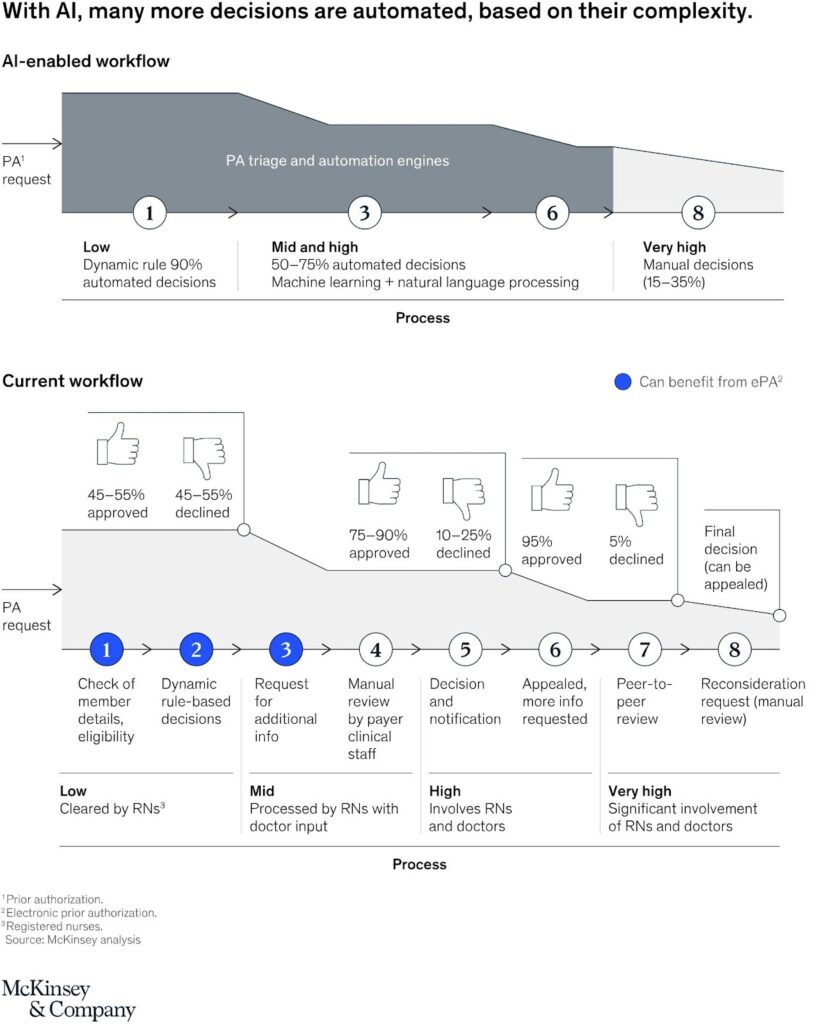
Implementation Considerations of AI in Prior Authorization
Rolling out healthcare AI for prior authorization is a business change that impacts people, processes, and data. Teams that start with a clear baseline, pick the right approach, and build security in from day one see faster wins and fewer surprises. Here’s how to set yourself up for success.
Assessing readiness
Begin with a short baseline. Measure volumes by specialty and payer, current turnaround, first-pass approvals, denial reasons, touches per case, and staff hours. Inventory systems and interfaces, EHRs, portals, clearinghouses, and any existing APIs, and note where data quality breaks down.
Review how policies are managed today: who owns the rules, how often they change, and where they live. Map roles and handoffs to identify friction points before implementing automation. Finally, define a focused pilot: one service line, a few payers, clear KPIs, and a timeline.
Ready-made vs. custom
Choose a ready-made platform when you need speed, your workflows align with industry patterns, and you can easily adapt to the product. You’ll get quicker deployment, lower upfront cost, and a steady roadmap. Go custom (or heavily tailored) when you run a hub, connect diverse participants, or carry unique business rules and data models. You’ll gain control and deeper integration at the cost of more design and ownership.
Many teams blend both approaches: they deploy an off-the-shelf core to prove value, then extend it with custom modules for high-volume specialties, payer nuances, and analytics. Whatever you pick, fix the target early, turnaround, first-pass yield, denial reduction, hours reclaimed, and cost per authorization, and instrument dashboards from day one.
Security and compliance
Treat security and compliance as design requirements, not afterthoughts. Protect PHI with encryption in transit and at rest, least-privilege access, MFA, and role-based controls. Keep end-to-end audit trails for submissions, decisions, and any model-assisted recommendations.
Build workflows that meet HIPAA privacy and security rules and support CMS expectations for electronic PA and decision timelines. Maintain human-in-the-loop checkpoints for edge cases, and govern models with versioning, monitoring, drift detection, and a rollback plan in place. This keeps you compliant today and ready for evolving oversight tomorrow.
Why Edenlab Is Your Reliable Partner in AI Prior Authorization Automation
Edenlab focuses exclusively on healthcare. We blend IT consulting, deep business analysis, and data engineering with hands-on claims and billing expertise. We design AI-ready data foundations and build FHIR-first, audit-ready workflows that incorporate privacy and governance from the outset.
Our teams integrate with EHRs via FHIR or HL7v2, connect to payer APIs and clearinghouses, and run on cloud-native platforms such as AWS, Azure, or GCP. Under the hood, we combine NLP and ML for evidence extraction and denial prediction, along with RPA for portals, as well as event streaming, rules engines, MDM, and full observability.
Results are routine requests that move in hours, not days. First-pass approvals increase, resubmissions and touches decrease, administrative costs per request decline, and audit trails become more transparent and consistent.
Edenlab has developed similar capabilities at a national scale and in complex environments, ensuring both compliance and operational effectiveness. Recently, for Heals.Asia, a leading TPA in Hong Kong, we replaced fragmented, manual adjudication with a FHIR-first engine that unified data exchange and formalized complex plan rules into a maintainable rules layer. We exposed simple APIs for eligibility, pre-authentication, predetermination, and claims, allowing participants to transact consistently. The outcome: straight-through processing for routine cases, decisions in hours rather than days, far fewer “need more information” loops, and meaningfully lower handling costs.
Conclusion
AI prior authorization in healthcare is the shift that transforms a chronic bottleneck into a predictable and scalable flow. Paired with FHIR and API-first exchange, it shortens routine decisions from days to hours, raises first-pass yield, and frees teams to focus on clinical work instead of portal work. For organizations running RCM hubs and HIEs, billing intermediaries and TPAs, RCM/EHR vendors, and provider or payer platforms, the benefits include increased throughput, reliability, and a better patient experience at scale.
At Edenlab, our work spans national-scale exchanges and complex adjudication, with tangible results: faster decisions, fewer reworks, lower handling costs, and audit-ready transparency. If you’re exploring AI for prior authorization, whether you operate a national hub, build RCM products, or run a multi-entity provider or payer platform, we’d be glad to compare notes, co-design a focused pilot, or review your architecture.

Turn prior authorization into an advantage
If you’re ready to move beyond pilots and paperwork, let’s co-design an AI-ready PA flow that fits your platform, your payers, and your policies. We’ll help you pick the right starting lane, stand up a measurable use case, and scale securely and compliantly.
FAQs
How can healthcare providers implement AI for prior authorization?
Start with a focused pilot where volume and friction are high, and establish baseline KPIs (turnaround, first-pass yield, minutes per case). Ensure data readiness from the EHR. Integrate AI for evidence extraction (NLP), completeness/denial risk checks (ML), and submission/status updates (APIs or portal RPA), keep humans in the loop for exceptions, then scale by specialty and payer while monitoring dashboards.
Which tasks in prior authorization can be fully automated by AI?
AI can determine if a PA is needed, extract clinical facts from the chart, assemble complete packets, submit them electronically, poll status, answer routine “need more info” requests using existing data, and write back the decision to the EHR. Straight-through processing is most effective for routine, policy-aligned requests; however, edge cases are still routed to humans.
Can AI handle complex prior authorization rules and exceptions?
Yes, combine a rules engine for explicit policy logic with NLP/ML to find and structure evidence, and route high-risk or ambiguous cases to clinical reviewers. Version rules, capture rationales, and maintain audit trails to ensure exceptions are handled safely and transparently.
How does AI integration affect healthcare staff workflow and efficiency?
Work shifts from portal chasing to exception management, resulting in fewer rekeys, fewer follow-ups, and clearer queues. Typical gains include routine decisions in hours (not days) and smaller denial and appeal backlogs.
Are AI-driven prior authorization systems compliant with healthcare regulations?
Yes, when built with compliance by design. Protect PHI with encryption in transit and at rest, least-privilege access, MFA, role-based controls, and end-to-end audit logs; align workflows with HIPAA and CMS electronic PA requirements and timelines; put BAAs in place with vendors; and govern models with versioning, continuous monitoring and drift detection, clear explainability, and human-in-the-loop review for exceptions.
Stay in touch
Subscribe to get insights from FHIR experts, new case studies, articles and announcements
Great!
Our team we’ll be glad to share our expertise with you via email