
Healthcare organizations generate enormous volumes of data every day, from EHR entries and lab results to claims, billing, and scheduling records. According to World Economic Forum analysis, a typical hospital produces around 50 petabytes of data per year, and 97% of it goes unused.
More data has not necessarily led to better answers. Information is fragmented across systems with limited interoperability, recorded in formats that take real effort to normalize, and reachable only through technical specialists and manual reporting cycles. Decisions get delayed or rest on partial evidence. Denied claims, preventable readmissions, and unnoticed utilization outliers quietly drive up costs.
This article explores why healthcare analytics for providers must go beyond traditional dashboards, giving every level of the organization access to comprehensive clinical, operational, and financial data and the insights built on it.
It examines what keeps that data out of reach and how a governed semantic layer (a shared model of approved clinical and business definitions), paired with conversational access in plain language, makes analytics usable from the boardroom to the point of care.
Kodjin Analytics is built on this architecture, and its AI has no direct access to patient records, clinical notes, or the raw database.
Analytics Is for Everyone, Not Just the BI Team
When people say “healthcare analytics,” they usually picture executive dashboards. But each level of the organization asks different questions of the same data.
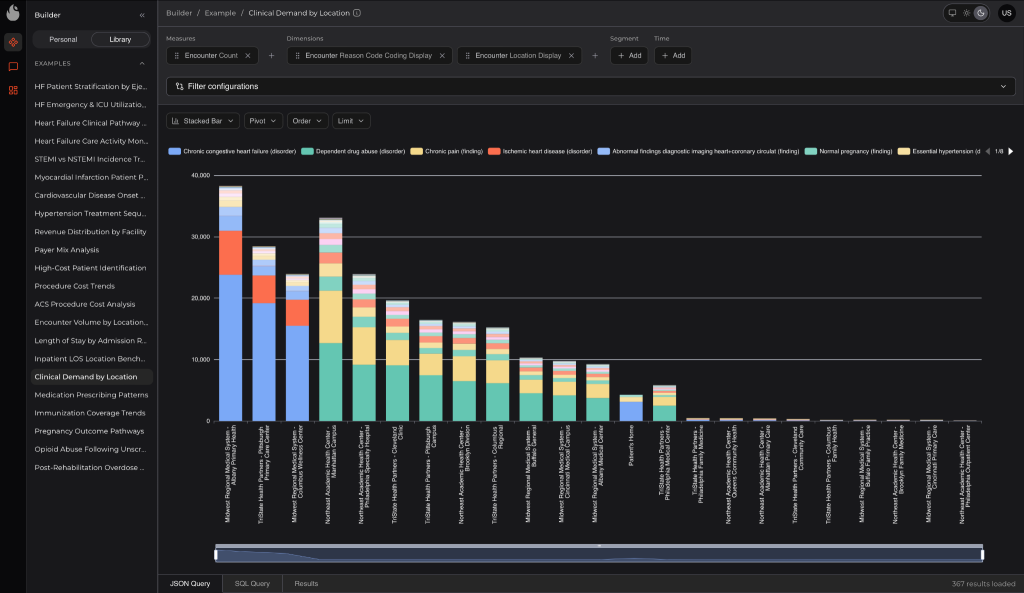
Executives and strategy teams need evidence for “where next” decisions: which populations and service lines to invest in, how referral patterns and payer relationships are performing, and which locations see the highest demand and for which conditions.
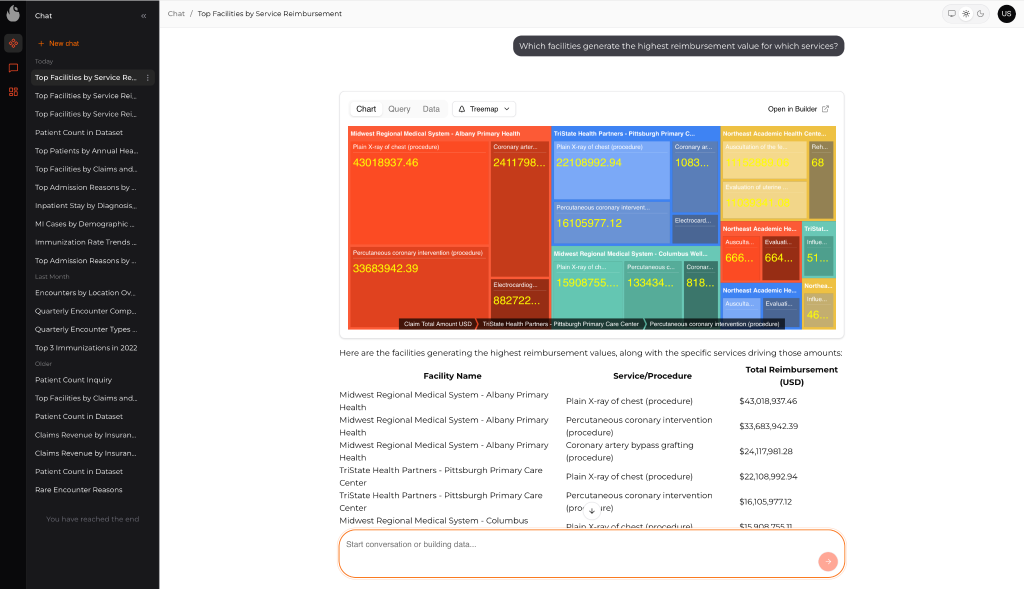
Finance and operations leaders need continuous visibility into costs, revenue, margins, and utilization across facilities, not a quarter-end reconstruction of what already happened.
Quality and compliance teams need to assemble data from multiple systems for quality measures, regulatory submissions, and audits. That work has historically taken weeks of manual effort per cycle.
Research teams need to build cohorts, track outcomes across care settings, and screen patients for trial eligibility, turning routine clinical data into a research asset.
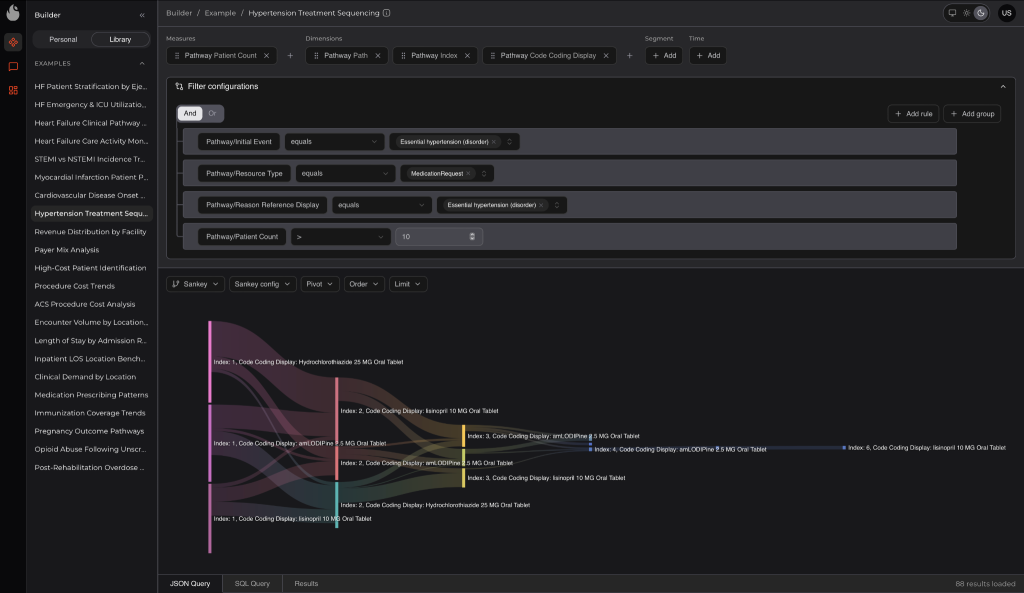
Care teams, department managers, and revenue cycle staff need answers between tasks: which beds are likely to free up today, or where workflows stall. Pathway analysis shows how patients move through care and where their routes diverge.
The questions differ. The problem is the same: in most organizations, only the first group gets served — and even they get served slowly.
Three Barriers That Keep Data Locked Away
Why does 97% of the data go unused when the demand for answers is universal? Three barriers, consistent across organizations:
Too complex. Healthcare data takes custom transformation pipelines and deep expertise to interpret: the same clinical fact can be recorded in several valid ways and coded in SNOMED CT, ICD-10, or local code systems. In practice, only 5–10% of users in an organization can analyze data at all. Everyone else files a request and waits.
Too slow. Batch processing means hours or days before data can even be queried, and new questions join an IT backlog. By the time the insight arrives, the patient has been discharged, the claim submitted, or the schedule set.
Too rigid. Dashboards answer yesterday’s questions. Every new question requires development. Users can’t explore freely, so they stop trying, and the organization’s analytical capability stops evolving.
Consider one clinically ordinary question: “How are our patients with Crohn’s disease treated, and what are the medication treatment lines?” To answer it, a team has to find every patient with the condition across code systems and diagnosis variants, work out when each diagnosis actually started, assemble medication history from prescriptions, pharmacy dispenses, administrations, and patient-reported records, line it all up on a timeline per patient, and only then aggregate the individual paths into a population view of first-line therapy, switches, and discontinuations.
Each step involves methodological decisions that must be made consistently, or the answer is silently wrong. That is why a question a clinical lead asks in one sentence traditionally becomes a multi-week project for a specialist team, and the same applies to readmission analysis, referral bottlenecks, cost variation, and audit readiness.
Read also:
How a FHIR-native semantic layer turned complex EHR data into self-service analytics
Read the case studyFrom Reports to Real-Time Answers
Most organizations are stuck at descriptive analytics, backward-looking counts like patient volumes or readmission rates. Diagnostic and comparative analytics explain why: why readmissions are higher at one facility, or how treatment pathways vary across providers. Predictive analytics anticipates what comes next, but it depends on the clean, consistent data many providers lack.
Moving beyond descriptive analytics does not hand decisions to a machine: clinical, financial, and operational judgment stays with people. What changes is how quickly they get a trustworthy answer. Instead of requesting a report, they ask in plain language:
- Care coordinator: “Which patients need follow-up this week?”
- Revenue cycle manager: “Which encounters have missing documentation before billing?”
- Department manager: “Why is appointment utilization lower in this department?”
- Clinical leadership: “How do treatment pathways for this condition differ across our facilities?”
- Research team: “Which patients may be eligible for this trial protocol?”
- Finance department: “What’s driving the cost variation in this service line?”
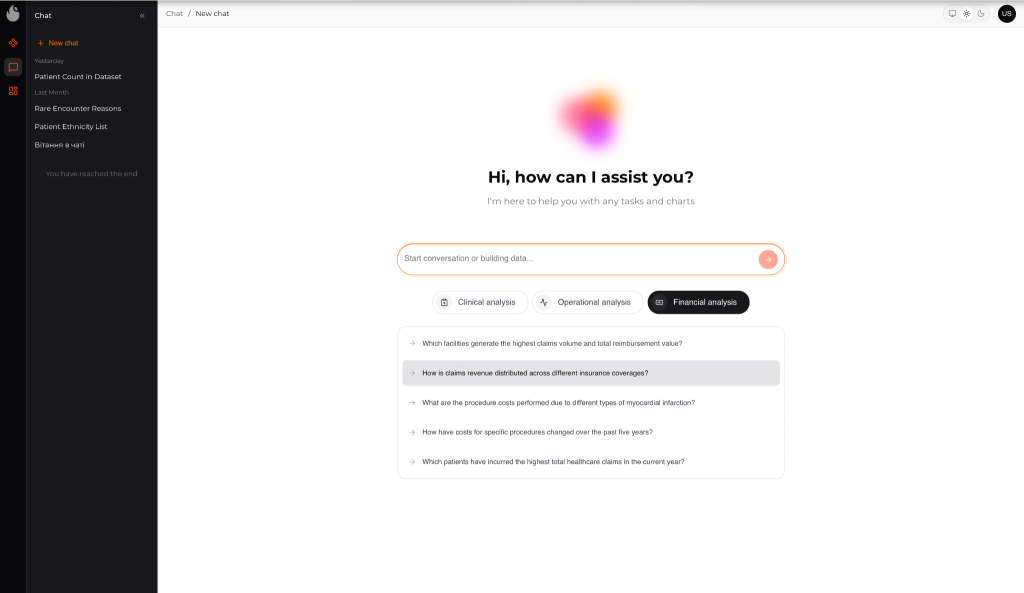
The bottleneck shifts from who can write the query to who knows what to ask, and that is exactly the expertise clinicians, managers, and analysts already have.
The Hard Part: Making Natural-Language Answers Trustworthy
This is where many AI analytics initiatives fall short, and where architecture matters.
Letting an AI translate questions directly into SQL against a healthcare database is risky: a readmission rate computed with a flawed join or an improvised formula looks plausible and drives wrong resource decisions, and nobody notices.
Kodjin Analytics takes a different approach. A governed semantic layer sits between raw data and the people asking questions. Instead of tables, columns, and source-system quirks, it exposes approved clinical and business concepts such as active patient, readmission, condition onset, cost, and follow-up window. Edenlab works with your teams to define these measures, dimensions, cohorts, and metric rules, so the model reflects how your organization actually works.
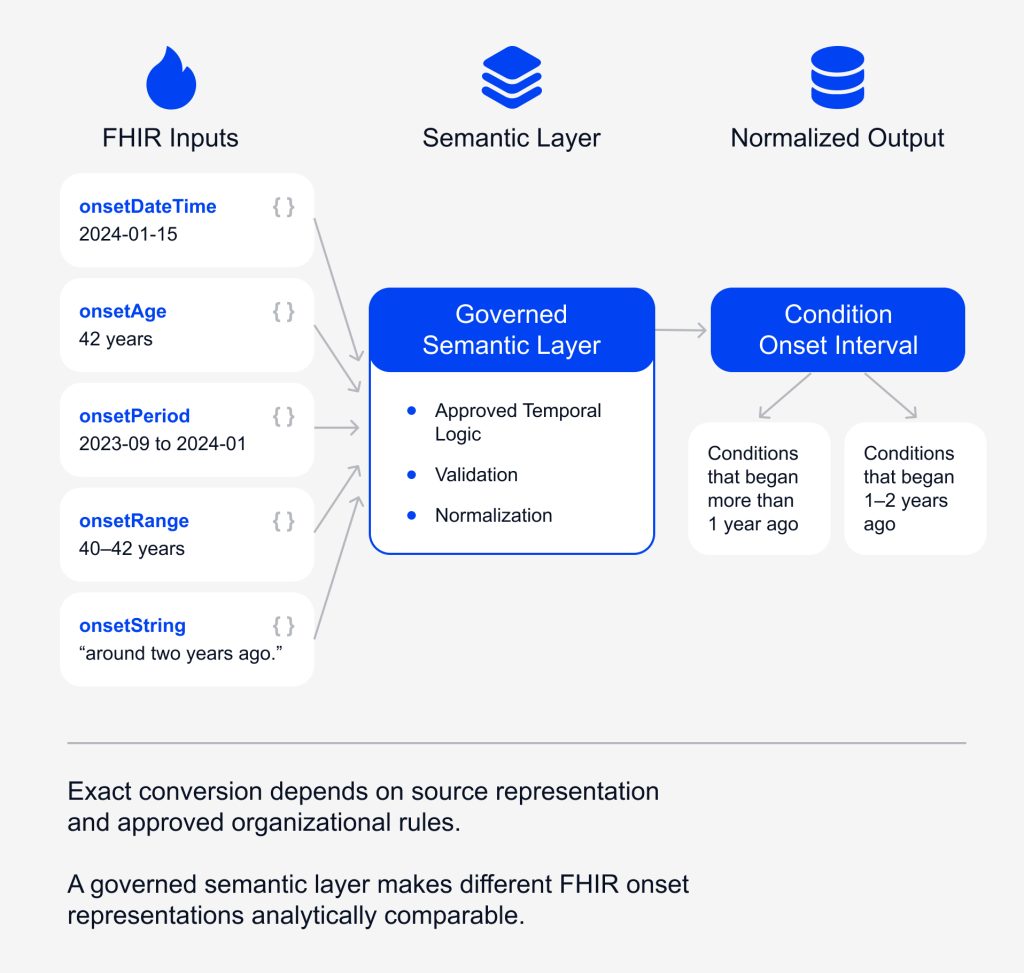
For example, the FHIR R4 Condition.onset[x] field can record when a condition began as an exact date, an age, a period, a range, or free text. One record specifies January 15, 2024, another says age 42, a third gives a date range. A direct database query cannot compare these values as one date column.
The semantic layer applies approved temporal rules first: it resolves an age against the patient’s date of birth, interprets periods and ranges by configured boundaries, and flags free text that cannot be normalized reliably. It then exposes a single consistent concept, such as onset interval. When a user asks “Which active patients have conditions that began more than one year ago?” the same logic applies to every eligible record.
The semantic layer then provides three controls:
- Consistent definitions. “Readmission rate” means the same thing for every user and every query, so three teams do not report three different numbers for the same metric.
- Managed complexity. “Patients with diabetes” resolves across approved code systems and record types, so users work with governed concepts rather than coding and schema details.
- Access control at query execution. Role-, row-, and column-level policies are enforced where the query runs, not only in the application interface.
Conversational AI sits on top of the semantic layer, with an explicit compliance boundary: the large language model (LLM) works only with semantic metadata (the approved names and definitions of measures, dimensions, and filters) and never receives raw patient data.
It composes a structured query from those concepts, and the query is validated and checked against access controls before it runs inside the data environment. The LLM cannot invent joins or use unapproved formulas.
This separation reduces the number of components and vendors that handle protected health information (PHI), supports data minimization under GDPR Article 5, and creates a clearer audit boundary for access authorization and activity review under the HIPAA Security Rule. It does not make a deployment compliant on its own, but it removes an unnecessary disclosure path and narrows what privacy, security, and vendor-risk teams must govern.
Every step stays auditable: the original question, the generated and executed queries, the access decision, and the result shape. If a privacy officer asks whether patient data is sent to the LLM, the answer is no.
Under the Hood: Built for Real Healthcare Data
Trustworthy answers also need an engineering foundation built for messy healthcare data. Kodjin Analytics can ingest data from EHRs, labs, billing, claims, and legacy platforms in different formats. It also handles FHIR natively, including nested structures and fields like onset[x] that hold several data types. These structures work well for data sharing but are hard to analyze directly.
Continuous stream processing. Where source systems support event-driven exchange, data becomes analytics-ready as it arrives instead of waiting for a nightly batch, so answers to operational questions can reflect what is happening now.
Terminology normalization. Records coded in ICD-10, SNOMED CT, LOINC, RxNorm, or local systems land in the same analytical bucket, and the tooling is compatible with OMOP standardized vocabularies, so a cohort like “patients with Crohn’s disease” is complete regardless of how each record was coded.
A high-performance analytical engine. Columnar storage supports sub-second queries across millions of records, and the engine provides the temporal logic healthcare analysis needs: event sequencing, drug and condition eras (continuous periods of therapy or illness) with configurable gaps, and pathway analysis of how patients move through care. New data updates the picture as soon as it is processed.
Layered access control. Four enforcement levels at a single gate: analytical domains by role (clinical, financial, administrative), semantic models (aggregate-only for executives, patient-level for care teams), row-level filtering by organizational context, and column-level masking of identifiable fields for aggregate-only roles. One place to audit, update, and verify.
Health IT vendors can embed the same semantic layer and APIs, white-labeled, in their own products and get AI-ready analytics without building it from scratch.

What Faster Answers Change for Finance and Care Management
Cost and reimbursement questions need clinical and operational context. Cost variation means little without the episodes, providers, and care pathways behind it, and a denial rate is just a number until you can trace it to documentation, coding, or a specific payer. Healthcare financial analytics on shared data makes those connections queryable.
In care management, the constraint is coordinator time. When risk, care-gap, and avoidable-utilization signals are visible in one place, teams can spend that time on the cohorts where it does the most good, not on whoever surfaces first in a monthly report.
Both teams can then allocate resources on current numbers, catch revenue leakage while it is still recoverable, and track value-based agreements against shared definitions. How much of that value materializes depends on those definitions matching how your organization books, codes, and contracts, which is why they are not shipped as a generic default.
Why Now
The pressure to make data usable, not just available, is intensifying on both sides of the Atlantic.
In the U.S., national health expenditures are projected to grow 5.4% a year on average through 2034, and data from ONC, the federal office for health IT, shows a persistent gap between availability and use: 71% of hospitals routinely had needed external clinical information available electronically at the point of care, but only 42% said clinicians often used it in treatment. Clinicians are also ready for better tools: the American Medical Association reports physician use of AI has surged, with confidence in the technology growing.
In Europe, demographics and regulation reinforce each other: 22.0% of the EU population was aged 65 or over as of 1 January 2025, and the European Health Data Space (EHDS) regulation entered into force on 26 March 2025, raising the bar for secondary use of health data. Together with GDPR and HIPAA, the EHDS pushes toward more protection and transparency, which favors architectures that limit AI to metadata and keep patient-level data inside the organization.
Conclusion
Healthcare providers need access to complete clinical, operational, and financial data, and the ability to build analytics on it, at every level: for strategy, financial performance, quality and compliance, research, and daily operations. Most of that data already exists, and 97% of what a hospital produces sits unused behind three barriers: too complex, too slow, too rigid.
Removing those barriers takes more than a chatbot. It takes a governed semantic layer built on the organization’s own definitions, a conversational interface whose AI never sees raw patient data, continuous processing, and access control enforced at one auditable gate.
That is what Kodjin Analytics delivers: one analytical foundation that gives every role in the organization trustworthy answers in plain language, while people keep making the decisions.
Need answers your dashboards cannot provide?
Show us the questions your teams cannot answer today. We will map the data, governance, and analytics approach needed to make them operational.
Stay in touch
Subscribe to get insights from FHIR experts, new case studies, articles and announcements
Great!
Our team we’ll be glad to share our expertise with you via email