
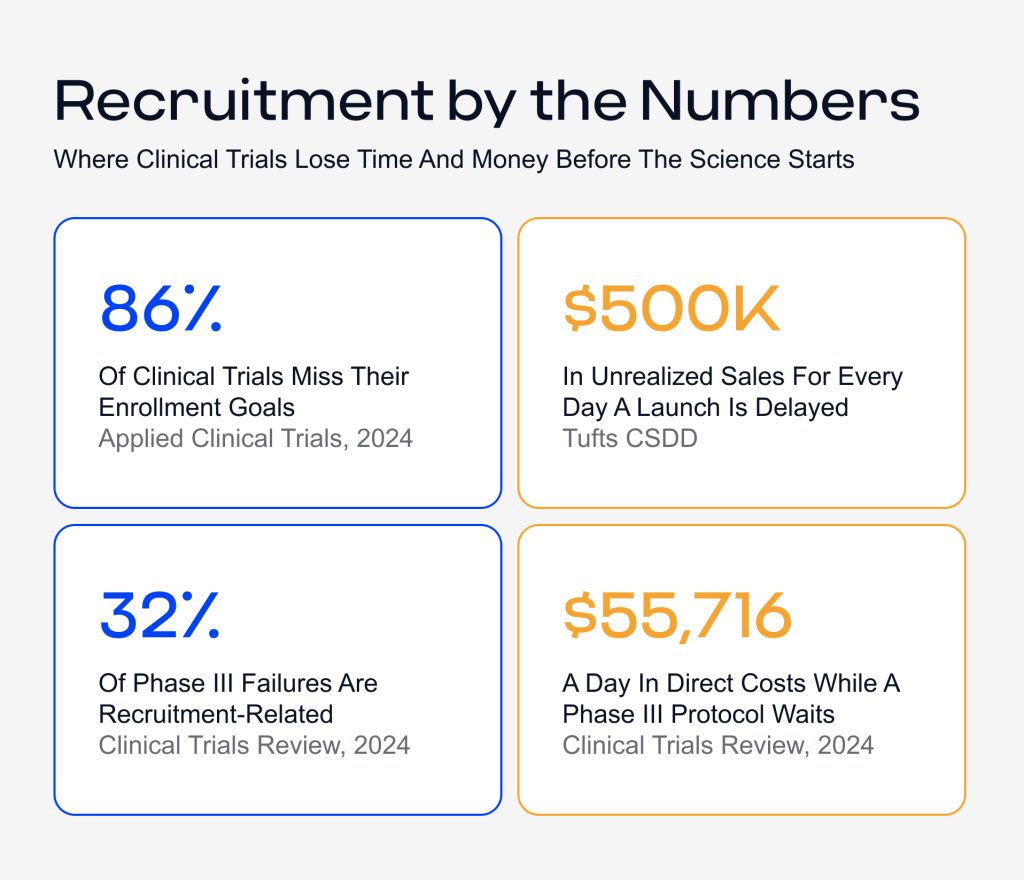
Recruitment is where most studies lose time, and the loss is rarely caused by science. Close to 86% of trials miss their enrollment goals, and the Tufts Center for the Study of Drug Development (Tufts CSDD) prices every day of delay at roughly $500,000 in unrealized sales. Meanwhile, the records that would answer the eligibility question sit in an EHR the site’s own clinicians write to daily.
Getting an answer still means a coordinator opening charts one at a time for weeks, against criteria written in prose that no system can execute. Custom clinical trial recruitment software closes that gap by turning those criteria into queries that run against data the organization already owns. Healthcare software development services aimed at this problem spend most of their effort on data engineering. What follows covers how the matching works, what sits underneath it, and which parts a team no longer has to write itself.
Research leads at provider organizations and site networks hit that data problem first. Clinical development teams at sponsors meet the same problem across sites they do not own. The sections below cover how patient matching works, what infrastructure the matching runs on, and which parts of a recruitment workflow a team no longer has to manage itself.
Highlights
- Recruitment failure is mostly a data-access problem. Eligibility logic cannot run on records that were never normalized.
- FHIR plus a semantic layer makes eligibility criteria computable the same way at every site.
- A FHIR-native foundation removes a year of infrastructure work, leaving the custom effort for workflows and eligibility logic.
What Is Clinical Trial Recruitment Software?
Clinical trial recruitment software identifies patients who may qualify for a study by running eligibility criteria against the clinical data an organization already holds, most often EHR records supplemented by registries and claims. It covers cohort discovery and prescreening, then coordinator review and enrollment tracking.
Clinical trial recruitment software is often confused with two neighboring systems. A clinical trial management system (CTMS) manages studies once they exist, covering milestones and site performance, and an electronic data capture system (EDC) captures data from enrolled participants. Clinical trial patient recruitment software matters before either becomes relevant, when a protocol must be matched to a live population.
Why Recruitment Stalls Before the Science Does
Enrollment problems end studies outright. The same 2024 review finds 32% of Phase III trials failing for recruitment-related reasons, while a Phase III protocol burns $55,716 a day in direct costs whether or not anyone is enrolling.
Protocol design carries part of the blame. Phesi’s 2026 analysis of more than 600,000 protocols found only 29.3% linked to documented patient data and outcomes. Sites inherit that. Criteria arrive that no local population can satisfy, and nobody finds out until screening has run a month.
Proof in Production: A FHIR-Native Analytics Platform
Zoadigm, a US healthtech company, engaged Edenlab to turn fragmented specialty-practice EHR data into commercial insight. An earlier vendor produced an architecture that couldn’t support the required functionality.
Edenlab delivered a full FHIR-native analytics platform with a no-code cohort and pathway builder, interactive dashboards, a semantic analytics engine, and a custom ELT module. The product handled validation, and ClickHouse materialized nested FHIR data for sub-second response.
Reported outcomes for end clients include a 9x higher match rate in patient selection than standard screening and more than $750K in added value on a single trial. A validated architecture and working prototypes were ready within three months, cutting time-to-market by 40%.
How EHR-Based Clinical Trial Matching Works
Six steps take raw records to a reviewed candidate list. This is how to recruit patients from EHR data without adding chart review time, and EHR patient recruitment fails at whichever step gets skipped.
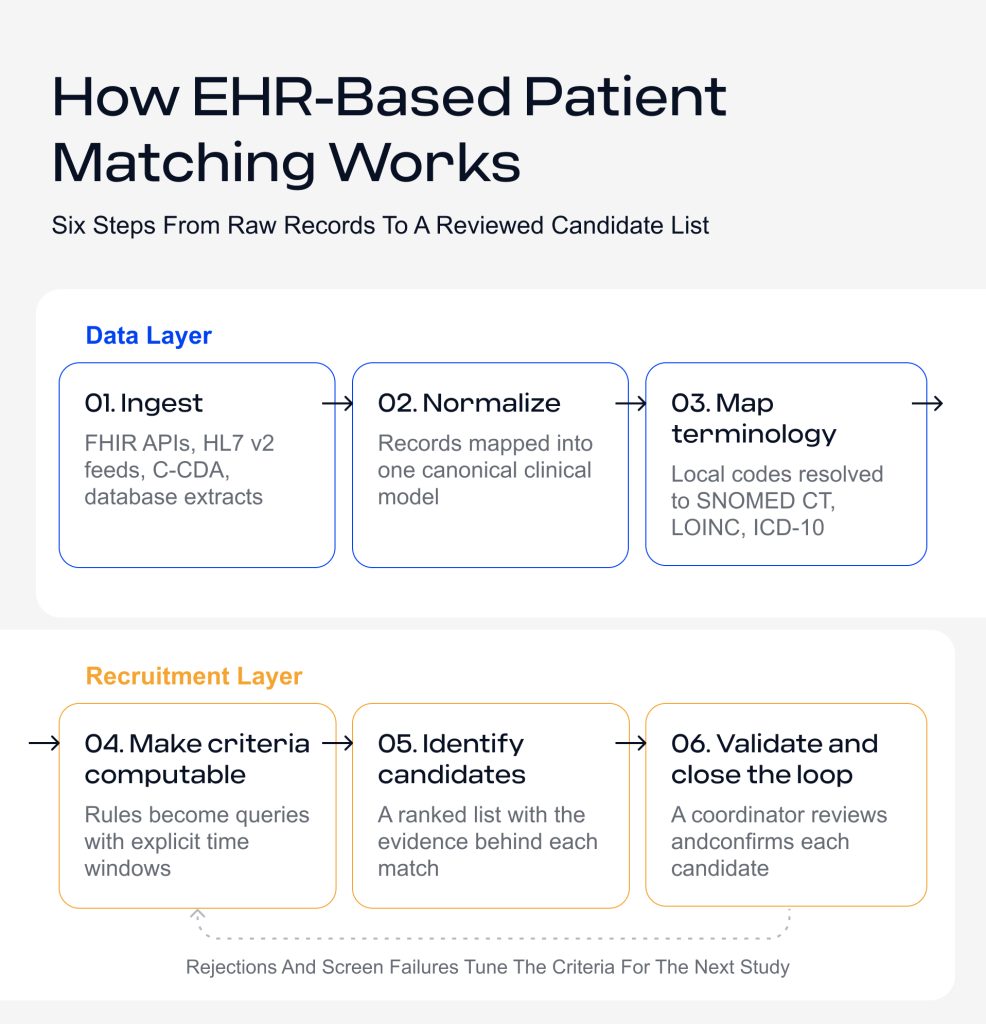
- Ingest. Data arrives through FHIR APIs, HL7 v2 feeds, C-CDA documents, or database extracts. Connecting research workflows to an EHR costs often takes more calendar time than the eligibility logic built on top of it, and clinical trial EHR integration is where vendor API limits appear.
- Normalize. Records are mapped into a canonical model, with dates, units, and data quality checked before anything is matched.
- Map terminology. Local codes resolve to SNOMED CT, LOINC, ICD-10, and RxNorm. Without this, a criterion written as “type 2 diabetes” silently misses patients recorded under local codes or different terms.
- Make criteria computable. Rules become queries with explicit temporal windows and a defined rule for missing data: diagnosis at least six months before screening, no systemic corticosteroids recorded within 30 days, most recent HbA1c within 90 days between 7.0% and 10.5%.
- Identify candidates. The query runs across the accessible patient population and returns a ranked list with the evidence behind each match, with missing data flagged rather than hidden.
- Validate and close the loop. A coordinator reviews the list and checks what the records cannot establish, such as corticosteroid use recorded outside the EHR. Rejections refine the query logic, and enrollment outcomes feed back, so screen failure patterns inform the next study.
Can your source systems support this pipeline? Our healthcare data integration team runs the readiness assessment first.
Providers, Research Organizations, and Pharma Need Different Workflows
All three build on the same data foundation. The differences show up in who uses the system daily and what each of them has to report.
| Dimension | Provider | Research organization/site network | Pharma sponsor |
|---|---|---|---|
| Core question | Which of our patients could join an open study? | How many eligible patients exist across our sites? | Which sites can deliver enrollment, and how fast? |
| Data scope | EHR, ancillary systems, local warehouse | Multi-site data, registries, consent records | Federated site data, real-world data, sponsor systems |
| Success metric | Time from protocol to candidate list | Cohort turnaround time, feasibility accuracy | Enrollment velocity, cost per enrolled participant |
A provider builds a recruitment layer that fits clinical workflow. A research network builds a clinical research recruitment platform whose cohort definitions survive from one study to the next. Sponsors face the harder constraint, since their tooling has to reach sites they do not own. A platform licensed for pharma therefore rarely fits a health system without modification.
The three diverge at the workflow layer, and that layer belongs to the organization that will use it. The data layer underneath can be the same one in every case. This split is worth holding up against any product on offer, since a platform with somebody else’s operating model baked into its workflow will need bending to fit, and the bending is where the budget goes.
Core Capabilities of a Modern Study Recruitment Platform
What does not change from one type of organization to the next is the list below. A provider, a site network, and a sponsor each put a different screen in front of a different user, but all three need these five capabilities present. A platform missing any one of them will not survive contact with a live study, whoever is running it.
- Eligibility criteria digitization. Protocol text becomes computable logic, versioned so a change stays traceable.
- Cohort discovery and clinical trial patient matching. Criteria run across the full population, so nobody hand-pulls a sample.
- Prescreening and review. Clinical trial prescreening software orders candidates by fit, then a clinician confirms or rejects each one with the reason recorded.
- Handoff and tracking. Clinical trial enrollment software passes approved candidates to eConsent and surfaces missed visits early.
- Analytics and audit. Every query and its result set are logged for Institutional Review Board (IRB) review.
Human review is the capability teams underestimate. A physician acting on it will not trust screening output with no explanation of the match.
Need help with healthcare data & analytics?
We are here to help. Check our
Healthcare Data & Analytics ServicesReference Architecture for Custom Clinical Trial Software
A recruitment platform is five layers deep, and users only ever see the top one. At the bottom, source systems feed a layer that collects the data and checks it on the way in. Above that, everything is rewritten into one shared format, so that a record from a hospital and a record from a registry can be compared at all.
The next layer holds the meaning: which local code counts as which diagnosis, and what a cohort is made of. Then the eligibility engine, where criteria become rules with dates attached and every match carries the evidence behind it. Clinical trial feasibility analytics, review queues, and audit logs sit on top, and that is the part the study team actually opens.
Most of the budget goes to the four layers nobody asks to see in a demo, and that is also where these projects fail. Performance is the usual example. Screening across millions of records stays interactive only if the engine was chosen for it at the start, and a query that takes two minutes gets run once and then avoided. Edenlab has built those lower layers before, at national scale, which is why a project with us can start at the eligibility layer instead of at ingestion.
Why FHIR Clinical Research Data Makes a Good Foundation
Raw EHR fields do not support eligibility logic on their own. The same clinical fact is recorded differently in two departments of one hospital, and dates are the least reliable column.
FHIR preserves the relationships between conditions, medications, encounters, and observations that a flat export destroys. Bulk Data export moves whole populations in one call, and the review screen can open inside the clinician’s existing session, instead of in a separate system. For sponsors, HL7 FHIR clinical trial integration makes one representation of research data possible across sites they do not control.
The second half is semantic. Semantic interoperability work turns nested resources into concepts a coordinator recognizes, such as an active diagnosis or a line of therapy. Cohort definitions written once then behave the same way everywhere, which is the whole point of standardization.
None of this makes FHIR the easy choice, and it is worth saying so. The specification is large, most recruitment tools avoid it by flattening records into a private schema, and a team meeting it for the first time loses months to profiles, terminology, and query performance.
The argument for taking it on is that the work is done once and holds for every study and every new data source after it. Our engineers work in FHIR full time, including a national eHealth system in production, which is what keeps the format from becoming the project.
AI Patient Matching in Clinical Trials: Where Guardrails Matter
AI clinical trial recruitment does three things well. It parses protocol documents and drafts structured criteria from prose. NLP clinical trial matching resolves facts buried in unstructured notes. Ranking then surfaces the strongest candidates, so a coordinator can size a cohort by asking a question in plain language. What none of this should do is decide eligibility.
| Approach | Strengths | Limitations | Best fit |
|---|---|---|---|
| Rules-based | Transparent, reproducible, straightforward to audit | Blind to unstructured notes, brittle when coding drifts | Well-coded data, regulated screening |
| NLP and LLM-assisted | Reaches information that structured fields fail to capture | Validation required per use case, bias must be managed | Note-heavy specialties, criteria drafting |
| Hybrid | Broad coverage with an auditable backbone | Higher engineering and governance effort | Most deployments of AI-powered clinical trial recruitment software |
Guardrails belong in scope from the first sprint. Outputs stay traceable to evidence, a human signs off per candidate, and PHI never reaches an external prompt.
Clinical Trial Recruitment Analytics
Clinical research software development follows a consistent sequence. Discovery sets the target protocols and the KPI baseline, and a readiness assessment establishes what the source systems support. Healthcare data integration for clinical trials comes next and carries most of the schedule risk. An MVP proves the pipeline on one protocol, then clinical validation compares matching against manual review before rollout.
| Metric | Definition | Business impact |
| Time to candidate list | Protocol receipt to first reviewed list | Whether a site can commit to a study |
| Screen failure rate | Screened participants who fail eligibility | Direct cost per avoided failure |
| Enrollment velocity | Participants enrolled per site per month | Trial timeline and sponsor confidence |
Clinical trial recruitment analytics only mean something against a baseline. Capture these before the build starts, along with prescreen-to-screen conversion and coordinator hours per enrollment. Improvements weighed against a remembered baseline convince nobody.
Not sure which metrics to commit to? Our healthcare data and analytics team scopes measurement alongside the first use case.
Build vs Buy Clinical Trial Recruitment Software
| Criterion | Off-the-shelf | Custom from scratch | Custom on a FHIR-native accelerator |
|---|---|---|---|
| Time to first cohort | Fast, if your data fits the vendor’s model | 12 to 24 months | Weeks to a data foundation, months to a product |
| Workflow fit | Vendor’s workflow, configurable at the edges | Exactly your workflow | Your workflow on a proven data core |
| Data ownership | Often vendor-hosted, limited export | Full ownership | Full ownership, your cloud or on-premises |
Off-the-shelf suits a single site with a small portfolio and clean data in one EHR. The risk is outgrowing it, which is the point at which most organizations start weighing healthcare IT solutions against a build. Custom clinical trial software earns its cost when eligibility logic is a differentiator or when data spans several organizations. A platform headed for commercial release has the same profile, since building a healthcare product for market means owning the roadmap yourself.
The choice reads as build-or-buy, but there is a third route between the two, and it is the one most teams end up taking. Edenlab works in all three modes. Buying means licensing Kodjin as a product and building on it with your own team.
Building means we deliver a custom platform end-to-end, the way we did for Zoadigm. The hybrid route keeps both halves: your workflows and your eligibility logic, built for you on top of our FHIR components as an accelerator, so the foundation year is already behind you on the day the project starts.

Kodjin Analytics as an Accelerator for Clinical Trial Platform Development
Most of the effort in a recruitment build is invisible to the user. Normalization, terminology services, query performance, access control, and audit logging eat the first year of a from-scratch project, none of it customer-specific.
Kodjin, Edenlab’s FHIR-native data platform, supplies that layer. The FHIR server handles validation and large-scale processing. The terminology service resolves coding differences across sources, and the ELT module connects EHRs and registries. Above them, Kodjin Analytics contributes a semantic layer and a no-code cohort builder, with interactive dashboards and conversational querying on top.
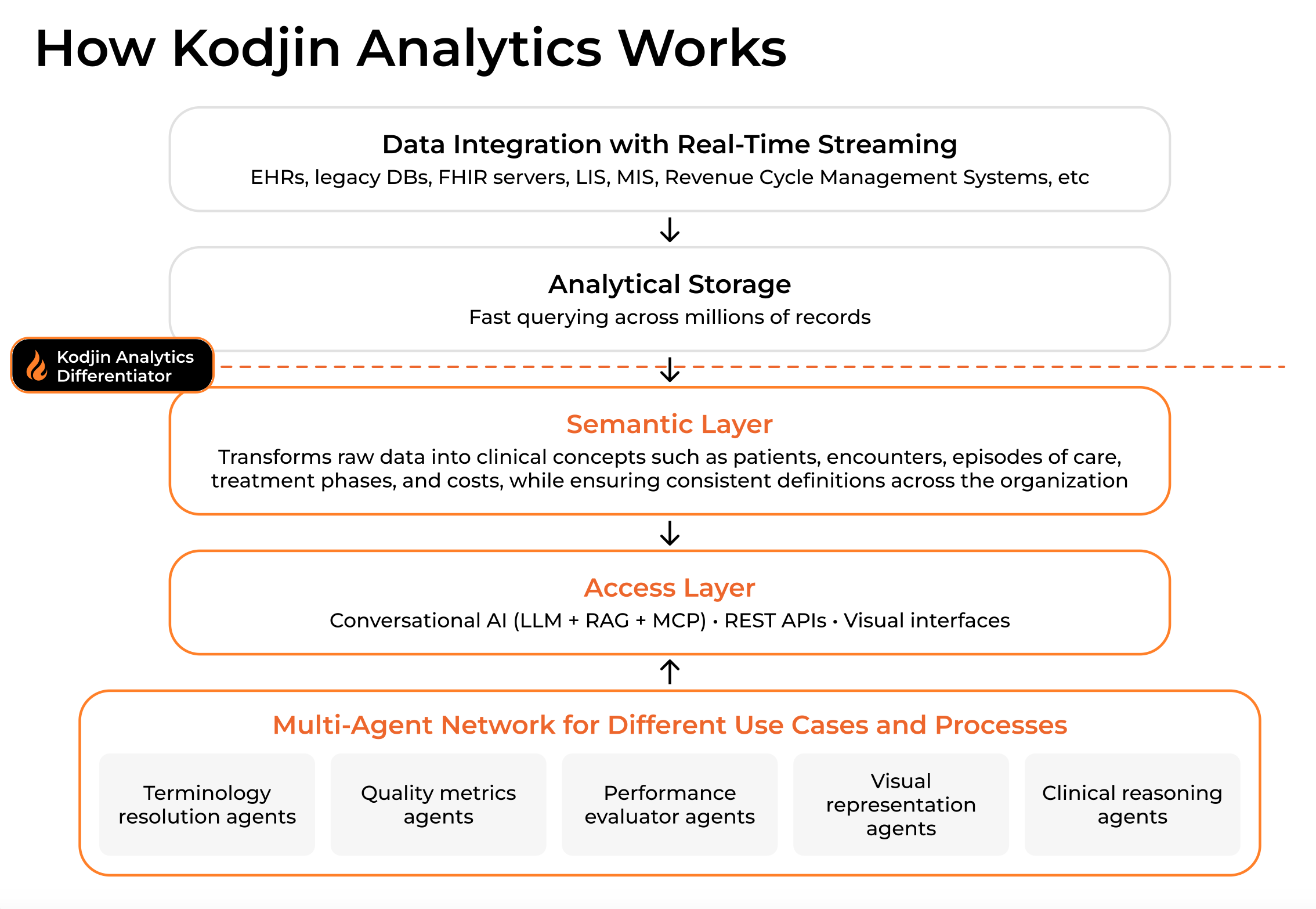
What remains is worth customizing: the eligibility model for your therapeutic areas, the review workflow coordinators will use, integrations with existing CTMS and eConsent tools, and a deployment model compliance can approve. The same components carry a national eHealth system serving 36 million users, which answers the volume question a compliance review asks. The accelerator is still a foundation, and a foundation is all it is.
Limitations Worth Stating Plainly
Clinical trial recruitment software inherits every weakness of the data beneath it. Structured records miss context that lives in narrative notes, and medication end dates are often absent. Protocol language is ambiguous often enough that two coordinators read the same criterion differently. Consent rules limit what can be queried, and models trained on one population degrade on another, so validation stays recurring.
Conclusion
The short answer to improving clinical trial recruitment is that eligibility logic must run against real clinical data, reviewed by the people who own the study. Outreach tooling rarely moves the enrollment number on its own, because recruitment for clinical trials stalls earlier, at the point where candidates are found by hand.
Three decisions shape the project. Scope comes first, since a single site with clean data is well served by a commercial platform while multi-source data points to a custom build. Then the starting point, because writing normalization and audit infrastructure from scratch costs a year before the first cohort query runs. Validation is third, and matching never checked against manual review will not survive its first IRB conversation.
Discuss your clinical trial recruitment software project. Edenlab works exclusively in healthcare, from clinical software engineering to life sciences software development for sponsor-side clinical development. Bring a protocol and your data sources, and we can map the architecture with you, whether the goal is a new EHR-integrated matching solution or the modernization of a stack that has outgrown its data layer.
Your EHR already knows who qualifies
Custom clinical trial recruitment software turns eligibility criteria into queries that run against real clinical data. Bring a protocol and a description of your data sources, and we will map the architecture with you.
FAQ
What is clinical trial recruitment software?
It identifies potentially eligible participants by running study criteria against EHR records and other clinical sources. The same system usually carries prescreening and review.
How does clinical trial patient matching software work?
Patient matching for clinical trials normalizes clinical data and maps local codes to standard terminologies. Criteria then run as time-windowed queries returning matches with their evidence.
How to automate clinical trial eligibility screening?
Automated eligibility screening turns criteria into computable queries and runs them across the whole population in one pass. Clinical trial eligibility screening software returns a list that a coordinator validates before outreach.
How does AI improve clinical trial recruitment?
AI extracts structured criteria from protocols, pulls clinical facts out of narrative notes, and ranks the strongest matches to the top of a coordinator’s list. Clinicians still decide eligibility.
How long does clinical trial recruitment software development take?
Building the data foundation from scratch takes a year before recruitment logic can run. On a FHIR-native platform, a working foundation takes weeks and a validated MVP a few months.
Stay in touch
Subscribe to get insights from FHIR experts, new case studies, articles and announcements
Great!
Our team we’ll be glad to share our expertise with you via email