
Healthcare providers often operate dozens of disconnected IT systems, each built for a specific function and never designed to work together. This fragmentation keeps data siloed across departments and facilities, makes it hard to establish a single source of truth, and slows down analytics, compliance work, and innovation.
A healthcare data strategy must unify these systems, make data trustworthy, and prepare it for analytics. The goal of this guide is to show providers how to approach building a healthcare data strategy in a realistic, phased way: where to start, what to prioritize, and what mistakes to avoid.
Highlights:
- How to turn “legacy chaos” into a governed data foundation that supports interoperability and analytics.
- A practical roadmap to assess current systems, define goals, choose standards, and implement controls.
- The most common mistakes that derail modernization, and how to sidestep them before they become expensive.
- A clear view of the tool layers needed for a modern data platform, from ingestion to governance and BI/AI readiness.
Why Healthcare Providers Need a Robust Clinical Data Strategy
A modern provider does not work as a single system. Instead it depends on a complex ecosystem built up over decades: EHR/EMR, lab systems, imaging systems (PACS), billing, scheduling, pathology systems and more. These systems often end up operating on different standards and formats at the same time, such as HL7 v2 messages, DICOM for imaging exchange, partial FHIR® facades, and proprietary database schemas.
For large, distributed hospital networks, this creates a structural problem. A hospital data strategy must reduce integration sprawl and create reusable, governed data that supports reporting, compliance, analytics, and operational improvement.
The consequences are practical, not theoretical: delayed clinical decisions, duplicate patient records, inconsistent reporting, manual reconciliation work, clinician frustration, analytics delays, compliance pressure, M&A integration complexity and fragmented patient journeys across departments and care settings.
That’s why data strategy in healthcare is not just a technical exercise. It is the architectural level response to chronic operational and organizational pressures. Well-designed, it allows providers to improve operational efficiency, reduce clinician burden, increase financial sustainability, enable better care coordination, improve reporting readiness, prepare data for AI use cases and reduce implementation risk over time.
A strong approach is based around 5 key priorities:
Interoperability
Interoperability makes it possible for data to move safely between EHRs, labs, imaging centers, payer systems, and partner networks, turning departmental systems into an organization-wide capability. A standards-based approach cuts down on fragile point-to-point interfaces and makes changes less expensive.
Security and compliance by design
Healthcare data is subject to rigorous regulatory, privacy, and security requirements that depend on the jurisdiction and use case such as HIPAA in the US, GDPR in the EU and other regional policies. A good strategy is to build access control, encryption, auditing and data minimization into the architecture up front rather than treat compliance as an afterthought.
Scalability and flexibility
Healthcare data environments are dynamic. Standards change, infrastructure patterns change, analytics needs evolve over time. A strong data strategy should facilitate controlled evolution, allowing organizations to embrace new standards, scale current architecture, and introduce new use cases without requiring repetitive rework or major replatforming.
Quality control and governance
If an organization can’t trust its own data, its strategy won’t work. Governance sets rules for who owns what, how things should be done, who can access what, how to protect things, and how to make sure things are of good quality. Without governance, teams make separate reports, fight over metrics, and go back to using spreadsheets and manual “reconciliation.”
Data usability for decision-making
Data strategy is not only about gathering, storing and preserving data. It also has to make data relevant for actual choices in the clinical, operational, financial and strategic arena.
This implies that data must be accessible in the appropriate format, at the appropriate time, and with sufficient consistency and context to facilitate analytics, performance management, planning, and reporting. If data is not reliably utilized in decision making, then the organization may be data rich, but insight poor.
If you can’t store validated, standardized data, you can’t sustainably deliver BI and AI, your team will stay trapped maintaining interfaces instead of improving outcomes.
Key Steps to Develop a Healthcare Data Strategy
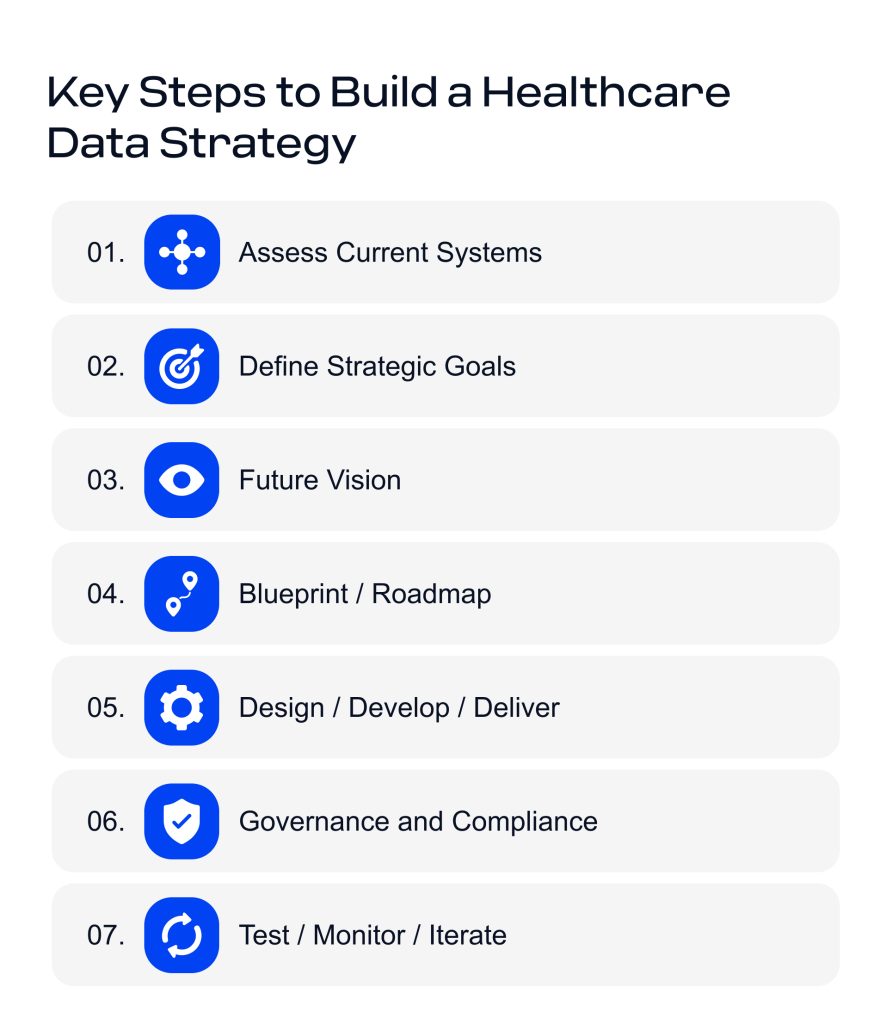
Organizations that want to develop healthcare data strategy capabilities need a phased approach that starts with legacy reality and moves toward governed, analytics-ready data.
These are the core phases organizations should follow to build healthcare data strategy across fragmented provider environments.
1) Assess current systems
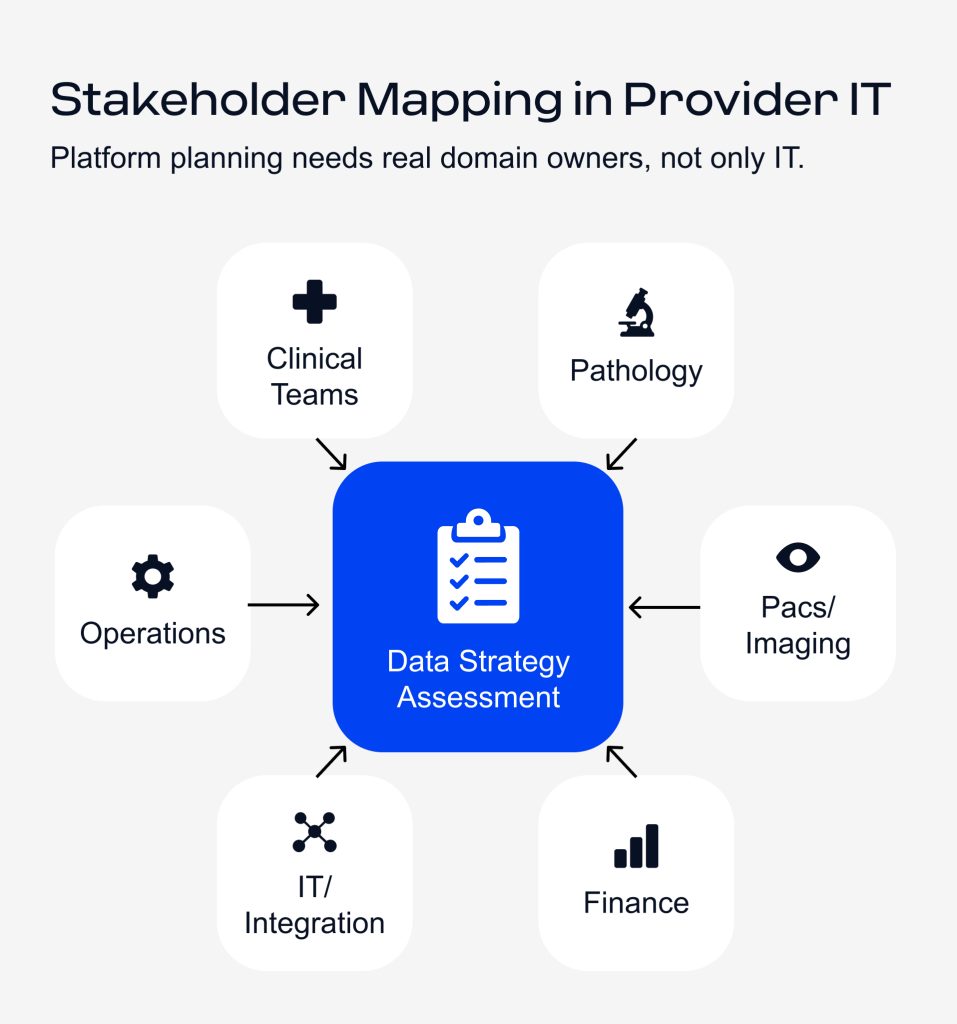
Begin with a complete inventory of systems, owners, data domains, data formats, interfaces, and operational limits. This should include not only IT but also clinical and operational stakeholders.
A big difference in big hospitals is that each domain system has its own “expert community.” Pathology teams are the best at understanding pathology workflows. PACS teams often don’t know how pathology systems work together, and finance teams don’t know how clinical exchange works. Part of the audit is stakeholder mapping, which helps you avoid making wrong integration assumptions by asking the wrong group.
2) Define strategic goals
A strategy is only as strong as the goals it supports: patient flow, reimbursement, reducing cost per encounter, scaling via M&A, improving clinical decision support, regulatory reporting, research enablement.
This is where you define what success looks like: KPIs, reporting expectations, latency requirements, and governance expectations.
3) Develop a future vision
Document the future-state data platform in terms of capabilities:
- What data should be queryable across the organization?
- Where do you need real-time events vs batch?
- What governance boundaries exist by role, department, and purpose?
- What is your migration strategy across standards and versions?
4) Create a blueprint/roadmap
Hospitals built over 20–50 years cannot be rewritten in a year. A blueprint should explicitly plan phased onboarding:
- Prioritize domains (e.g., meds, labs, imaging, encounters)
- Use facades/gateways where replacement is unrealistic
- Keep mission-critical HL7 v2 working while building the FHIR-based canonical layer.
5) Design, develop, deliver
Implementation should be approached as a controlled pipeline:
- ingestion and routing
- transformation and normalization
- terminology alignment where needed
- identity/record linkage patterns (MPI as applicable)
- consent/policy enforcement where applicable
- repository storage (FHIR/CDR + analytics store as needed)
- API and analytics enablement.
6) Implement governance and compliance controls early
Governance is not “documentation.” It is enforced behavior:
- role-based access (RBAC/ABAC patterns)
- encryption in transit and at rest
- audit logs and retention policies
- validation and quality dashboards
- operational monitoring and alerting.
7) Test, monitor, and iterate
A strategy is not a one-time project. It must evolve with priorities and constraints, or it becomes obsolete.
From data pipeline design to data quality and analytics enablement,
get a partner with deep healthcare expertise and a strong understanding of industry standards, compliance requirements, and scalable healthcare data infrastructure.
Healthcare data & analytics software development and consulting servicesCommon Mistakes That Undermine Data Strategy Success
Healthcare organizations repeatedly fall into similar traps, especially when starting from legacy ecosystems.
Neglecting interoperability from the start
If you start by “just integrating what we have” without standardization, interfaces multiply, maintenance compounds, and topology drifts toward a spaghetti-like mess.
Avoid it: define canonical models and reusable integration patterns early.
Choosing technology without long-term scalability
Picking tools based on today’s pilot often creates tomorrow’s bottleneck. A scalable strategy uses modular components and plans for growth in data volume, org complexity, and use cases.
Avoid it: anchor architecture on standards and observable SLOs; choose replaceable components.
Underestimating regulatory and compliance requirements
Teams often treat compliance as a finishing step. In regulated environments, that leads to rework, risk, and broken timelines.
Avoid it: bake audit, access control, encryption, and data residency constraints into the blueprint.
Lack of clear governance or data ownership
If nobody owns a domain dataset, quality collapses, reports diverge, and trust disappears. Governance establishes who owns data, how it’s standardized, who can access it, how it’s protected, and how quality is maintained.
Avoid it: define data stewards and enforce rules through tooling and process.
Not involving key clinical and operational stakeholders
Data platforms fail when designed only by IT. Domain systems are operated and understood by specific clinical teams; ignoring them creates incorrect assumptions and broken workflows.
Avoid it: involve the real users and domain owners from day one.
Attempting to build everything in-house without needed expertise
Large providers with strong internal teams may succeed. Many others underestimate the scope and end up stuck operating integration engines indefinitely.
Avoid it: use proven platforms and partners where it reduces risk and accelerates time-to-value.
Ignoring legacy system integration challenges
Treating HL7 v2 and legacy databases as “good enough” blocks analytics and AI readiness. HL7 v2 is a message format, not a durable storage model; once messages land, data becomes proprietary schemas again, making analytics inconsistent and hard to scale.
Avoid it: keep legacy running, but build a governed canonical layer (often FHIR-based) for durable reuse.
Failing to plan for data quality and validation
If you don’t validate and standardize at ingestion, you’ll pay later in analytics and reporting. Data must be structured and validated to power BI and AI reliably.
Avoid it: implement validation checkpoints, profiling, and quality dashboards early.
Overlooking the need for real-time analytics readiness
If you only design for batch loads, you’ll struggle with modern requirements (alerts, monitoring, near-real-time dashboards).
Avoid it: plan for “two speeds” where needed, batch for history and streaming for events.
Treating data strategy as a one-time project
Priorities, standards, and org structure change. Strategies that don’t evolve become shelfware.
Choosing the Right Tools and Infrastructure
A modern healthcare data architecture is a layered system. Tools should be selected based on roles in the architecture, not brand checklists.
Repository and canonical layer (FHIR/CDR)
For many providers, a secure central repository enables durable reuse: analytics, research, population health, and reporting. Edenlab recommends governed repositories as a path to standardized, reusable data, with role-based access and privacy controls.
This is where a FHIR server can act as a canonical store for standardized resources.
Kodjin FHIR Server is designed as a secure, enterprise-grade FHIR repository, with compliance-oriented features and operational tooling. It supports deployment across cloud and on-prem environments and integrates with modern monitoring and infrastructure stacks (e.g., Kubernetes, Prometheus, Grafana).
This approach is grounded in Edenlab’s experience delivering healthcare data infrastructure for large provider ecosystems, national-scale interoperability programs, and FHIR-native environments where governance, security, and operational resilience must be built in from the start.

Integration, ingestion, and orchestration (beyond a monolithic integration engine)
Traditional integration engines behave like monolithic ETL: connect sources, transform, deliver. In large ecosystems, their built-in capabilities can become limiting. Modern toolchains use separate, specialized components for connectors, orchestration, change data capture, and streaming.
For complex programs, Edenlab highlights hybrid architectures that combine orchestration with batch ingestion for history/backfills and streaming ingestion for real-time events into a platform or CDR.
Analytics and BI/AI enablement
A healthcare analytics strategy depends on having standardized, governed, and accessible data. Interoperability and governance aren’t separate concerns; they are prerequisites for trustworthy analytics.
A strong healthcare data analytics strategy reduces rework and misalignment and replaces manual spreadsheet workflows with consistent, shared metrics.
Conclusion
A healthcare data strategy is not primarily about collecting data or buying tools. It is long-term architectural resilience: interoperability you can maintain, compliance you can prove, data you can use seamlessly and analytics you can trust.
Providers that start early and build incrementally are the ones that avoid getting trapped in permanent integration chaos. A modern strategy recognizes legacy realities, introduces durable canonical models, and evolves with standards and use cases over time.

Schedule a session with our experts
to align on scope, governance, and a practical modernization roadmap tailored to your healthcare data goals.
Stay in touch
Subscribe to get insights from FHIR experts, new case studies, articles and announcements
Great!
Our team we’ll be glad to share our expertise with you via email