
Healthcare leaders keep asking for real-time dashboards, but what they usually need is something more specific and more attainable: trustworthy operational insight fast enough to change what happens next. A bed manager deciding whether to open surge capacity does not need a perfect longitudinal dataset. They need confidence that the last admissions, transfers, and critical lab results are represented accurately and consistently within minutes, not tomorrow morning.
That shift in expectations is forcing a shift in architecture. Batch-first data warehouses and nightly ETL jobs were built for periodic reporting, finance, and retrospective analytics. Adopting real time analytics in healthcare requires a fundamentally different architectural approach: treating clinical and operational data as a stream of events, governed and observable the same way you would operate any other mission-critical system.
It is less about moving bigger volumes on a schedule and more about treating clinical and operational data as a stream of events, governed and observable the same way you would operate any other mission-critical system.
Why batch-first analytics breaks at enterprise scale
Most healthcare enterprises didn’t choose “slow analytics” on purpose. It’s the emergent result of decades of point solutions, departmental systems, and integrations designed around billing cycles or interface availability. The EHR may be “the source of truth,” but the truth is scattered across LIS, RIS/PACS, pharmacy systems, scheduling, claims, call centers, and an expanding universe of devices and patient-generated data.
Each system has its own identifiers, timing, and semantics. Batch pipelines paper over those differences by taking snapshots and reconciling later, which works fine until the business starts asking questions that require immediacy.
The pain shows up in familiar ways: dashboards that disagree with the EHR, alerts that arrive after clinicians have already acted, operations meetings dominated by arguments about which report is “right,” and analysts building one-off extracts because the standard pipeline can’t meet a time-sensitive need. The deeper issue is that batch pipelines implicitly assume that the organization can afford latency, rework, and ambiguity. Real-time use cases expose that assumption as false.
The enterprise architecture shift: from pipelines to a data nervous system
Real-time healthcare analytics works best when you treat the platform as a nervous system. Source systems produce events – admission created, lab resulted, medication administered, claim status updated – and the platform reliably captures, standardizes, validates, and distributes those events to the consumers that need them.
This is where many solutions fall short. They try to “speed up the warehouse” without changing the mental model. They add more frequent batch jobs, increase compute, and call it streaming. The outcome is often fragile: the jobs still fail, only now they fail more often, and the organization becomes less confident in the numbers because there is no coherent way to understand what is complete, what is delayed, and what is corrected.
An event-driven approach doesn’t mean abandoning the lakehouse or warehouse. It means pairing it with an event backbone and a serving layer designed for freshness. The historical store remains essential for auditability, replay, longitudinal analytics, and training models. The difference is that the “fresh path” is engineered as a first-class product with observability and governance, rather than an afterthought bolted onto a nightly load.
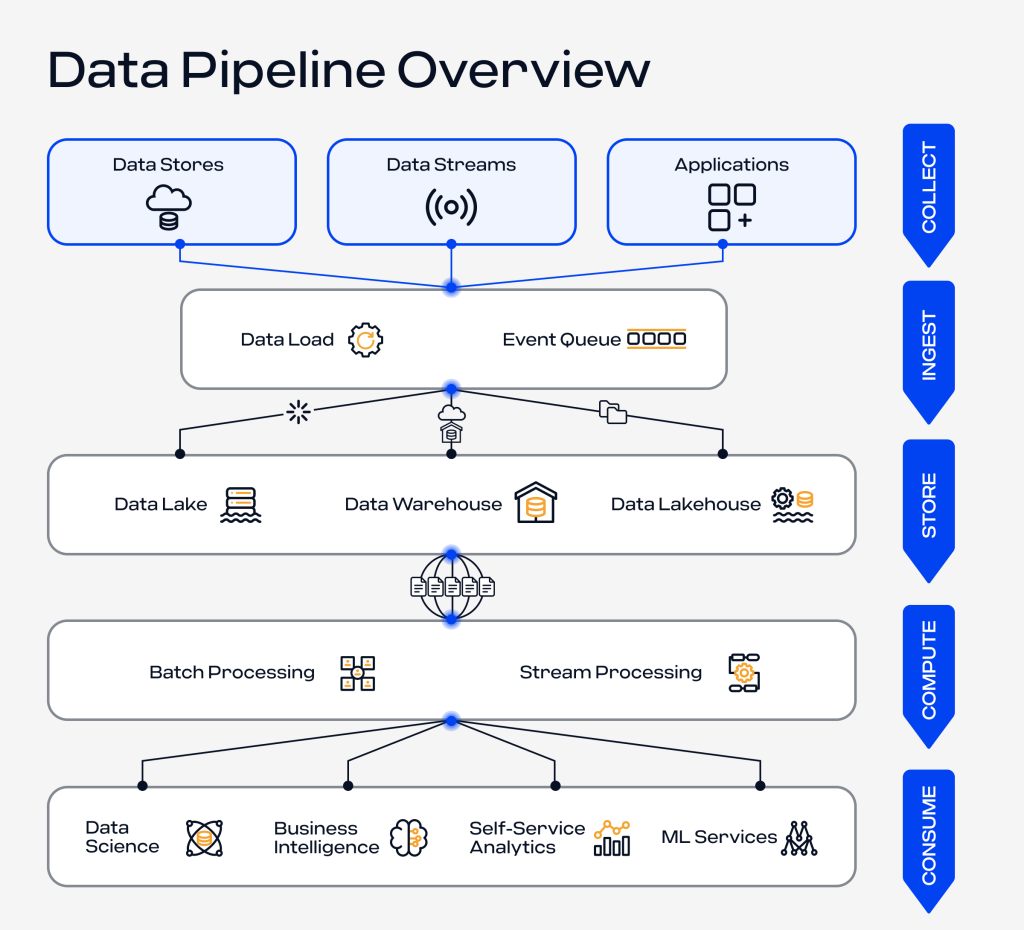
Ingestion
Healthcare ingestion is never uniform, and pretending it is will burn your timeline. The same enterprise may ingest HL7 v2 messages from one facility, use FHIR® APIs for another, receive claims in files, and have direct database access for a legacy departmental system. Real-time architecture needs to accommodate that diversity without turning into a bespoke integration project for every feed.
Where source systems support event notifications, you can reduce latency and load by subscribing to change events rather than polling. In the FHIR ecosystem, the Subscription resource is explicitly intended to establish proactive event notifications from a FHIR server to another system, triggered by state changes or events defined by topics the server supports. This can be a clean path for certain workflows, especially when the EHR or a national platform already exposes eventing patterns.
Where you have transactional databases and strong operational constraints, change data capture is often the pragmatic option. CDC is fundamentally about capturing inserts, updates, and deletes in a source system so downstream systems can stay synchronized without repeatedly reloading full datasets. In healthcare, CDC can be valuable for operational stores, scheduling systems, revenue-cycle platforms, and other systems that were never designed to emit analytics-friendly events.
And sometimes, the only realistic option is micro-batching. That’s not a failure; it’s a design choice. A five-minute extract that is stable and observable is often more useful than a “real-time” integration that silently drops messages or produces inconsistent results. The goal is not ideological purity. The goal is a platform that can hit the SLA for the decisions that matter.
Standardization
Once events arrive, enterprises face the harder problem: making them comparable across sites and systems. Real-time platforms can’t wait for a quarterly data harmonization project. They need lightweight, repeatable standardization that happens continuously.
This is where FHIR becomes less about APIs and more about semantics. Even if your ingestion isn’t purely FHIR, a canonical model aligned to FHIR concepts helps teams converge on the same definitions for patient identity, encounters, orders, observations, medications, and organizations. It also creates a stable contract between producers and consumers. Without that contract, your fastest pipeline will still produce slow decisions because every dashboard becomes an argument about definitions.
Standardization in real-time also requires humility about messy data. You will see late lab results, amended reports, corrections to patient demographics, and encounter merges. Your processing layer needs to treat these as normal, not exceptional. That means handling idempotency, deduplication, ordering, and eventual correction as core requirements. The best platforms make it easy to understand what changed, why it changed, and what downstream outputs were affected.
Storage and serving
Enterprises often try to pick a single storage technology and force every workload into it. Real-time analytics benefits from separating responsibilities while keeping lineage intact.
The fresh path typically relies on a serving layer that can answer operational questions quickly and predictably. That might mean materialized aggregates, a low-latency analytical store, or a metrics layer that updates continuously. The point is to avoid asking your entire historical lakehouse to behave like an operational system.
The history path remains your system of record for analytics. It stores raw events and curated datasets with enough context to support audits, replay, and reproducibility. When an executive challenges a real-time metric, you want the ability to trace it back to the originating events and transformations, not to defend it with the pipeline will reconcile overnight.
When these two paths cooperate, something important happens: trust increases. Users stop treating fresh dashboards as approximate, because you can show completeness, timeliness, and reconciliation behavior explicitly. Freshness becomes an engineered property, not a hope.
Data quality and observability
Real-time programs rarely fail because teams can’t move data quickly. They fail because teams cannot prove that the data is correct enough for the decision being made. That’s a quality and observability problem, not a throughput problem.
Healthcare operational analytics needs continuous validation. You want checks that run as data arrives, not days later. That includes schema checks, value constraints, referential integrity where possible, terminology validation where it is feasible, and consistency checks that catch sudden breaks in upstream behavior. More importantly, you need monitoring that speaks the language of the business. “Kafka lag is high” does not help a bed management leader. “ADT feed is delayed by 17 minutes for Facility B, and discharge counts are incomplete” does.
This is also where governance becomes practical rather than bureaucratic. If you can’t answer who owns a metric, what its SLA is, how it is calculated, and what happens when it is wrong, then your platform will devolve into dozens of parallel “shadow pipelines” built by teams who don’t trust the shared one.
Security, privacy, and regulation
Real-time analytics increases the surface area of data movement, which raises the stakes for security and privacy engineering. Enterprises need segmentation, least-privilege access, encryption, retention discipline, and a clear stance on how identifiable data is handled across environments. But regulation is also shaping the direction of travel for interoperability and secondary use readiness.
In the U.S., ONC’s HTI-1 final rule has an effective date of March 11, 2024, and it continues the push toward more transparent, standardized exchange expectations in certified health IT. In the EU, the European Commission notes that the European Health Data Space Regulation was published on 5 March 2025 and entered into force on 26 March 2025, beginning a transition period toward its application. Even if your organization is not directly regulated by every jurisdiction, these frameworks influence vendor roadmaps, procurement expectations, and the baseline capabilities leaders will assume should exist.
The implication for real-time platforms is simple: you should build as if you will need to explain data access, provenance, and transformations. A fast platform that cannot demonstrate governance will be treated as a risk, not an advantage.
Fresh data increases risk unless access, lineage, and policy are engineered upfront.
We help teams implement least-privilege, auditability, retention controls, and metric ownership as part of the platform.
Healthcare data exchange compliance and regulatory-ready software developmentHow enterprise healthcare analytics can implement this without blowing up operations
The most successful transformations treat real-time analytics as a product rollout, not a migration event. They start with a small number of high-leverage decisions where freshness changes behavior – often operational flow, critical results follow-up, or a targeted revenue-cycle process. They define the SLA for those outputs, then build the minimum architecture that can meet it with reliability and auditability.
That first release is where you establish the patterns you will scale: how you ingest, how you standardize, how you validate, how you monitor, how you manage schema evolution, and how you respond when something breaks. The temptation is to skip these “platform chores” because they don’t look like business value. In reality, they are the reason the platform earns trust and survives contact with the enterprise.
Scaling comes next, but it works only if you standardize the work itself. Real-time does not scale through heroics. It scales through repeatable onboarding, clear contracts, shared observability, and an operating model where domains can own their data products while the platform team owns the common rails. Over time, the platform becomes less about building pipelines and more about enabling teams to publish reliable datasets and metrics with predictable behavior.
The pitfalls that keep repeating, and how to avoid them
The most common failure mode is trying to make everything real-time. Enterprises spread effort across too many sources and end up with a platform that is technically impressive but operationally unstable. Another is ignoring semantics: teams build fast pipes that move inconsistent concepts, so every downstream consumer reinterprets the data differently.
A third is treating monitoring as optional. When you lower latency, you also lower the time you have to detect and correct problems before they affect decisions.
There is also a cultural trap. Real-time platforms expose reality faster, including uncomfortable reality. If leadership expects “perfect numbers instantly,” teams will game the system or retreat to slower reports. If leadership accepts that freshness comes with explicit completeness indicators, clear definitions, and transparent correction behavior, teams can build trust gradually and sustainably.
Conclusion
Real-time analytics is not a single dashboard upgrade. It is an enterprise capability that blends event-driven ingestion, canonical semantics, a serving layer designed for freshness, a historical foundation designed for auditability, and an operating model that treats data quality and observability as non-negotiable.

When you build it that way, the organization stops asking for “real-time” as a vague aspiration. Instead, leaders start asking sharper questions: which decisions deserve minute-level freshness, what SLAs we’re willing to hold ourselves to, and what governance is required to trust the answers. That is the point where real-time analytics stops being a technical initiative and becomes an enterprise advantage.

Ready for real-time, not chaos?
If leadership asks for “real-time dashboards,” we’ll help you define actionable SLAs, design the event backbone + serving layer, and ship a reliable first release in production.
FAQ
How does real-time analytics boost healthcare enterprise performance?
By turning live clinical and operational data into faster decisions, reducing bottlenecks, preventing delays, cutting waste, improving throughput, and tracking KPIs continuously (bed flow, ED wait, OR utilization, readmissions, revenue cycle).
What factors are critical when selecting a healthcare analytics partner?
Healthcare data interoperability strength (HL7/FHIR), security/compliance (HIPAA/GDPR, SOC 2/ISO), proven delivery in similar settings, scalable architecture, strong data governance, explainable models, integration with your EHR/BI stack, and clear ownership/SLAs.
How can analytics optimize hospital resource allocation?
Forecast demand (admissions, ED surges), predict length of stay and discharge readiness, optimize staffing by unit/time, improve bed management, and reduce OR/cath lab idle time via schedule and turnaround insights.
What strategies accelerate the adoption of real-time analytics among clinical and administrative staff?
Start with a few high-impact workflows, co-design dashboards with end users, embed insights directly into existing tools (EHR/ops systems), provide role-based views and alerts, train with real scenarios, and show quick wins with KPI impact.
How can analytics improve operational efficiency across multiple hospital sites?
Standardize KPIs and definitions, enable cross-site benchmarking, identify variation and best practices, coordinate patient transfers/bed capacity, centralize command-center views, and automate reporting so leaders act on one “source of truth.”
Stay in touch
Subscribe to get insights from FHIR experts, new case studies, articles and announcements
Great!
Our team we’ll be glad to share our expertise with you via email