
For most mid-size healthcare providers, BI dashboards have become standard, tracking operational KPIs like scheduling, billing, and wait times. But despite all the charts, a real clinical or strategic advantage often remains out of reach. Day-to-day, clinicians and staff work in systems designed for documentation, not discovery.
These tools capture what happened, but rarely help teams understand why or what should happen next. For organizations focused on analyzing healthcare data, the link between data and healthcare operations and real-world outcomes often stays weak, even though the importance of data in healthcare is obvious whenever something goes wrong.
This gap is not for lack of effort. Over the last decade, clinical data analytics has evolved well beyond static reporting. Leading organizations are using data to improve care quality, reduce risk, and drive smarter decisions at every level.
In other words, data analytics in the healthcare industry has shifted from basic reporting to targeted, actionable data in healthcare that demands a response. The difference is clear: real insight doesn’t come from dashboards alone. It depends on clean data, the right architecture, and domain-specific analytics tools built for healthcare—like Kodjin Analytics.
But even the best tools require more than technology. Success depends on how deeply analytics is embedded into clinical routines and how well partners like Edenlab can bridge the gap between IT and real-world outcomes.
In this article, we will explain why BI dashboards alone are not enough, how data analytics and healthcare work together to transform everyday care, and what it takes to unlock the true potential of your healthcare data and analytics, with practical guidance for mid-size providers ready to move from routine reporting to real impact.
Need help turning your healthcare data into real insights?
Book a consultation with EdenlabMaking Data Useful: What Actionable Healthcare Insights Look Like
When analytics moves from a side-activity to an embedded step in the workflow, common problems become manageable:
- Care gaps and missed follow-ups. Instead of showing a retrospective count, the system flags patients who have fallen out of a protocol and prompts the responsible role to act before closing the visit. Behind the scenes, patient data analytics and clinical data analytics identify those gaps.
- Payer workflows. Open cases that require additional documentation or missing service codes are queued to the right staff with the exact actions needed to get a clean claim out the door, powered by data analytics in health management logic baked into workflows.
- Readmission risk. A clinician viewing a returning patient sees context from prior visits and relevant risk signals in line, not in a separate report, shaping decisions at the point of care.
- Research-ready data. Data quality rules catch out-of-range vitals, missing units, or incomplete lab metadata as part of ingestion, so datasets can be reused without weeks of cleanup.
These examples share a pattern: analytics that demand a response. Think traffic signs, not landscape photos. You don’t admire them; you act on them. Designing for that outcome requires more than a BI license and more than ad-hoc hospital data analytics reports.
Building an analytics product for healthcare?
Edenlab helps design and develop healthcare analytics platforms and domain-specific tooling, so your metrics, cohorts, and rules work with real clinical data, not just tables.
Details on Healthcare Analytics product development pageWhy BI tools alone don’t deliver healthcare-grade value
Domain structure is not optional. Clinical data isn’t just rows in a spreadsheet; it represents observations, medications, lab values, and encounters, structured according to FHIR® and standardized code systems like SNOMED CT, LOINC, or RxNorm. Generic BI tools can’t interpret, validate, or correlate these structures and codes. As a result, dashboards may look complete but miss the underlying medical context, leading to misinterpretation or missed risks.
Data quality and compliance are fundamental. In healthcare, accuracy isn’t negotiable; mistakes have real consequences. Analytics touching patient care must guarantee traceability, audit trails, and explainable results at the individual level.
If your data contains inconsistent units or incomplete fields, a BI tool might visualize trends that are factually wrong. For example, it could display “1,000” and “1” as if they are comparable, even if one is mg/L and the other is g/dL. Without domain logic, false signals go unnoticed, and clinical trust is lost.
Workflows — not just charts — drive value. For mid-size providers, analytics must be embedded in everyday processes. Standalone dashboards often become dead ends; insight does not reach the person who can act on it. Lean teams don’t have time for extra tools; they need relevant analytics triggered inside the systems they already use, supporting real-time decisions at the point of care or administration.
Dashboards don’t create impact. Analytics does when it’s embedded into workflows and backed by validated, healthcare-native data (FHIR structure, terminologies, units, traceability).
Clinical insight requires more than visualization. It requires data that’s prepared, validated, and encoded for healthcare, and analytics that fit naturally into clinical and operational processes. Without this foundation, even the best-looking dashboard remains just another screen, disconnected from impact.
The foundation of a scalable healthcare analytics system
A robust healthcare analytics system is only as strong as its data foundation and workflow integration. In real-world mid-size organizations, the technology must do more than collect data; it has to make that data trustworthy, available, and actionable inside daily routines.
Data isn’t useful until it’s unified and validated
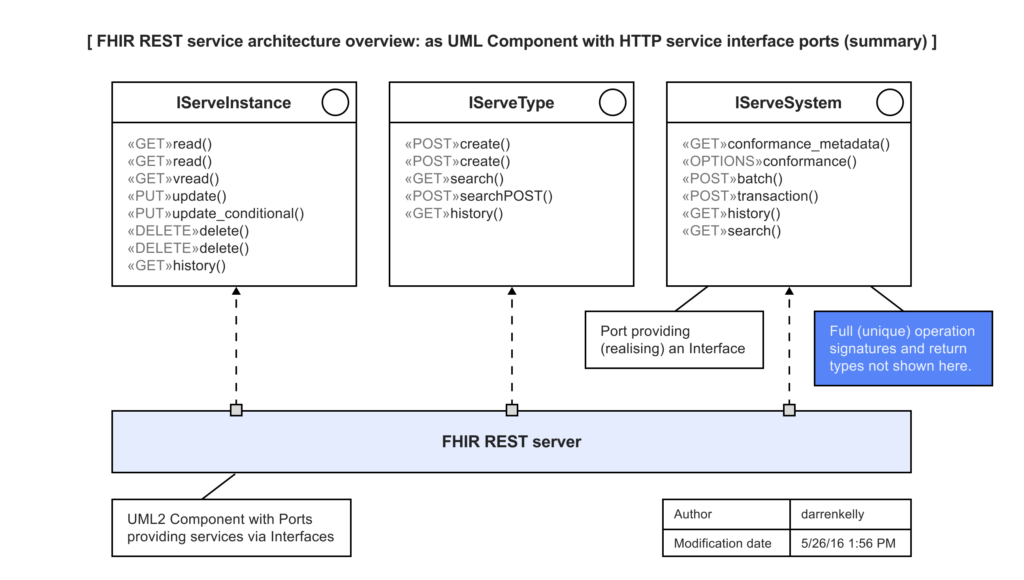
Most providers have data scattered across multiple systems: EHRs, lab software, devices, or insurance records. The first challenge is to build reliable data pipelines that ingest, normalize, and validate this information.
FHIR standards help enforce structure, but validation requires context; what counts as a “valid” lab result or procedure in one organization may differ elsewhere. Without this step, big data analytics in healthcare will always be limited by data quality issues or hidden gaps.
Centralized analytics only works if it’s secure and governed
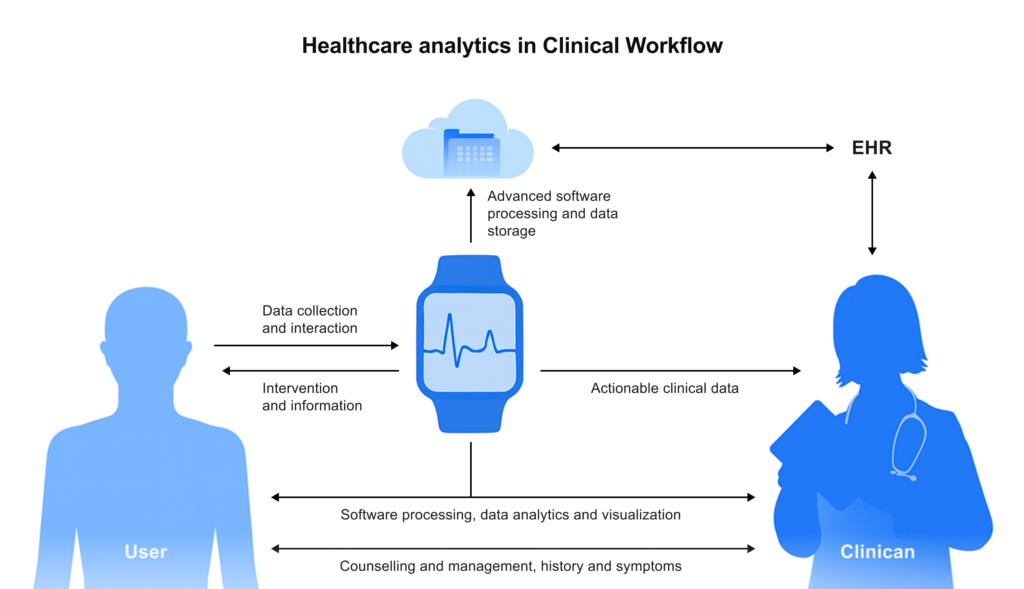
Patient-level data must be stored in a way that supports both granular analysis and strict privacy requirements. Access controls need to reflect real-world roles: clinicians, nurses, admin staff, and researchers. If this isn’t in place, data either remains locked away or is exposed to unnecessary risk.
Analytics engines must understand the medical domain, not just tables
Simple aggregation or visualization isn’t enough. Reusable logic—metrics, cohort definitions, clinical rules—should be built on an understanding of clinical entities, not just data fields. If your analytics can’t recognize that a blood pressure “130/80” is different from “80/130,” errors creep in, and trust is lost.
Terminology and unit harmonization are essential
Healthcare data comes with inconsistent coding and measurement units from different sources. An effective analytics pipeline must reconcile these differences, mapping and converting codes and units so that trends and comparisons reflect reality – not technical artifacts. Kodjin’s ability to validate and normalize units at the FHIR level is a practical example.
Visualization is only valuable after the groundwork is done
BI dashboards are still needed, but only after data quality, context, and domain-specific rules are enforced. If you skip the heavy lifting, your dashboard just visualizes confusion.
Context must drive design
Every metric or dashboard must serve a specific purpose, tied to a clear decision or workflow. Who will use it? At what point in the process? What action should it prompt? Without this focus, analytics becomes noise—just another tool that staff ignore.
The real differentiator is not the technology stack, but how well the analytics is embedded into the day-to-day reality of each role. Only then does the system deliver on the promise of better, faster, and safer decisions for organizations investing in data analytics in the healthcare industry.
Kodjin Analytics in real healthcare workflows
Kodjin Analytics is built for this exact path. It isn’t a generic BI layer; it is a healthcare-native analytics platform designed to slot into day-to-day work and grow with your organization.
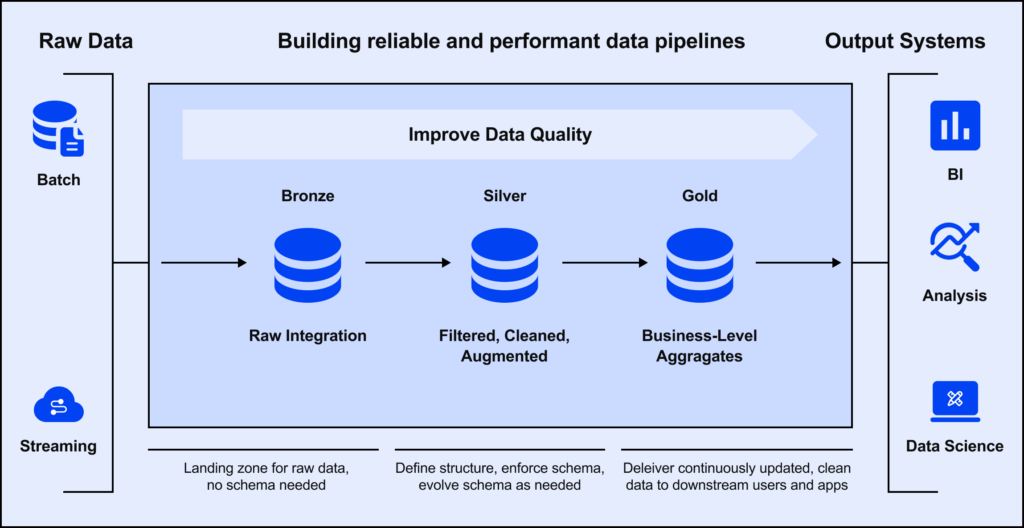
Traditionally, healthcare data pipelines often rely on the “medallion approach,” where data moves through three progressive layers:
- Bronze: Raw ingestion from source systems, with only minimal validation and transformation applied, just enough to make the data usable.
- Silver: The main transformation and validation stage, where core business rules, data quality checks, and normalization are enforced.
- Gold: Fully processed and reliable datasets, ready to power BI tools and analytics, where the data finally begins delivering value to users.
With Kodjin Analytics, this classic multi-stage process is simplified and accelerated. Kodjin reduces the time between raw data ingestion and real-world insights, so organizations start benefiting from their data much sooner. The FHIR-first architecture ensures that critical validation, terminology harmonization, and unit normalization happen in-line, without forcing teams to build patchwork solutions across the pipeline.
Management uses it to monitor operations and finances, but also to surface avoidable leakage: unfinished documentation, claims stuck for missing codes, or service lines drifting from targets.
Clinicians review treatment patterns and patient cohorts with context-aware metrics that respect terminologies and units, showing what changed since the last encounter and what the guideline suggests next. This makes patient data analytics and clinical data analytics directly usable at the point of care.
Researchers assemble outcomes and population datasets faster because validation, units, and code systems are handled in the pipeline rather than patched later.

Underneath, Kodjin’s FHIR-first architecture does the unglamorous work that generic tools skip: resource-level validation, terminology resolution, unit normalization, and profiling to define what “good” data means in your environment.
On top of that, teams can build queries visually or with more advanced builders; less technical users can reuse validated datasets without reinventing logic. Emerging natural-language and assistant features can accelerate query building, but the crucial piece is still the trigger: what should the system ask you to do, and when?
Edenlab’s role is hands-on. We align the platform to your goals, prepare and onboard your data, and help wire insights into existing workflows so they are actionable by default. Over time, the same stack that powered initial reporting extends cleanly into quality measures, clinical benchmarking, and payer collaboration, without replatforming.
See what “analytics-ready” looks like with a real FHIR semantic layer.
Read the case studyConclusion: Start small and build for transformation
You don’t need a big-bang transformation to get out of the dashboard rut. Pick one or two high-value use cases—closing specific care gaps, reducing avoidable denials, or exposing readmission drivers in line for a service line—and wire the analytics into the workflow so action is mandatory, not optional. Measure impact, then expand.
As you do, keep the core principle in mind: data analytics and healthcare must serve real decisions, not just generate charts. The importance of data in healthcare becomes tangible when actionable information in healthcare reaches the right person in time to change an outcome.
Edenlab partners with mid-size providers for the full journey: roadmap and architecture, data preparation, Kodjin Analytics configuration, training, and continuous optimization. If your current setup begins and ends with a BI dashboard, it’s time to review it. The tools you already have may be enough for the routine. To change outcomes, you need analytics that change the routine.

Ready to move beyond “pretty charts”?
Talk to Edenlab about an actionable analytics roadmap: from data validation and normalization to implementing Kodjin Analytics and embedding insights into real clinical and operational workflows.
FAQs
How can smaller healthcare providers start building a data warehouse?
Smaller healthcare providers can begin building a data warehouse by first clearly identifying the core business needs and regulatory requirements they must address. This typically involves selecting a scalable cloud platform, choosing data integration tools that can pull data from EHRs, billing, and other key sources, and adopting a phased approach: start with basic operational data and expand gradually. Open-source or healthcare-specialized solutions like Kodjin Analytics can reduce complexity, as they are designed to integrate with FHIR and support healthcare-specific validation and transformation workflows out of the box, minimizing both technical and staffing burdens.
What’s the role of clinical terminologies in healthcare analytics?
Clinical terminologies, such as SNOMED CT, LOINC, and ICD, are fundamental in healthcare analytics because they standardize how diagnoses, procedures, and lab results are represented. This ensures data from multiple systems can be aggregated, compared, and analyzed in a meaningful way. Effective analytics platforms automatically map and normalize incoming data to the appropriate terminology, enabling accurate cohort analysis, benchmarking, and outcome tracking across diverse data sources.
How does Kodjin Analytics support compliance with data privacy regulations?
Kodjin Analytics is designed with privacy and compliance at its core, leveraging a FHIR-native data model that includes fine-grained access controls, audit trails, and support for consent management. The platform aligns with major regulations, such as GDPR and HIPAA, ensuring that data access is logged and restricted by role, and sensitive data can be de-identified or masked as needed for analytics purposes. Integration with your organization’s existing identity management and consent workflows helps maintain continuous compliance without manual intervention.
How long does it typically take to implement a custom analytics solution?
The timeline for implementing a custom healthcare analytics solution depends on the complexity of your data sources, integration requirements, and the level of customization needed. For many organizations, an initial operational dashboard or reporting solution can be live within a few weeks if data sources are well-defined and standards-based. More complex implementations, such as those requiring extensive data cleaning, mapping, and user training, may take several months, but Edenlab’s hands-on approach and ready-made accelerators often reduce typical project durations.
What types of data preparation are required before analytics can be useful?
Before analytics can deliver meaningful insights, source data usually needs to be validated, cleaned, normalized, and mapped to standard terminologies and units. This includes deduplicating patient records, resolving inconsistencies, standardizing date formats, and ensuring that key fields (such as diagnoses or lab results) are coded appropriately. Tools like Kodjin Analytics automate much of this process, handling validation and normalization in the ingestion pipeline, which reduces manual data wrangling and ensures analytics-ready datasets.
How can analytics support value-based care or quality reporting?
Analytics platforms can support value-based care and quality reporting by providing real-time visibility into key clinical and operational metrics, such as care gaps, patient outcomes, cost of care, and adherence to guidelines. By aggregating and standardizing data from across the organization, analytics solutions can automatically calculate quality measures, flag at-risk patients, and generate reports required for payers or regulators. This helps providers identify improvement opportunities, track progress, and demonstrate performance under value-based contracts.
Stay in touch
Subscribe to get insights from FHIR experts, new case studies, articles and announcements
Great!
Our team we’ll be glad to share our expertise with you via email