
A patient arrives at the emergency department unconscious. The clinical team needs allergies, current medications, chronic conditions, and recent encounters — immediately. In most countries, that information is still scattered across EHR platforms, pharmacies, laboratories, and government registries. Health information exchange is not an abstract interoperability goal; it decides how fast and how safely that patient is treated.
This is the problem a national health information exchange (national HIE) exists to solve. It is not one big central database. It is a coordinated ecosystem of exchange services, standards, identity management, consent logic, security controls, and governance that lets authorized data move consistently across the healthcare system.
The hard part is not connecting systems — it is building a national health information network that protects privacy, aligns hundreds of stakeholders, and stays resilient under operational and cybersecurity stress.
This article looks at national HIEs from an implementation perspective: the architecture decisions that determine success, the failure modes that stall national programs, and lessons from real-world exchange models — including Edenlab’s own experience designing and building Ukraine’s national eHealth system, one of the world’s largest HL7® FHIR®-based systems in production.
What a National Health Information Exchange Should Deliver
A national health information exchange system lets authorized participants access and share patient data across organizational, regional, and platform boundaries. It typically connects regional health information networks, national registries, providers, payers, pharmacies, laboratories, and public health bodies under one governance and standards framework.
The model may be centralized, federated, or hybrid — but the goal is constant: get critical information where it is needed while enforcing consent and preserving trust.
In practice, a national HIE network must serve many use cases at once: continuity of care, emergency access, e-prescriptions, referrals, lab and imaging results, reimbursement, public health reporting, and eventually analytics. That is why a national HIE is an infrastructure program, not an application.
The health information exchange benefits are well documented: fewer data gaps at the point of care, fewer duplicated tests, better care coordination, stronger public health surveillance, and higher-quality data for planning. But those benefits only materialize when the exchange model is designed around real-world implementation constraints — not just technical connectivity.
Architecture Decisions That Determine National HIE Success
The right design depends on the country’s healthcare model, legal framework, digital maturity, and trust environment. But successful programs share the same core layers.
1. Centralized, Federated, or Hybrid Exchange Model
The exchange model defines where data lives and how it is accessed. Each option carries distinct trade-offs:
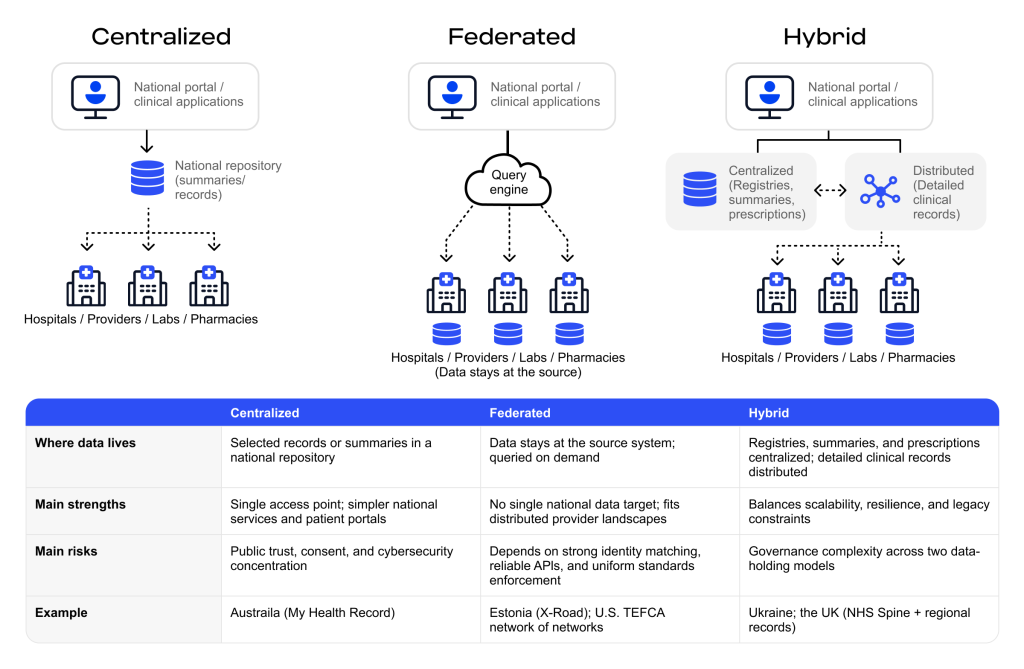
For most national programs, hybrid architecture is the realistic path: it balances scalability, resilience, governance, and the constraints of existing systems. In Ukraine, Edenlab combined a national clinical data repository for core records with decentralized storage and private EHR integrations — a deliberate hybrid choice that later proved critical to resilience.
2. Core Infrastructure and Operational Resilience
A national platform must handle enormous volumes of records, transactions, and participating systems. High availability, disaster recovery, performance monitoring, audit logging, and security controls are day-one requirements — Ukraine’s system was engineered to support a sustained load of 1,000 requests per second while serving 36.5 million user accounts.
Many programs underestimate this: a national HIE is not a launch project but a long-term operational platform requiring onboarding, incident response, compliance checks, and scaling under production conditions.
3. Standards for Semantic Consistency
Health information exchange and interoperability are related but not identical. A country can mandate a standard, yet remain fragmented if implementations diverge. National programs need more than a decision on FHIR® or HL7® — they need national implementation guides, profiles, validation rules, conformance testing, and terminology services that define how participants represent data, not just how they transmit it.
Modern networks usually support several health information exchange standards simultaneously: FHIR for API-first exchange, HL7 v2 for legacy messaging, DICOM for imaging, and terminologies such as SNOMED CT, LOINC, and ICD, all requiring mapping and governance.
Without this semantic layer, connected systems still produce incompatible data and unreliable analytics. Purpose-built tooling — such as a FHIR server with an integrated terminology service and validation — turns standards policy into enforceable practice.

4. Patient Identity and Record Matching
Identity is one of the most sensitive and technically demanding parts of national exchange: records from different providers must resolve to the correct person, and mismatches carry direct clinical risk. Some countries link records to a national identifier; others rely on a Master Patient Index (MPI) with probabilistic matching.
Ukraine illustrates why identity must be an architectural decision, not a downstream integration task. When the program began, the country had no registry suitable for primary identification — civil records were assigned to acts rather than people, and citizens could legally refuse a taxpayer number. Edenlab built a national Master Patient Index from scratch so every patient’s data connects to a unique digital profile, enabling both clinical exchange and government support programs.
5. Consent, Privacy, and Patient Trust
A national HIE needs a consent model that is understandable, enforceable, auditable, and consistent with regulation — who can access what data, for what purpose, under what conditions, with what logging. Frameworks such as the GDPR and HIPAA set the legal floor, but compliance alone does not create trust. Granular consent, patient-facing access logs, clear communication, and visible enforcement are what make national exchange legitimate in practice.
6. Cybersecurity, Data Sovereignty, and Resilience
Security must be designed into the architecture, not added after integration. One major breach can interrupt care and erode trust in the entire program. A resilient model includes encryption in transit and at rest, least-privilege access, multi-factor authentication, continuous monitoring, incident response, third-party testing, and explicit rules for cloud hosting and data sovereignty. Security is also a governance issue: every participating organization expands the risk surface, so shared security requirements matter as much as central controls.
7. Analytics Readiness and Public Health
Most national HIEs eventually support use cases beyond individual care: surveillance, vaccination tracking, population planning, reimbursement oversight, and policy evaluation. Analytics cannot be built on fragmented or poorly governed data. Designing terminology consistency, data quality rules, consent, and auditability into the exchange from the start is what makes trustworthy analytics possible later.
Where National HIE Projects Commonly Fail
National initiatives rarely stall because the vision is wrong. They stall because predictable implementation risks are addressed too late.
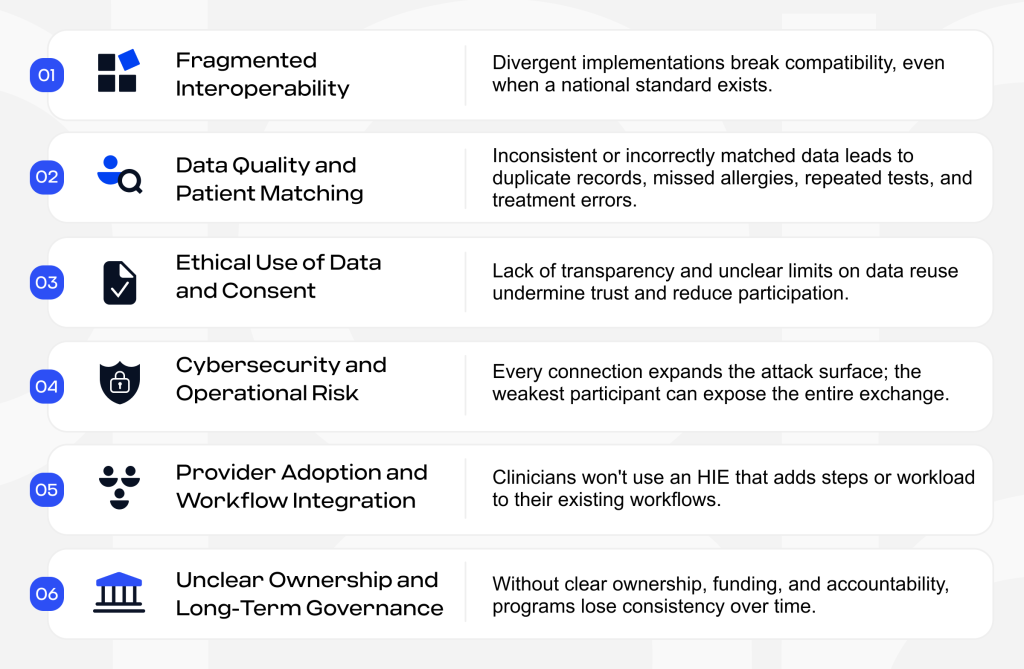
Fragmented Interoperability
Health systems run multiple EHR platforms, legacy databases, paper workflows, laboratory and pharmacy systems, and public registries. Even under a national standard, individual implementations diverge enough to break compatibility. The answer is to pair policy with implementation support: national FHIR implementation guides, validation tooling, conformance testing, integration sandboxes, onboarding support, and incentives that make modernization realistic for health information exchange organizations and providers alike.
Data Quality and Patient Matching
Inconsistent or incorrectly matched data produces duplicate records, missed allergies, repeated tests, and treatment errors. A national program must establish data quality rules early: required fields, validation, duplicate resolution, identity assurance levels, and governance for correcting errors. Machine-learning-assisted matching helps, but cannot substitute for a clear identity strategy.
Ethical Use of Data and Consent
If people do not know who accesses their records or how data may be reused, they resist national exchange — especially where private entities can monetize aggregated data without explicit protections. Opt-out models maximize coverage; opt-in models maximize patient control. Both require transparency, access logs, and enforceable limits on secondary use.
Cybersecurity and Operational Risk
Every connected system expands the attack surface. Ransomware, insider misuse, weak authentication, and insecure integrations become national-level risks. Security programs must impose shared requirements on participants — otherwise the least secure organization becomes the entry point into the entire exchange.
Provider Adoption and Workflow Integration
A technically sound HIE fails operationally if clinicians do not use it. Adoption suffers when the exchange adds documentation effort or steps to existing workflows in EHRs and health information exchange software at the point of care. A successful rollout requires workflow design, user testing, training, helpdesk support, feedback loops, and incentives for meaningful use — not just a launch announcement.
Unclear Ownership and Long-Term Governance
Programs lose consistency after launch without clear ownership, funding, and accountability. A long-term governance model must cover standards, onboarding, certification, security, consent, dispute resolution, and data quality.
Examples of Health Information Exchange: Lessons from Five National Models
Real-world examples of health information exchange show there is no single architecture that fits every country. Legal structures, digital identity maturity, public trust, funding, and legacy systems all shape the right model.
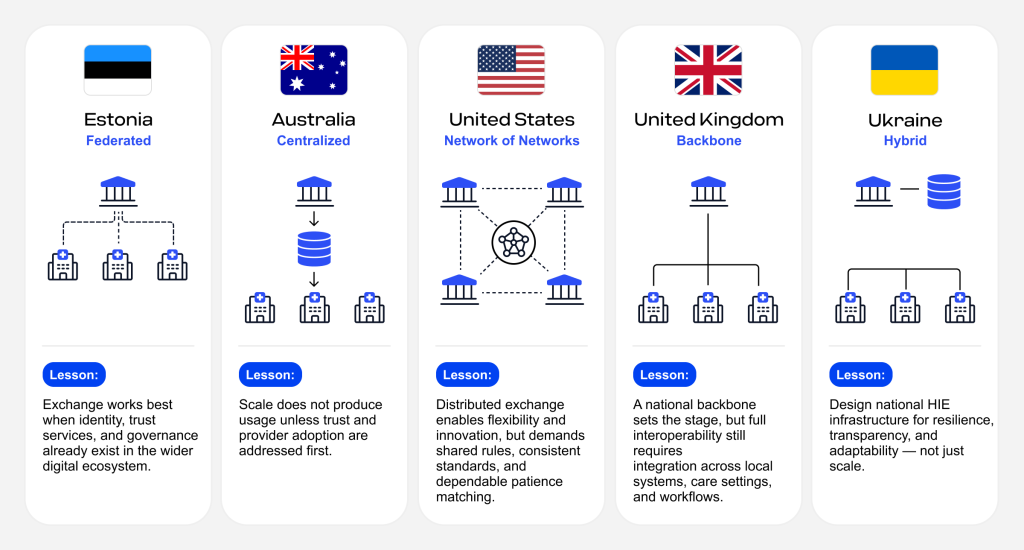
Estonia: Digital Identity and Decentralized Trust
Estonia’s health information network is built on strong national digital identity and the decentralized X-Road data exchange layer: records stay with source systems and are queried through the national infrastructure. The lesson: exchange works best when identity, trust services, and governance already exist in the wider digital ecosystem.
Australia: Centralized Access and the Trust Trade-Off
Australia’s My Health Record shows both the power and the cost of a centralized national record. When the program shifted to an opt-out model in 2018–2019, roughly 2.5 million Australians opted out amid privacy and security concerns — a reminder that scale does not produce usage unless trust and provider adoption are addressed first.
The United States: A Network of Networks
The U.S. has no single national HIE. It has a mix of regional, state, and private HIE networks, and each regional health information exchange organization historically set its own rules. TEFCA now establishes a common trust and governance framework across that landscape, with the first Qualified Health Information Networks designated in late 2023. The lesson: distributed exchange enables flexibility and innovation, but demands shared rules, consistent standards, and dependable patient matching.
United Kingdom: National Backbone, Regional Integration
The NHS Spine provides a national infrastructure layer for key services, while regional shared-record initiatives handle care coordination. The lesson: a national backbone sets the stage, but full interoperability still requires integration across local systems, care settings, and workflows.
Ukraine: Resilience and Modular National Infrastructure
Ukraine’s eHealth system — which Edenlab designed and built — demonstrates what a modular, FHIR-oriented national architecture delivers under extreme conditions. When the program started, only about 5% of Ukrainian healthcare organizations used any EHR, and most records were on paper.
Today the system serves more than 36.5 million users, and the national e-prescribing service alone has generated over 75 million e-prescriptions, with around 1.6 million created every month across 15,000+ participating pharmacies. Its public-private model, decentralized storage, unique patient identifiers, and API-first exchange have kept it operating through wartime infrastructure attacks. The lesson: design national HIE infrastructure for resilience, transparency, and adaptability — not just scale.
What to Consider from Day One
Early design choices determine whether the system becomes functioning infrastructure or another fragmented project. Plan national rollout across these domains:
- Governance model: ownership, participation rules, certification, compliance, dispute resolution, long-term funding.
- Exchange architecture: centralized, federated, or hybrid — chosen on legal, operational, and trust constraints.
- FHIR and standards strategy: national implementation guides, profiles, terminology rules, validation, conformance testing.
- Patient identity strategy: how records are matched, linked, corrected, and protected across providers.
- Consent and access control: rules that are enforceable, auditable, and understandable to patients and providers.
- Security and resilience: encryption, monitoring, incident response, disaster recovery, data sovereignty, third-party testing.
- Provider onboarding: integration support, training, workflow alignment, incentives for meaningful use.
- Analytics readiness: data quality, terminology, auditability, and governance layers that support future public health use cases.
How Edenlab Supports National HIE Initiatives
Edenlab helps governments, healthcare organizations, and technology leaders take interoperable health data infrastructure from strategy to production — aligning architecture, standards, security, governance, and rollout into one workable operating model.
That experience is grounded in real national-scale delivery. Edenlab designed Ukraine’s national eHealth system, one of the world’s largest HL7 FHIR-based projects in production: 36.5+ million users, 1,000 RPS sustained load, fault-tolerant national infrastructure, REST API access, electronic digital signatures, private EHR integrations, and a national clinical data repository in HL7 FHIR format. The same expertise underpins the Kodjin Interoperability Suite — a FHIR server, terminology service, and mapping tooling built to help national programs enforce standards in practice.
From architecture and FHIR strategy to platform engineering, integrations, governance, and analytics-ready data foundations, the goal is exchange infrastructure that is not only technically interoperable, but secure, scalable, trusted, and actually used.
Conclusion
The goal of a national health information exchange is simple to state: the right health information, to the right authorized users, at the right time. Implementation is the hard part. Success depends less on the storage architecture than on standards, patient identity, consent, security, governance, provider adoption, and public trust. National exchange is not a data-sharing project — it is a long-term infrastructure and trust project. The earlier those layers are built into the HIE network, the more likely it is to survive beyond the pilot stage.

From interoperability strategy
to FHIR implementation and secure data governance, we help governments and healthcare leaders design, build, and scale national health information infrastructures.
FAQs
What's the difference between a national HIE and a regional HIE?
Regional HIEs connect organizations within a particular region or provider group. A national HIE enables nationwide exchange, typically linking regional health information networks, national registries, providers, payers, pharmacies, laboratories, and public health organizations under a common governance and standards framework.
What are the main standards for health information exchange?
Common standards include FHIR for modern API-based exchange, HL7 v2 for legacy messaging, DICOM for imaging, and clinical terminologies such as SNOMED CT, LOINC, and ICD. National programs also need implementation guides, validation rules, and conformance testing to make those standards consistent in practice.
How does FHIR make health data exchange easier?
FHIR is an API-first approach to health data interoperability. It lets systems expose and consume structured data in a modular way, simplifying integration with applications and services. In a national HIE, FHIR works best when supported by national profiles, terminology rules, validation, and governance.
What is the biggest obstacle to national health information exchange?
Not any single technology — it is the combination of fragmented systems, uneven standards implementation, gaps in patient matching, unclear governance, privacy concerns, cybersecurity risk, and low provider adoption. National programs must address these collectively.
How do hospitals and health agencies establish a secure HIE system?
A secure HIE system combines identity and access management, least-privilege access, multi-factor authentication, encryption, audit logging, continuous monitoring, incident response, compliance governance, and periodic risk assessments — applied both to central infrastructure and to every participating organization.
Stay in touch
Subscribe to get insights from FHIR experts, new case studies, articles and announcements
Great!
Our team we’ll be glad to share our expertise with you via email