
The digital health market has already moved on from standalone tools. Healthcare software shifts toward connected systems, built to support collaboration between clinics, payers, researchers, public agencies, and patients. Teams move away from isolated apps and focus on modular platforms where different users and workflows can operate in the same space.
This reflects a broader shift in how a healthcare business operates, with value-based care, public programs, and research depending on data sharing and coordination. The same applies to public health programs, research initiatives, and modern care delivery models. All of them require systems that can interconnect, evolve, and scale. Building a healthcare technology platform answers that need.
Expert opinion
Health care is beginning to understand the economic power of platforms, especially in a data-rich environment. The industry is in an early phase of experimentation.

M.D., managing director of Digital Care Advisors
In this article, we’ll break down what makes a modern healthcare technology platform, how to think about its structure, and why platformization has become the natural direction for product teams who want to stay relevant and build for the future.
Highlights:
- Platform-first architecture is replacing one-off healthcare apps, helping medical businesses support more users, roles, and services in one place.
- FHIR® is becoming the global standard for health data exchange, with 73% of countries now recommending or requiring it.
- Security and compliance are a must from the start, with role-based access, consent tracking, and audit-ready infrastructure designed for real-world healthcare delivery.
Key Trends of Healthcare as a Platform
Healthcare is shifting from isolated tools to modular platforms that grow with the system, connect data and services, and adjust as new demands appear. Let’s review this and other trends of platformization.
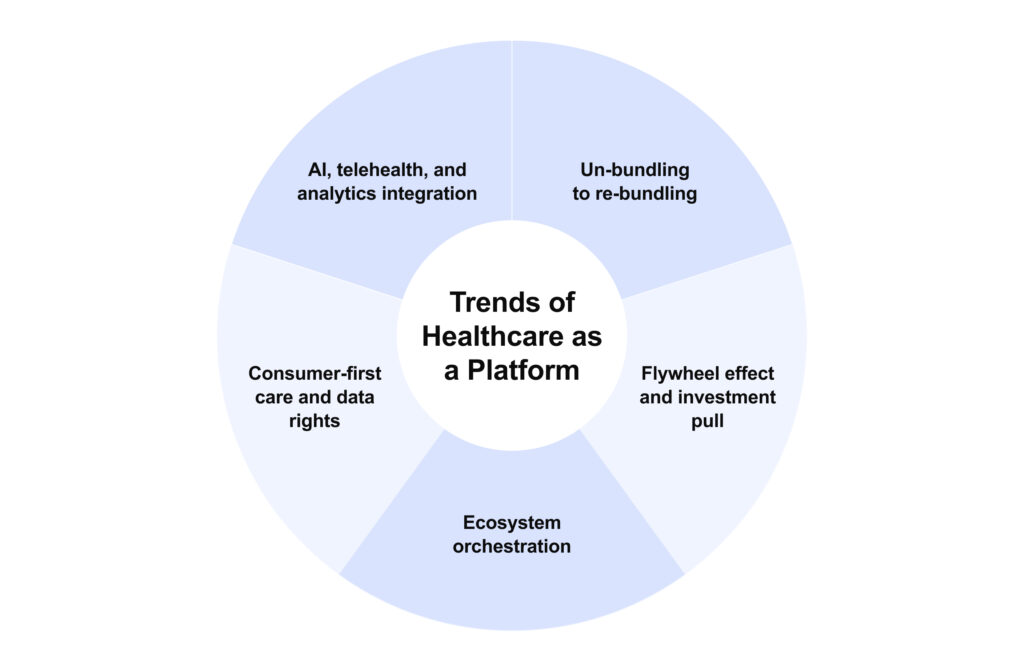
- Un‑bundling to re‑bundling. Healthcare used to rely on separate tools for every task: one app for billing, another for scheduling, and a third for analytics. It created messy, disconnected workflows. Now, platforms are bringing these tools under one roof, making it easier for care teams to work together and for patients to stay involved.
- Flywheel effect and investment pull. Platform adoption creates its own momentum. As more companies join, they bring partners and data with them, which adds value and draws even more users. This cycle is picking up pace, driven by steady funding and rising interest in digital health.
- Ecosystem orchestration. Leading organizations are coordinating networks of developers, device makers, payers, and clinics. Platforms serve as hubs that connect these actors, enabling value exchange across the system.
- Consumer‑first care and data rights. Patients now expect access to their data across settings and devices. Platform models support real-time interoperability and consent-driven data sharing, responding to the shift towards patient control and regulatory demands.
- AI, telehealth, and analytics integration. Many healthcare platforms now fold in AI, remote monitoring, telemedicine, and analytics as standard features. This shift turns platforms into smarter systems that learn, adapt, and support care in real time.
What Makes a Healthcare Platform Different from an App?
In healthcare, the word “platform” often gets tossed around without much precision. But when you’re planning to create a medical technology platform that will grow with you, it’s worth getting this difference right. A platform is designed for expansion, where you can build, add, and connect things over time.
An app usually does one job well. It might support a single workflow, such as scheduling, billing, or prescribing, and is shaped around its internal logic. A platform, by contrast, acts as the foundation. It connects different tools, data flows, and users into something cohesive. And most importantly, it stays open to what comes next.
Designing a platform from the ground up?
We are here to help. Check our
Healthcare Data Platform Development servicesThis matters for healthcare startups, too. Launching with a narrow app means locking yourself into a specific use case. Launching a platform gives you room to grow through partnerships and integrations. It lets others add value too: developers, data providers, and even entire health systems. Instead of building all the functionality yourself, you’re offering a structure where others can plug in. Here’s how the difference plays out in real life:
| Aspect | Application | End-to-End Platform |
| Purpose | Handles one specific task, such as booking an appointment | Acts as a base for different workflows, teams, and product directions |
| Structure | Built around a fixed use case with little room for change | A flexible setup that allows new features or services to be added over time |
| Workflow scope | Focuses on a single step or segment of the process | Supports everything from data collection and transformation to analytics and user actions |
| Data movement | Mostly keeps data inside its own logic, hard to sync with outside tools | Designed to connect with other systems through standards like FHIR or OpenEHR |
| Users | Often built for one group, like patients or doctors | Meant for many roles: developers, care teams, analysts, business users, and others |
| Flexibility | Comes with preset features that are hard to adjust | Can be tailored to fit complex setups and changing needs |
| Connectivity | Usually connects only through parent platforms or add-ons | Works well with external tools, APIs, and third-party systems |
| Security and access | Often needs extra work to meet privacy or security standards | Built with roles, consent, and compliance in mind from the beginning |
| Growth potential | Hard to adapt when new requirements or users come in | Can grow across teams and use cases without starting over |
| How it delivers value | Everything is owned and operated by one team with limited sharing | Allows others to build on top, re-use data, and extend functionality |
Why Platform Architecture Creates More Business Value
A well-designed platform helps your product grow in value, stand out in the market, and connect more easily with others. Here’s what it brings to the table:
- Better investor appeal. Platforms support more than one application or user type. That flexibility often attracts stronger interest from investors looking for long-term upside.
- Quicker feature rollout. When each module is independent, you can launch updates without slowing down or reworking everything.
- New revenue paths. You can open the system to other teams, apps, or services. That lets you earn not just from end users but also from partners building on top of what you’ve created.
- Easier changes over time. Whether it’s a new rule, new data type, or new workflow, you can adjust without a major rebuild.
- More value with every connection. As more users and services join, the platform becomes more useful to everyone involved. That makes it harder to replace and easier to grow.
Why Choose FHIR for Building Healthcare Technology Platforms
In healthcare tech, architecture choices shape what you can (and can’t) do later. That’s where FHIR comes in. Its adoption is growing fast across healthcare. What started as a data standard has become the default choice for building systems that need to connect and scale. According to Firely research, 78% of countries surveyed have formal regulations for electronic health data exchange as of 2025. 73% of them now recommend or require FHIR.
FHIR supports interoperability by design, making it a natural fit for platform-based products that must integrate with external tools, services, and workflows. That’s why so many teams are now building with FHIR from the start. At Edenlab, we’ve worked with FHIR from the early days. Our team has helped both public and private sector clients build systems where interoperability is baked in from the start.
One example is Elation Health, a top U.S. EHR vendor. The company teamed up with Edenlab to transition its EHR platform to a modern, FHIR-based architecture in response to new regulatory requirements. Instead of reworking their system from scratch, Elation Health used Edenlab’s modular setup to align with FHIR requirements and meet compliance deadlines quickly. This approach helped them get certified and made it easier to exchange data, connect to external apps, and extend their product without major rebuilds.

Core Components of a Modern Health Platform
A strong health platform starts with the proper structure. In this block, we explore the main components of a robust healthcare system.
The foundation of a healthcare platform is the data layer. Most of them today use HL7 FHIR to connect providers, registries, labs, and insurers. In Europe, OpenEHR is a more common choice for long-term storage and rich clinical records. Both make it easier to work across systems without writing endless custom connectors.
Cloud-native infrastructure gives you the flexibility to handle real usage, whether you’re launching a national system or testing a product with a few early users. You can roll out new services fast, without rethinking your architecture every time.
APIs help your platform plug into the tools your users already use, from pharmacy systems and mobile apps to third-party analytics. They keep everything in sync without forcing you to rebuild what already works.
Access control and data modeling handle the details behind the scenes. These tools define who can see what, based on their role, region, or organization. They’re also what make it possible to trace records, manage consent, and support clear data flows.
The final component is a business layer, the part of the platform that does something. This is where care teams assign patients to programs, where payers process claims, or where researchers run queries on real-world data. It’s where clinical logic, billing rules, or population health dashboards live.
Compliance, Security, and Scaling in Healthcare Platform Development
In healthcare, trust starts with how you handle data. Building a healthcare platform isn’t just about rolling out features. From the first line of code, you need to think about compliance, security, and the ability to grow without causing future problems.
Compliance
No matter if you work with providers, payers, or public institutions, your platform will handle sensitive health data. That means you must follow regulations, such as HIPAA, GDPR, and local interoperability standards like the ONC 21st Century Cures Act. These rules shape how you track access, store consent, and manage patient rights such as data access, sharing, or removal. The most resilient platforms are built with these needs in mind, not patched in later.
At Edenlab, we’ve helped clients meet complex compliance demands at scale, including national infrastructure projects with thousands of users and multi-level access models.
We helped launch Ukraine’s National E-Health system, a nationwide platform built from scratch that now serves over 36 million people. The system works on HL7 FHIR and connects thousands of providers and pharmacies through real-time APIs. It handles clinical data, prescriptions, referrals, and reimbursements. We also implemented pseudonymization, deduplication via machine learning, and fraud detection tools to meet strict regulatory and security demands at a national scale.
Security
Strong healthcare data security solutions aren’t just encryption and firewalls. It’s how your system behaves when multiple teams are using it across locations, departments, and access levels. This means:
- Role-based access control (RBAC) and attribute-based access control (ABAC): Users see only what they should. Rules combine roles with attributes like organization, location, purpose of use, data sensitivity, and time. Least-privilege by default, with just-in-time elevation and full audit.
- Data protection by design: Encryption, audit logs, and secure data flows that are implemented into every layer from the very beginning.
- Granular consent models: The platform supports detailed, verifiable consent for every patient or user.
These are part of how the platform handles core logic, workflows, and edge cases.
How to Build a Healthcare Technology Platform Step-by-Step
A modern healthcare platform evolves from real operational needs. It supports patient safety, adapts to regulatory pressure, and fits within the realities of healthcare delivery. Below is a simple process to help tech teams and healthcare leaders move from ideas to infrastructure:
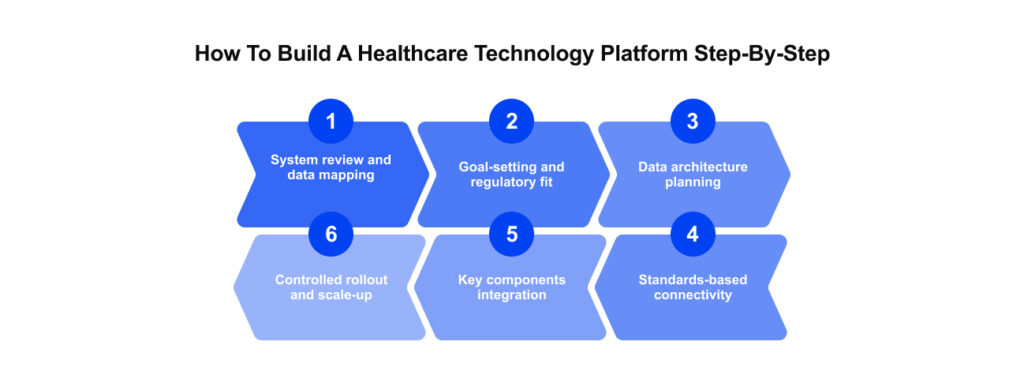
1. System review and data mapping
The first step looks at what’s already in place: data sources, integrations, and gaps in access or compliance. This stage helps define what can stay and what must change.
2. Goal-setting and regulatory fit
Platform goals take shape next, shaped by both business priorities and required regulations. Whether the focus is reimbursement speed or better care transitions, the system must also meet frameworks like HIPAA, GDPR, or local mandates.
3. Data architecture planning
This phase defines how data will move and where it will live. FHIR-based, modular, and cloud-ready architectures allow for better performance and long-term flexibility. Edenlab provides input here from architecture reviews to deployment blueprints. The platform contains the following layers and elements:
| Layer | Core elements |
| Data ingestion | HL7 v2, FHIR APIs, DICOM, CSV, EDI, custom devices; streaming/messaging for real-time; batch pipelines; API gateways. |
| Storage & management | Clinical/admin/operational stores; data mastering/golden records. |
| Processing & transformation | ETL/ELT pipelines; terminology services; de-identification/pseudonymization; data-quality and validation rules. |
| Security | Identity and access management; audit/logging; encryption; consent management; compliance frameworks. |
| Analytics & intelligence | BI/reporting; population-health analytics; AI/ML pipelines; clinical decision support. |
| Monitoring & operations | Observability stack; data lineage/provenance; cloud scalability; disaster recovery and backup. |
4. Standards-based connectivity
Connectivity gets defined through standards and open interfaces. FHIR, APIs, and consent-aware access ensure external systems can interact without custom workarounds.
5. Key components integration
Once the foundation is ready, the core components go in: patient portals, analytics dashboards, data sync with clinical systems, and rules for access control. Everything stays modular to keep future changes simple.
6. Controlled rollout and scale-up
Before wider use, the platform runs in a safe test setting. Synthetic data and user feedback help refine behavior. Rollouts happen gradually by department, provider group, or function.
Our Experience in Health IT Platforms Development
Edenlab focuses on building systems that go beyond standalone applications. Our healthcare product development services are rooted in platform thinking, helping health tech teams create flexible, modular solutions that are ready to scale and connect with others. Whether we take on the entire development process or support only the backend, the goal is to strengthen your product’s foundation and long-term potential.
We often collaborate with teams that shift from legacy systems to modern FHIR architecture and need a partner with expertise in data, interoperability, and compliance. In these cases, we take care of the platform infrastructure while our clients focus on what makes their product unique.
We recently collaborated with Heals.Asia, one of Hong Kong’s largest TPAs. Their legacy workflows for appointments and claims relied heavily on manual steps. Using the Edenlab Kodjin FHIR server and terminology service, we developed independent but connected modules for provider directories, appointment booking, and clinical data aggregation from multiple EHRs.
We also introduced a separate financial module with a flexible auto-adjudication engine that handles eligibility and claims workflows based on plan data. Each module was designed with its own business logic and custom FHIR profiles, enabling interoperability and scalability without locking the client into a rigid system structure.
Building healthcare platforms is complex and rarely means only code. In turn, it’s important to take care of structure, long-term planning, and a clear understanding of healthcare systems. We’ve done this across national projects and startup MVPs, and we’re ready to help you do the same.
Conclusion
If you want your healthcare product to grow, connect, and stay relevant, it needs to be more than just another app. In this article, we looked at what sets platforms apart: modular design, open standards like FHIR and OpenEHR, business logic layers, and the ability to evolve without rewriting everything. We covered core architecture, security, compliance, and how to scale while keeping full control.
Edenlab builds platforms that check all those boxes. We’ve worked on national-level infrastructure and startup MVPs alike. We understand how to combine fast delivery with long-term flexibility using open APIs, cloud-native tech, and ready-made tools like Kodjin to keep teams moving.
We’ve helped national governments launch digital health infrastructures. We’ve worked with early-stage startups to ship their first FHIR-first MVPs. Whether the challenge is scale, speed, or interoperability, we bring the platform thinking and technical depth to make it work without locking you into rigid architecture.
Our focus is modular, standards-based healthtech platform development. That means you get the freedom to add features, swap tools, or bring in new partners without starting from scratch. And with tools like the Kodjin FHIR Server, you don’t have to reinvent the backend; you can move faster, stay compliant, and stay focused on the product layer that sets you apart.

Build the healthcare platform your product deserves
From modular EHR backends to full-scale national data platforms, we help teams design systems that grow with them. Whether you're building from scratch or evolving your architecture, Edenlab brings the tools and experience to get you there.
FAQs
Should we build our own healthcare platform or buy something premade?
If your setup is complex or you want full control, creating a healthtech platform is the better path. It lets you design around your data, users, and rules. Buying off the shelf can be faster, but it often brings limits you’ll have to work around later.
What hidden work or costs come with building a platform from scratch?
It’s not just writing code. You’ll need to plan how different systems talk to each other, test your integrations, manage permissions, and stay compliant from the start. Standards like FHIR or OpenEHR help, but they still take time to do right. Skipping this early work usually means headaches later.
Can modular design really help us avoid vendor lock-in?
Yes. When parts of your system can run independently, you can replace or improve them without rebuilding everything. It also gives you more control over updates and pricing; you’re not tied to one vendor’s roadmap or stack.
How do we make sure the platform won’t fall behind on rules or standards?
Build with open formats, like FHIR or OpenEHR, and set up proper access controls, logs, and consent tracking from the beginning. If these are baked into the system, you’ll be ready when local or international rules change.
What’s the actual difference between a data platform and an interoperability layer?
An interoperability layer just moves data between tools. A platform does more: it holds the data, gives people secure access, and runs the business logic on top. It’s where decisions get made, records stay consistent, and teams actually do their work.
Stay in touch
Subscribe to get insights from FHIR experts, new case studies, articles and announcements
Great!
Our team we’ll be glad to share our expertise with you via email