
The term “clinical analytics” is a method for systematically analyzing health data with the goal of improving patient care and business processes. It entails gathering and analyzing data from various sources, including medical imaging, claims, surveys, wearables, electronic health records (EHRs), and more, employing quantitative and qualitative techniques.
In modern programs, especially clinical analytics based on FHIR®, teams focus on interoperable data models so that insights travel across systems. This method aids in the discovery of trends that can improve healthcare system efficiency and patient care by supporting evidence-based, outcome-driven decision-making.
Indeed, in order to accomplish the worldwide objectives of providing fast, effective, equitable, and outstanding treatment, experts argue that clinical analytics must be implemented across healthcare systems.
Even though there is a deluge of clinical data available thanks to the broad use of EHRs, doing nothing more than installing an EHR system would not necessarily result in better quality or insightful understanding. By transforming raw data into actionable knowledge, analytics is the secret to releasing the value of this data.
Why Is Clinical Analytics Important?
Providing high-quality treatment while keeping costs down and meeting stringent standards is a huge challenge for healthcare organizations today. To overcome these obstacles, clinical analytics gives the necessary insight.
For instance, medical facilities must learn which therapies work best for certain diseases. Among insurance firms’ goals is the detection of fraudulent activity and the evaluation of claim risk. Early detection and response are crucial for public health officials in the event of a disease epidemic or new health trend. In each of these instances, effective analytics enables the sorting through of massive data sets to derive actionable insights.
Despite the significance, analytics adoption is not a level playing field for all organizations. Getting data digitized and collected is still the primary goal of many large health systems when it comes to healthcare data sharing; yet, they have not yet properly utilized this data for insights. It might be difficult for smaller clinics, startups, and research groups to access high-quality datasets from disparate sources, making it difficult for them to implement advanced analytics or even AI.
On the flip side, hospitals collect a lot of patient data with electronic records and monitoring equipment, but they might not have the data science staff or the right tools to properly evaluate it. These differences bring attention to a fundamental truth: clinical analytics is important for all, but removing obstacles to data integration is the key to realizing its full potential.
Use Cases of Clinical Analytics Across Healthcare
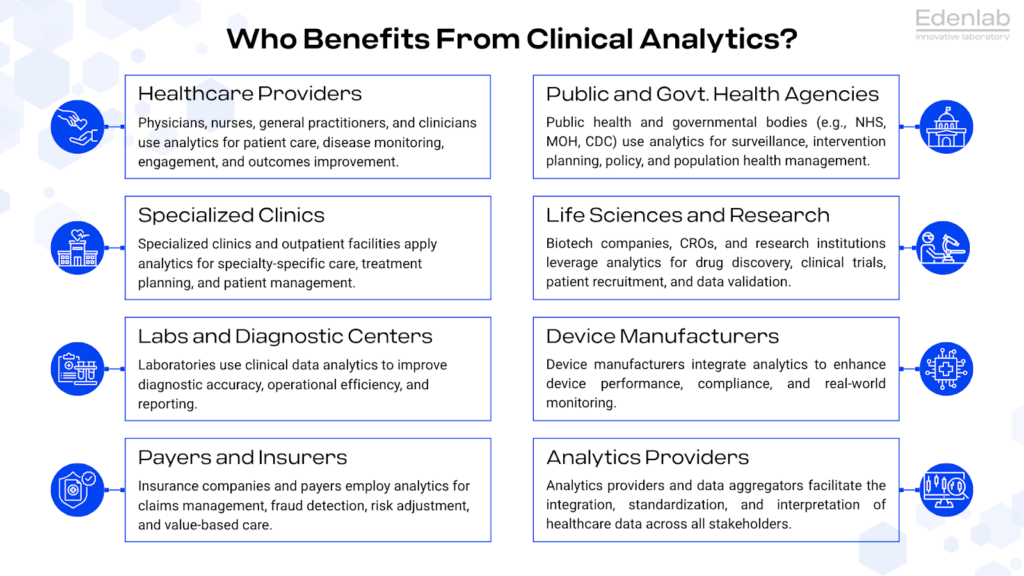
Analytics help hospitals track patient populations, forecast deterioration, and support evidence-based treatment practices. For instance, clinicians can follow vital signs and test data patterns to detect sepsis and other problems early. Past surgery outcomes assist surgical departments in determining which procedures improve recovery durations, enhancing treatment quality and efficiency.
Analytics are useful for health insurers in reducing fraud and managing risk. By reviewing claims data and clinical results, payers can identify patients at risk for financial loss due to dubious billing practices or those who would gain from care management programs. Analytics aid insurers in identifying cost-effective suppliers by prioritizing efficiency and quality above quantity.
Public health authorities use clinical analytics for epidemiological surveillance and health planning. They can spot epidemics or worrying patterns by combining regional vaccination, infection, and chronic illness data. Public health professionals may allocate resources and arrange interventions like vaccination programs and health warnings in the most needy regions using this data-driven approach, potentially preventing health disasters.
Pharma and biotech businesses employ analytics throughout drug development and distribution. AI-generated medicine research can find new drug candidates or targets by analyzing massive studies and real-world data. Analytics helps clinical trials pick the correct patient populations and evaluate their reactions in real time, speeding up and improving studies. After medications hit the market, pharma firms examine patient adherence and results to identify efficacy and safety issues across groups.
Internal vs. External Analytics Resources
Organizations must decide between using internal or external resources when deploying clinical analytics. Internal analytics resources are the data scientists, informaticists, and IT personnel who work within a healthcare company to create and oversee analytics solutions.
These internal teams can create unique dashboards, adjust analytics to the organization’s specific requirements, and have complete control over the data on secure internal servers. This is why a lot of big health systems put money into analytics departments or centers of excellence in-house.
Alternatively, you can use external analytics resources, which entail bringing in outside solutions or knowledge. This could be in the form of consulting, buying a proprietary healthcare solutions stack, or even just employing analytics services in the cloud.
One way to speed up deployment is by utilizing external solutions. These solutions usually come with pre-built models, tools, and support. But data security and vendor lock-in problems may arise, and they may be less configurable.
A third option exists: some companies outsource the actual tool configuration and extension to internal staff. Factors such as company size, available funds, talent pool, and strategic ambitions frequently play a deciding role. In contrast to smaller clinics that may choose to opt in to an analytics software service, larger hospitals with strong IT departments may construct their own custom analytics warehouse.
Whether analytics are conducted in-house, with external partners, or through a combination of the two, it is essential that they are in line with the organization’s objectives.
Current EHR and Data Analytics Solutions: Gaps and Opportunities
Although they are often restricted in scope, most current EHR systems do have reporting and analytics capabilities. Instead of concentrating on large-scale data analysis, traditional EHRs are more concerned with documenting and retrieving individual patient information.
As a result, healthcare companies typically export EHR data to independent data warehouses or analytics platforms for more advanced analysis (for example, merging clinical and financial or operational data). It can be difficult to interchange data between systems due to the fact that many EHR suppliers utilize proprietary data formats, which create closed ecosystems and complicate data exchange in healthcare, especially when integrating with proprietary healthcare solutions.
Historically, data silos — information locked in one application and inaccessible to other applications due to a lack of interoperability — have been the norm. Data aggregation can be challenging even when data can be exported due to discrepancies in data definitions and granularity. For example, separate systems may record a patient’s medicine in different structures or coding systems, which can make merging and analyzing the data more difficult.
Plus, as said before, there is no assurance that the data will be utilized optimally just because an EHR is in place. To close the gap between healthcare companies’ analytical demands and transactional EHR systems, innovative solutions are needed to fill these gaps. A standardized method to collect and consolidate healthcare data for analysis is provided by integrating FHIR into clinical analytics, which is where the challenge begins.
The Role of FHIR in Data Preparation and Integration
It is common practice in clinical analytics to use an ETL method, which stands for “Extract, Transform, Load,” to retrieve data from various sources, standardize it, and then put it into analytics tools. Although it gets the job done, this method can be difficult, time-consuming, and resource-intensive.
One of the primary challenges with healthcare analytics is that data is spread out and not always uniform across different platforms. Some organizations have trouble getting data, while others don’t have the tools they need to analyze it properly.
A lack of standardized datasets is a common problem for public health organizations, research institutions, and regulatory authorities when trying to aggregate data. On the other hand, clinical and medical settings naturally gather massive volumes of data, but they often do not have the means to derive useful insights from it.
FHIR acts as a critical middleware, bridging the gap between disparate data sources and analytics platforms. This is the core of clinical analytics and FHIR integration: it ensures that only validated, structured, and complete data enters analytics workflows, preventing errors caused by inconsistencies or missing information.
Unlike traditional approaches that rely on manual data cleansing processes, FHIR automates validation through its built-in profiling and standardization mechanisms. This allows organizations to focus on the analytical process itself rather than dealing with raw, unstructured, or inaccurate data.
While FHIR does not perform statistical analysis or visualization, it lays the foundation for analytics by creating a reliable, structured dataset. Without proper data validation, analytics results can be misleading, leading to incorrect conclusions and flawed decision-making. By acting as a filtration and normalization layer, FHIR helps ensure that analytical models receive high-quality input, ultimately improving the accuracy and reliability of healthcare insights.
Implementing FHIR in a Proprietary Clinical Analytics Solution
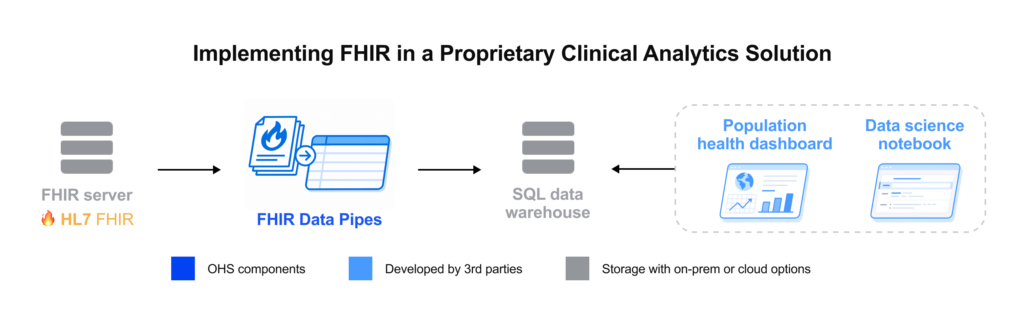
For organizations with a proprietary clinical analytics and FHIR initiative, implementation involves several practical steps. First, the proprietary analytics platform must be able to communicate with FHIR servers (the systems that host FHIR APIs for EHRs or data repositories).
This typically means configuring secure connections and authentication to a FHIR API for healthcare analytics, since patient data is sensitive. Once connected, the next step is mapping the data: each analytics metric or field needs to correspond to the appropriate FHIR resource and field.
One of the challenges is ensuring that the data extracted via FHIR is optimized for analysis. FHIR data is highly normalized (spread across many resource types and links between them), which is great for healthcare data interoperability but can be complex for direct analytics use. Thus, teams often have to transform and aggregate FHIR data into a schema suitable for analytics, for example, joining a patient’s multiple FHIR resources into one consolidated record in a data warehouse.
Optimizing FHIR data for analytics might include filtering out unnecessary details, translating codes into user-friendly labels, and flattening nested FHIR structures into tabular formats. Some organizations use intermediate staging databases or “FHIR-to-SQL” converters that take FHIR JSON and load it into relational tables for easier querying. The goal is to retain the richness of the clinical data while making it queryable for analysts and data scientists within proprietary healthcare solutions.
Another key aspect is performance. Analytics often involves querying large volumes of data (e.g., all lab results in the past year for thousands of patients). Pulling this through a live FHIR API can be slow if not managed well. Caching strategies, incremental data updates, or using bulk FHIR data export (a feature of FHIR that allows exporting data in bulk files) are techniques to consider. Essentially, implementation needs to balance using the FHIR standard as a data intake mechanism with the reality that effective analytics may require additional data engineering.
Overcoming challenges in FHIR Integration
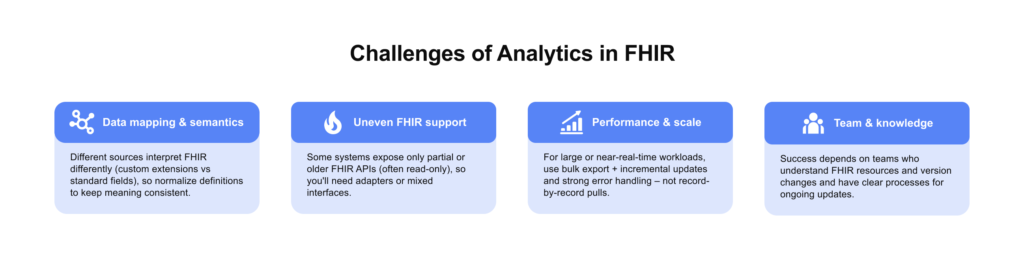
Integrating FHIR into an existing analytics solution is not without challenges. One major implementation challenge is data mapping and consistency. Different healthcare organizations might use the FHIR standard slightly differently or have custom extensions for certain data. If your proprietary solution is pulling from multiple sources (say, two different EHR systems via FHIR), you may find that one hospital records social history in a custom extension while another uses standard fields; your analytics pipeline must handle these variations.
As industry experts point out, standards like FHIR still have inconsistencies in how they are applied in practice. Ensuring consistent definitions (semantic interoperability) is crucial so that, for example, a diagnosis code or lab result means the same thing across sources.
Another challenge is that not all systems fully support FHIR yet. While many major EHRs offer FHIR APIs (especially for reading data), some legacy systems may lack this capability or only implement older versions of FHIR. There can also be limitations, such as only exposing certain data types via FHIR or not supporting write-back (which may be less of an issue for analytics if you’re mostly reading data).
Bridging these gaps might require custom adapters or continued use of traditional interfaces alongside FHIR. In some cases, getting to a truly comprehensive data set might require combining FHIR data with other data extracts if certain fields aren’t available via FHIR.
Performance and scalability are additional concerns. If the proprietary analytics solution scales to large data volumes or real-time analysis, the FHIR interface must handle high-throughput data access. This might involve working closely with EHR vendors or using bulk data endpoints and then updating incrementally rather than pulling data record-by-record. Robust error handling is also important; network issues or malformatted data from a source could disrupt the analytics pipeline if not properly managed.

Lastly, there is an organizational challenge: adopting FHIR requires not just technical changes, but also training and mindset shifts. The team managing the analytics solution needs expertise in FHIR resources and must stay updated with the standard’s evolution (FHIR is updated periodically). Cultivating in-house knowledge or choosing a technology partner familiar with FHIR can mitigate this.
Regulatory and Compliance Considerations
Whenever clinical data is involved, regulatory considerations are paramount. Integrating FHIR into clinical analytics doesn’t change the fundamental need to protect patient privacy and comply with healthcare regulations — it simply changes the way data flows. Health data privacy laws like HIPAA in the United States (and GDPR in Europe for patient data) set strict rules on how patient information is used, stored, and shared.
A FHIR-based integration must ensure that any data requests comply with patient consent and data use policies. For example, if analytics is being done for quality improvement or operations, it typically uses de-identified or aggregated data to avoid exposing personal health information unnecessarily. Using FHIR as a data source means that developers should carefully scope the API queries to fetch only the minimum necessary data fields for analytics purposes, an approach aligning with privacy by design.
There are also regulatory standards and incentives driving the use of FHIR. For instance, the 21st Century Cures Act and associated regulations in the U.S. require that EHR vendors provide APIs (often FHIR-based) for data access and prohibit “information blocking.” This climate encourages the use of standardized APIs for interoperability. An organization integrating FHIR should thus ensure that it is leveraging these APIs in compliance with licensing or usage guidelines set by the EHR vendor or data source.
Additionally, when combining data from multiple sources via FHIR, one must be mindful of data governance — maintaining an audit trail of where data came from, how it was transformed, and who has accessed it. This is important not only for compliance, but also for trust in analytics results (provenance tracking helps validate that the data is credible).
Security is another critical consideration. FHIR APIs must be secured with authentication and authorization protocols (such as OAuth 2.0 with SMART on FHIR) to ensure only authorized systems and users can retrieve data. Any proprietary analytics solution using FHIR will need to manage secure credentials and potentially handle token refreshes and permissions for each data source. Compliance audits might require demonstrating that appropriate safeguards (encryption, access controls, etc.) are in place for the data pipeline data exchange in healthcare and clinical analytics.
Real-World Use of FHIR in Clinical Analytics and Best Practices
1. Managing Data Granularity
FHIR’s strengths in representing highly granular data, such as individual lab results in Observation resources, can also overwhelm analytics pipelines if left unfiltered. To address this, projects like SQL-on-FHIR enable converting nested FHIR data into tabular structures, allowing data engineers to choose precisely what to import — like daily averages instead of every reading — to keep analytics clean and performant. This aligns with best practices advising that excessive granularity (“drowning in data”) should be pre-empted by requesting only analytics-relevant summaries.
2. Aggregating Cross-Source Data
Large-scale analytics often require merging records from different clinical systems — labs, admissions, pharmacy, etc. — which challenges patient identity alignment and context preservation. A JMIR Med Inform review emphasized that while FHIR supports semantic normalization across multiple resource types (Observation, MedicationRequest, Encounter), organizations also need robust identity management and join logic to ensure accurate analytic outputs.
3. Use-Case-Driven Integration
Instead of loading “all the data” and figuring out analytics later, experts recommend starting with focused use cases, such as tracking surgical site infections within 30 days post-op or supporting FHIR prior authorizations, and mapping only the required FHIR resources to address that question. For example, specific concerns (medication management, decision support) can guide data extraction via precise FHIR resources.
4. Iterative, Scalable Development
Large populations and high data volumes make it impractical to load and analyze everything at once. Research using PostgreSQL and preprocessing frameworks at Erlangen-Nürnberg University Hospital demonstrates how organizations can stage FHIR data in manageable subsets for statistical analysis, then iterate and scale gradually. Further, the SQL-on-FHIR work underlines the value of iteratively optimizing FHIR-to-table logic as usage grows.
Conclusion
Integrating FHIR with a clinical analytics platform marries the strength of interoperability with the power of data-driven insight. We have explored how clinical analytics and FHIR integration can transform raw health data into meaningful improvements in care and efficiency.
By using FHIR’s standardized API and data format, proprietary analytics solutions can break down data silos and ingest information from various sources in a consistent way. While there are challenges in implementation — from technical mapping issues to ensuring compliance and managing data volume — the benefits of FHIR for healthcare data analytics are compelling.
Organizations that successfully harness FHIR in their analytics workflows gain agility in accessing data and can more easily adapt to new data sources or regulatory requirements. They also position themselves at the forefront of health IT innovation, leveraging a technology that is increasingly an industry standard. In an era where healthcare decisions are increasingly data-driven, the ability to use a FHIR API for healthcare analytics offers a competitive edge: it ensures that decision-makers have timely access to comprehensive, well-structured data.
Ultimately, the integration of FHIR into clinical analytics is a key step toward a future of healthcare that is not only digitally connected but also intelligently informed by the wealth of data at our disposal. By optimizing data exchange and analysis in tandem, healthcare organizations can better navigate the complex “murky swamp” of healthcare data and emerge with clearer insights that benefit patients and providers alike.

Ready to accelerate your clinical analytics with FHIR?
Contact our experts today to discuss how Edenlab can help optimize your data integration and analytics workflows.
FAQs
Why should I integrate FHIR into my clinical analytics solution?
By standardizing the flow of data from EHRs, laboratories, devices, and claims into your analytics stack, FHIR integration into clinical analytics improves data quality and traceability while speeding up time-to-insight. You can expect data that is compatible with other systems (FHIR resources + profiles), validation that is strong, audit trails that are easier to clean up, and the ability to scale up for more complex use cases (predictive models, quality KPIs, population health).
How long does it take to implement FHIR?
Each project is unique; it highly depends on scope, source systems, and readiness.
Can you help with regulatory compliance?
Yes, our solutions align with HIPAA, GDPR, and information-blocking rules via minimum-necessary access, SMART on FHIR/OAuth2, encryption in transit/at rest, audit logs and provenance, consent and data-use controls, de-identification/pseudonymization pipelines, retention and access policies, and the documentation regulators expect to support audits and ongoing governance.
Stay in touch
Subscribe to get insights from FHIR experts, new case studies, articles and announcements
Great!
Our team we’ll be glad to share our expertise with you via email