
Contact us

Preparing wearable data for an Austrian research institute to enable real-time, GDPR-compliant, and EHDS-aligned use of PGHD for preventive and personalized care 

Enabling EHDS-aligned research through cloud-based FHIR integration of wearable health data
Ludwig Boltzmann Gesellschaft
  • 18 publications, including the International Journal of Medical Informatics and Studies in Health Technology and Informatics
  • Winner of the Austrian Nexus Digital Health Innovation Challenge
  • Finalist of the X-eHealth Interoperability
Project summary Business goal Solution Innovation Value delivered

Project summary

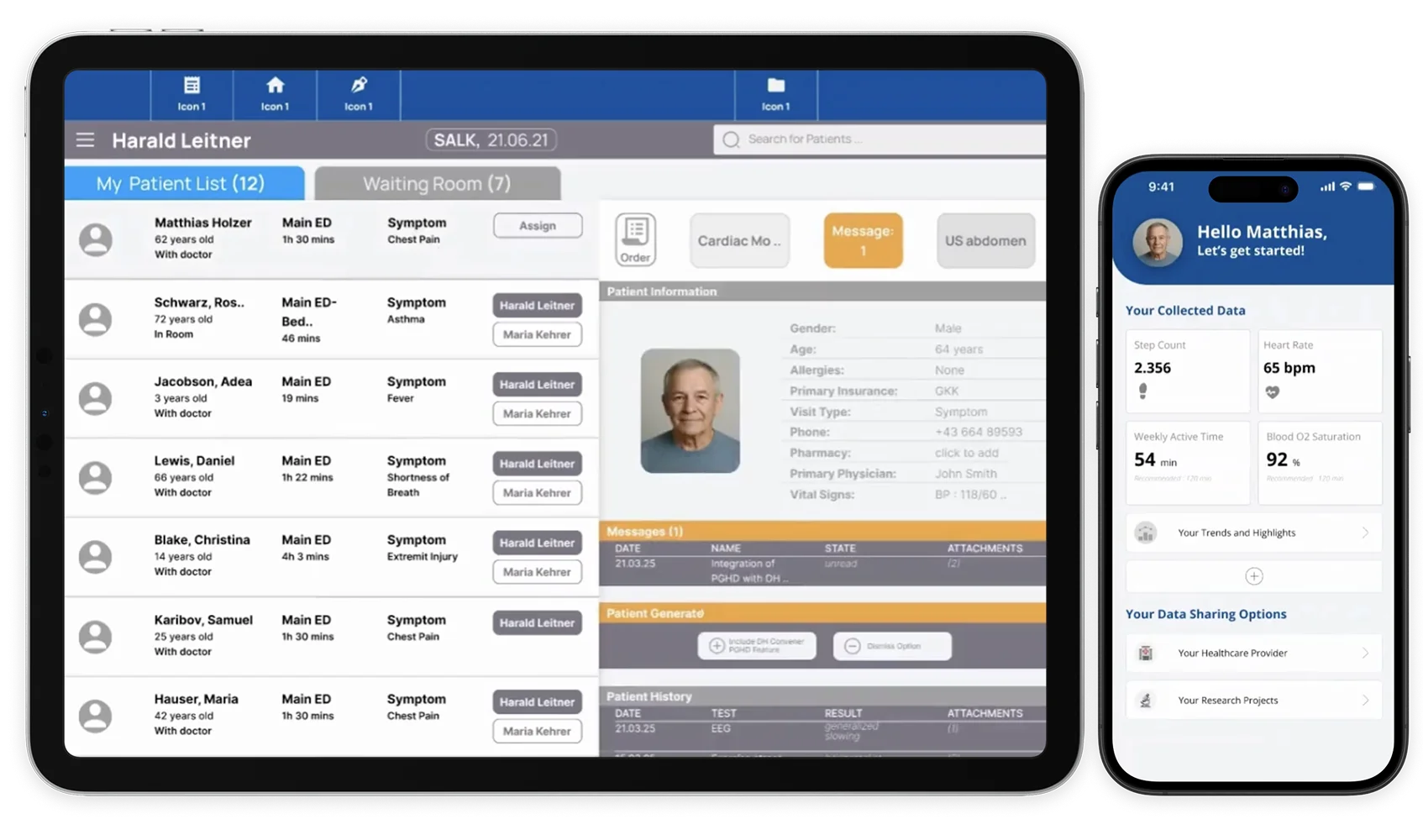
The Ludwig Boltzmann Institute for Digital Health and Prevention (LBI), an Austrian research institute advancing digital health innovation, set out to pioneer a real-world model for integrating Patient-Generated Health Data (PGHD) from wearables into clinical and research workflows. In collaboration with Edenlab, LBI implemented a cloud-based, FHIR-native platform that transforms real-time data from Garmin devices into standardized, interoperable health records. This solution became one of the first practical demonstrations of how EHDS-aligned, GDPR-compliant PGHD can be securely shared and reused for research and preventive care.

Business goal and challenge

LBI sought to validate how wearable-derived health metrics could be integrated into research and clinical environments to enrich understanding of patient health beyond traditional settings.

The institute initiated the Digital Health Convener (DH-Convener) project, which aims to build an interoperability- and security-as-a-service platform for integrating PGHD with EHRs. The goal was not only technical but also regulatory and conceptual: to prove that PGHD can be safely incorporated into the EHDS ecosystem as a legitimate and reusable data source.

The main challenge was to design an interoperable, GDPR-compliant, and future-proof infrastructure that enables researchers to securely use real-time PGHD while laying the foundation for future clinical integration, giving participants full control over their patients’ data privacy.

Enabling EHDS-aligned research through cloud-based FHIR integration of wearable health data

The solution

The platform streams wearable PGHD from Garmin devices into a FHIR-native backend on AWS, so researchers and clinicians can use near-real-time metrics alongside clinical data, securely and with GDPR-aligned consent. FHIR Server handles mapping and storage – teams get standards-based data they can trust for research and care. The ecosystem follows Findable, Accessible, Interoperable, and Reusable principles, ensuring research-grade data governance aligned with EHDS standards.

Key solution components and features:

Real-time PGHD ingestion

Continuous capture from Garmin Vivoactive 4 via Fitrockr, prepared with the Fitrockr data dictionary for consistent downstream use.

Modular Open Research Platform (MORE)

Supports the collection of patient-reported outcomes, experience measures, and digital questionnaires, extending the dataset beyond physiological metrics to behavioral and subjective insights.

FHIR mapping engine

Edenlab’s Kodjin Data Mapper (Liquid templates) converts raw metrics to FHIR Observation and QuestionnaireResponse resources for plug-and-play use across systems.

Consent & GDPR controls

A participant portal manages sharing preferences, including exclusion of sensitive items; all transfers are encrypted end-to-end.

Secure FHIR storage & APIs

Edenlab’s Kodjin FHIR Server on AWS provides a secure, cloud-based environment where wearable and self-reported data are stored in a standardized FHIR format, ready for cross-system exchange and integration into research or clinical workflows.

Digital Health Convener (DH-Convener) data model

Aligns all collected data with openEHR and OMOP frameworks, enabling semantic interoperability and standardized reuse of PGHD in secondary research and innovation projects. 

Use cases for end-clients (providers and researchers):

Continuous data collection and digital biomarkers

Collect continuous heart rate, activity, stress, and sleep data from wearables in near real time to support prevention studies and digital endpoint validation without increasing clinical workload.

PGHD-to-EHR interoperability

Integrate wearable health insights directly into existing research or clinical data environments, allowing teams to view and analyze real-time patient-generated information alongside medical records for a more complete picture of health and outcomes.

Consent-driven research data sharing

Collect participant consent once, govern use centrally, and share de-identified datasets for research while meeting GDPR obligations.

Scalable multi-device programs

Extend beyond Garmin by adding new connectors and mappings, keeping one semantic model and API surface as programs grow.

Enabling EHDS-aligned research through cloud-based FHIR integration of wearable health data

Edenlab’s innovation

Edenlab addressed one of the fundamental challenges in digital health – the inability to make patient-generated data from wearables usable within regulated healthcare and research environments. We transformed fragmented, non-standardized data into a secure, interoperable, and regulation-ready format, effectively bridging the gap between personal health tracking and compliant, EHDS-aligned medical data use.

Challenges Solutions
Challenge

Fragmented data sources and inconsistent semantics

Wearable, survey, and research data originated from heterogeneous systems (Garmin, Fitrockr, MORE), each using its own schemas and identifiers, making standardization across research environments nearly impossible.

Solution

Centralized interoperability model

Edenlab implemented a modular architecture using the Kodjin FHIR server as a normalization layer, mapping data from multiple sources into a unified semantic model aligned with FHIR.

Challenge

Non-clinical origin of PGHD

Data from non-medical devices lacked formal structure, traceability, and compliance safeguards required for clinical or research reuse.

Solution

FHIR-native compliance framework

We transformed raw PGHD into traceable, standards-based FHIR resources enriched with metadata and provenance, enabling research-grade data quality and reuse under GDPR and FAIR principles.

Challenge

Ensuring ethical data use and verifiable GDPR compliance

Integrating wearable data into research workflows required not only technical security but also demonstrable participant autonomy, transparent consent management, and end-to-end auditability.

Solution

Continuous validation and compliance monitoring

Edenlab developed a participant-controlled web portal where users could review wearable data, exclude sensitive items, and voluntarily trigger sharing. This design operationalized GDPR principles through verifiable user action, not paperwork, ensuring trust, transparency, and audit-ready accountability.

Challenge

Scalability for cross-platform expansion

Integration of continuous data streams from multiple wearable and research platforms required a scalable, standards-based architecture capable of accommodating new devices and data types without redevelopment.

Solution

Declarative, plug-and-play onboarding

Through reusable Liquid mapping templates and modular integration design, new wearables or PGHD platforms can be added rapidly, with stable performance and minimal configuration overhead.

Challenge

Real-time data streaming at scale

Integrating continuous data streams from wearable devices required maintaining low latency and stability under varying research workloads, without sacrificing reliability or scalability.

Solution

Optimised Rust architecture deployed on AWS

Edenlab deployed the platform on AWS EKS with optimized data flow design and load balancing. The Rust-based backend efficiently handled high-throughput ingestion and real-time transformation of wearable data into FHIR resources, ensuring consistent performance and reliability as data volume and participant numbers grew.

Kodjin FHIR Server for standardized, secure storage and retrieval of wearable and research data.

Fitrockr platform & API for real‑time collection and secure ingestion of Garmin Vivoactive 4 data.

AWS services (EC2, EKS, EBS, VPC, NLB, EIP, ASG, SSM) to provide scalable compute, container orchestration, persistent storage and more.

Kodjin Data Mapper to transform raw PGHD into FHIR Patient, Observation, QuestionnaireResponse resources.

Value delivered

Edenlab led the end-to-end development of the LBI interoperability prototype, from concept design and architecture to implementation, validation, and secure cloud deployment.

01

Demonstrating real-world feasibility of PGHD interoperability

The collaboration between LBI and Edenlab proved that secure, real-time integration of wearable health data into research and healthcare systems is technically and organizationally feasible. The prototype provided tangible evidence that PGHD can be standardized, governed, and reused responsibly within the European regulatory framework.

02

Creating a bridge between research and healthcare practice

The project showed how data generated outside clinical settings can enhance both research and preventive care. By linking continuous wearable data with established medical and research infrastructures, LBI gained a working model for future preventive and personalized care studies.

03

Establishing a foundation for EHDS-aligned innovation

This work became a reference point for the Digital Health Convener initiative and a proof of how FHIR-based, GDPR-compliant infrastructure can underpin broader EHDS objectives – enabling ethical, cross-border reuse of health data for science and public health improvement.

Related tags

Wearable health data PGHD integration EHDS interoperability FHIR standardization GDPR-compliant research Real-world evidence Remote monitoring Digital biomarkers EHR connectivity Secondary data use Research data sharing Preventive care innovation Interoperable health platforms Data-driven healthcare
Ready to see what we can do for you?
Contact us

More success stories

Check all cases
Healthcare
Governmental agencies
Ukraine Ukraine

National E-Health system

The E-Health system is one of the world’s largest HL7 FHIR projects in production, with over 36,5 million users.

Learn more National E-Health system
Healthcare
Payers & TPAs
Hong Kong Hong Kong

FHIR-based claims auto-adjudication engine

An auto-adjudication engine was built for one of the largest TPAs in Hong Kong to automate claims processing for all the major health insurance companies in Hong Kong.

Learn more FHIR-based claims auto-adjudication engine

Let’s talk about your goals

Connect directly with our experts for clear answers and practical guidance on how we can help.

    Name

    Business email

    Message

    Your form has been submitted successfully

    We will contact you shortly

    "In Edenlab, they don’t just follow your technical brief as other outsourcing companies, but care about the final result and are ready to help you find the best way. Their deep expertise in FHIR is impressive. We appreciate it a lot, as many really good solutions were born in this cooperation."

    Kodjin White Paper

    Please, leave your email to get Kodjin White Paper

      Full name

      Business email

      Your form has been submitted successfully.

      Find the Kodjin Interoperability Suite White Paper in a new tab.

      Guide on HTI-1 Final Rule updates

      Please leave your email to get the guide.

        Full name

        Business email

        Your form has been submitted successfully.

        The guide will open in a new tab.

        Guide to Patient and Population Services API

        Please leave your email to get the guide.

          Full name

          Business email

          Your form has been submitted successfully.

          The guide will open in a new tab.

          HL7 FHIR Explained

          Please leave your email to get the guide.

            Full name

            Business email

            Your form has been submitted successfully.

            The guide will open in a new tab.