
Modern providers, payers, HIEs, EHRs/EMRs and public health programs are constrained by rigid, over‑complicated stacks that make integration slow, upgrades risky, and analytics painful. Choosing the right healthcare data tech stack is a strategic decision: the wrong choices ripple across security, scalability, compliance, and delivery velocity for years, especially when you’re targeting a scalable healthcare data platform that must serve multiple domains and keep evolving.
This guide shows how to choose a tech stack for healthcare solutions that must scale safely, interoperate broadly, and evolve with regulations and care models. It reflects our experience designing and delivering national and enterprise platforms, including building healthcare data platform capabilities that support phased modernization without breaking operations.
Highlights
- Your healthcare data platform tech stack determines interoperability, safety, and time‑to‑insight, not just hosting costs.
- Anchor your healthcare platform architecture on HL7 FHIR® and an enterprise‑grade FHIR® server to avoid re‑platforming later.
- Treat HIPAA compliance, GDPR healthcare, observability, and cost control as first‑class requirements in the healthcare infrastructure stack.
- Use a modular, vendor‑neutral platform with phased migration from HL7 v2/CDA to FHIR® to reduce risk and lock‑in.
What to Look for in a Healthcare Tech Stack
Selecting a stack isn’t just choosing tools—it’s setting constraints and freedoms for the next three to seven years. The decision should align with long‑term goals, regulatory posture, and integration needs.
Key Decision Criteria
Compliance & Security
Make healthcare data security non‑negotiable: encryption in transit/at rest, centralized KMS, fine‑grained RBAC/ABAC, policy‑as‑code, immutable audit trails, and continuous posture management. Include consent enforcement aligned to jurisdictional rules (HIPAA, GDPR, local data residency). Zero‑trust networking and private service endpoints should be the default.
Interoperability
First‑class HL7 FHIR® and RESTful APIs with stable versioning. Prefer API‑first design and schema governance so upstream changes don’t cascade into breakages. Validate inbound/outbound messages against IGs; isolate partner‑specific transformation in adapters to keep your solution architecture clean.
Scalability & Elasticity
Plan for system scalability across data volume, concurrent users, and modules. Favor cloud‑native applications with horizontal scaling and managed storage/streaming to absorb spikes from backfills, device bursts, and registry syncs. Define SLOs (ingestion latency, search P95, bulk export throughput) early; choose services that can meet and measure them.
Modularity & Replaceability
Aim for modular architecture where storage, messaging, compute, semantics, and APIs are loosely coupled. This protects you from vendor changes and enables incremental upgrades—true platform flexibility.
Legacy Compatibility
Assume coexistence with HL7 v2/CDA for years. Use a FHIR® facade and gateways to wrap legacy endpoints, then redirect domains (Patient, Encounter, Observation) to modern services over time. This supports a strangler‑fig migration and reduces the blast radius of change.
Operational Fit
Adopt DevOps from day one: containerization, IaC, GitOps CI/CD, SLOs, canary/blue‑green, and full‑stack observability (logs, metrics, traces). Harden backup/restore, disaster recovery, and cost guardrails before go‑live.
See how Edenlab delivers end-to-end healthcare IT consulting, integrations, and analytics—future-proofed and FHIR®-powered.
We are here to help. Check our
Healthcare IT consulting servicesCore Tech Stack Components
A sound healthcare data platform architecture separates concerns so each layer can scale/evolve independently, which is exactly what you want when building healthcare data platform foundations that must carry multiple products and changing regulations.
Data & Storage Layer
- Relational: PostgreSQL for transactional integrity and referential safety.
- NoSQL database: MongoDB (or similar) for flexible documents/metadata.
- Analytical: columnar/lakehouse storage for cohorting and quality reporting.
- Vector: optional stores to support RAG‑style analytics and intelligent retrieval.
Ingestion & Synchronization
- Change Data Capture via a message queue backbone (e.g., Kafka + Debezium) for low‑latency replication and event sourcing.
- Batch/ELT using connectors (e.g., Airbyte) and orchestration (Apache Airflow or AWS MWAA) for scheduled pipelines, enrichment, and DQ checks.
Interoperability & Semantics
- FHIR® server (e.g., Kodjin) as the system of record for normalized clinical resources.
- API Gateway with rate limiting, authNZ, and versioning to expose RESTful APIs.
- Terminology services and mapping tools to align sources to FHIR® and analytics models.

Security & Governance
- Centralized auth (OIDC/OAuth 2.0), secrets management, envelope encryption, and continuous audit logging.
- Data governance: catalog/lineage, quality SLAs, PII/tokenization, and consent rules a policy engine can evaluate.
Application & Services
- microservices architecture to encapsulate domain capabilities (orders, consents, scheduling, reporting).
- event‑driven architecture for reliability and decoupling (sagas, outbox pattern).
- Internal services for tech stack for healthcare analytics (quality measures, registries, dashboards, semantic exploration).
Infrastructure & Operations
- Kubernetes on AWS/Azure/GCP as cloud infrastructure for healthcare.
- GitOps pipelines, autoscaling, multi‑AZ resilience, policy enforcement, and multi‑tenant isolation where required.
Why FHIR® is the Essential Foundation for Your Healthcare Platform
Using HL7 FHIR® as the foundation of your healthcare data platform isn’t just about following rules or keeping up with the market; it’s a conscious architectural choice that will determine how your system can grow, work with other systems, and change.
FHIR® creates a single canonical model that hides a lot of the historical complexity and inconsistency that have made it hard to share healthcare data. By using FHIR®, organizations can move away from weak, point-to-point integrations and broken proprietary formats to a system where clinical, administrative, and analytical domains all use the same language. This makes it easy to combine, change, and reuse data later on.
From a technical point of view, FHIR’s composable resource model makes it possible to directly connect with real-world healthcare entities and workflows, as well as to expand across business and regulatory contexts.
FHIR® is designed to be modular, unlike older standards. It supports gradual adoption through gateways and facade patterns, which means it can work with HL7 v2 or CDA while moving to a modern API-driven core. This phased migration feature is important for lowering costs and operational risk because it separates system modernization from high-stakes, big-bang cutovers.
Also, FHIR® works well with RESTful APIs, event-driven paradigms (when used with messaging backbones like Kafka), and microservices architectures. This makes it a good fit for cloud-native, horizontally scalable applications.
Security and privacy are also moved from being afterthoughts to being basic parts of the design. FHIR® natively supports granular, resource-level authorization, which is important for meeting both HIPAA and GDPR requirements in settings where consent requirements are complicated and changing.
In production, FHIR®-based platforms always have less integration debt, shorter development cycles for new services, and much more flexibility in supporting new analytics and AI use cases. Organizations don’t have to use vendor-specific tools or proprietary extensions because there are strong implementation guides, standardized terms, and a lively open-source community. This makes the platform more resilient and protects investments for the future.
Using FHIR® as the backbone isn’t just about following the rules. It is about making a platform that can grow, change, and work with other systems to provide long-term value as healthcare moves toward more patient-centered, data-driven, and distributed care models.
Proven Architectural Patterns
FHIR® gateway + strangler pattern
Place an API/FHIR® gateway in front of legacy feeds; progressively route domains to modern services while legacy systems continue to operate.
Event‑sourced integration strategy
Use Kafka as the publish/subscribe backbone; emit canonical FHIR® events so producers and consumers decouple cleanly.
Analytics via semantic layer
Map FHIR® resources to curated analytical schemas; expose a semantic layer so clinicians and analysts can query without writing SQL.
Privacy and consent enforcement
Centralize consent rules and scopes; push decisions to a policy engine that services can query consistently.
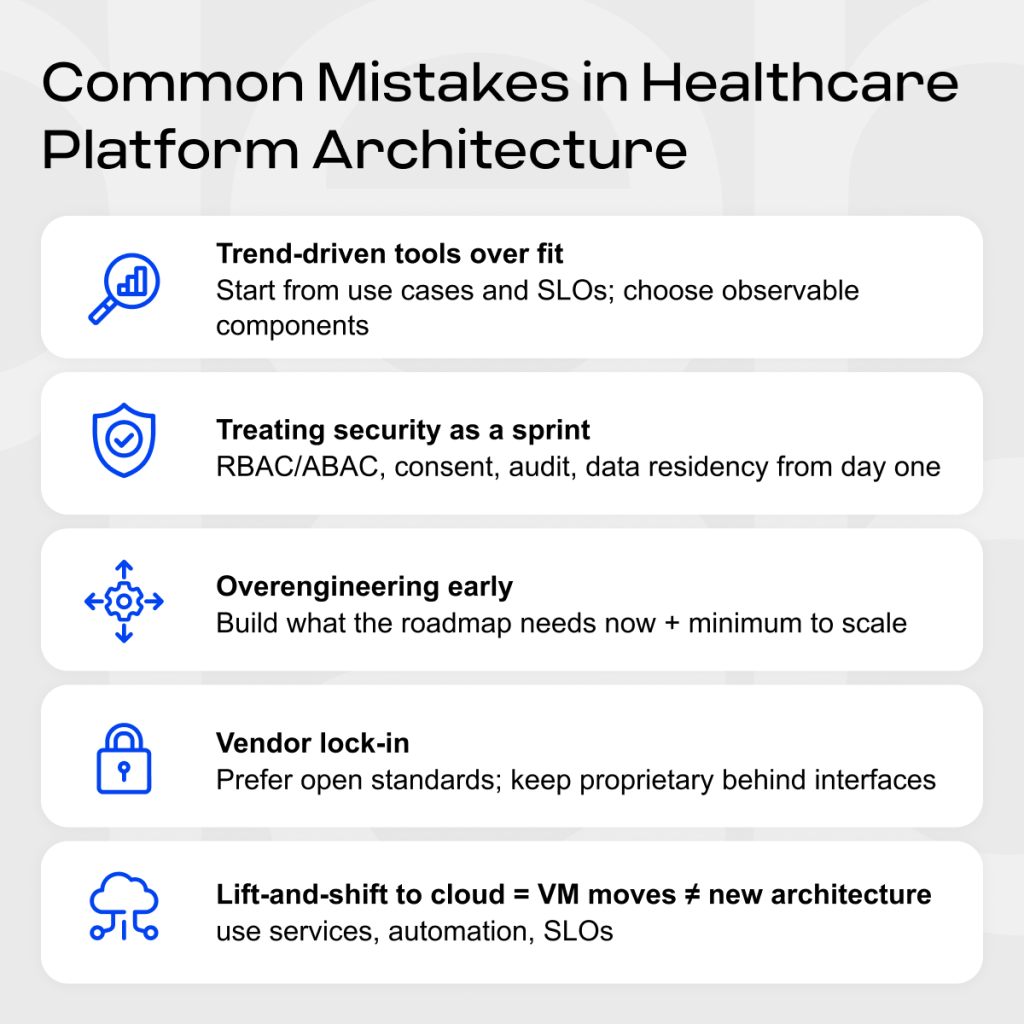
These patterns enable tech stack comparison and incremental rollout without service disruption while preserving flexibility for future modules.
Conclusion
Choosing the best tech stack for healthcare data is not a checklist—it’s an architectural strategy. The right foundations unlock safer data exchange, faster delivery, and sustainable cost. Edenlab supports clients from assessment and technology evaluation through design, implementation, and operations.

We dive deep where others skim
Our healthcare software development firm brings the expertise and precision needed to tackle the industry complexities. With a specialized focus on healthcare processes, regulations, and technology, we deliver solutions that address the toughest challenges.
FAQs
Can we reuse parts of our legacy system?
Yes. Use a FHIR® facade and gateways to wrap legacy endpoints, then replace back‑ends gradually without breaking consumers.
How do FHIR® servers differ?
The depth of standards compliance and performance varies: resource fidelity, validation, search capabilities, bulk operations, security hooks, and ops tooling.
How long does stack evaluation takes?
Typical technology evaluation runs a few weeks, depending on scope and source systems.
Do you help post‑launch?
Yes — monitoring, performance tuning, upgrades, and roadmap support are essential for long‑term value.
Stay in touch
Subscribe to get insights from FHIR experts, new case studies, articles and announcements
Great!
Our team we’ll be glad to share our expertise with you via email